Quick answer
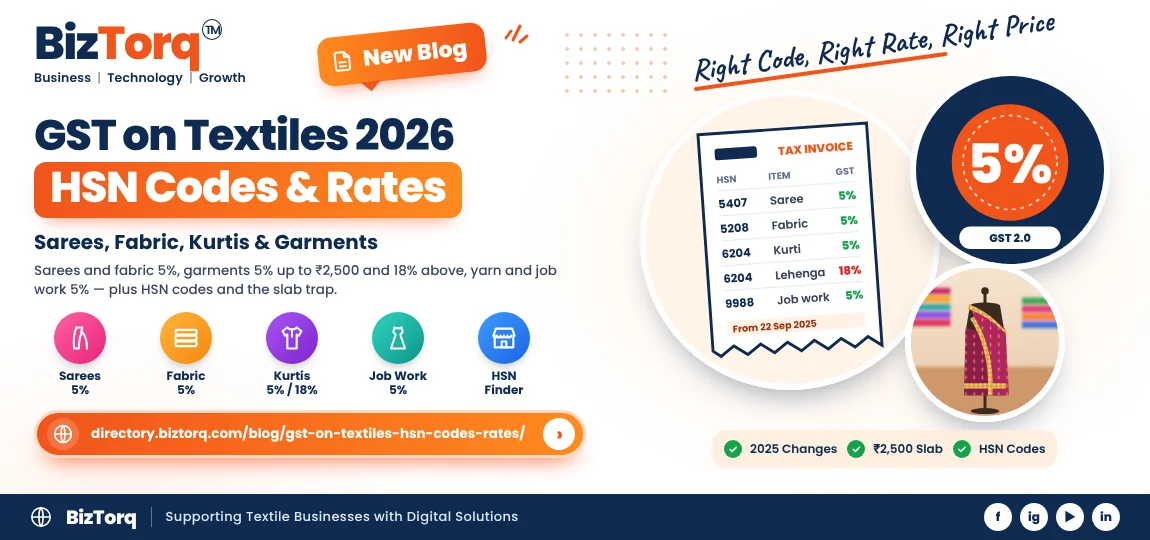
Since 22 September 2025, GST on textiles works like this: sarees, fabric, dress materials, yarn and fibre are 5% at any price; readymade garments such as kurtis, suits and lehengas are 5% up to ₹2,500 per piece and 18% above ₹2,500; and textile job work such as dyeing and printing is 5%. Within Gujarat, 5% is charged as 2.5% CGST + 2.5% SGST; to another state it is 5% IGST. Look up any item in our GST & HSN finder.
GST is one of the first questions every textile buyer and seller asks: what rate applies, which HSN code goes on the invoice, and what changed after the 2025 GST reform. The 56th GST Council meeting on 3 September 2025 changed several textile rates, and the new rates apply from 22 September 2025.
This guide explains the current rates for each type of textile product, the HSN codes Surat traders use most, and the ₹2,500 garment slab that catches many sellers out.
Textile GST Rates at a Glance (2026)
| Product | Common HSN | GST rate |
|---|---|---|
| Sarees (woven: silk, cotton, synthetic) | 5007, 5208, 5407, 5408 | 5% at any price |
| Fabric and unstitched dress material | 5208–5212, 5407–5408, 5512–5516, 6001–6006 | 5% at any price |
| Kurtis, suits, lehengas and other garments | 6104 (knitted), 6204 (woven) | 5% up to ₹2,500 a piece; 18% above |
| Laces, borders and embroidery | 5804, 5806, 5810 | 5% |
| Man-made yarn (polyester, viscose, nylon) | Chapter 54 | 5% (was 12%) |
| Man-made fibre | Chapter 55 | 5% (was 18%) |
| Textile job work (dyeing, printing, embroidery) | SAC 9988 | 5% |
HSN codes go deeper than these headings, and the exact code depends on the fibre and whether the item is woven, knitted or stitched. Search item by item in the GST & HSN finder.
What Changed on 22 September 2025
- Man-made fibre: cut from 18% to 5%.
- Man-made yarn, including polyester texturised yarn (PTY): cut from 12% to 5%.
- Garment slab: the 5% limit rose from ₹1,000 to ₹2,500 per piece, but garments above the limit now pay 18% instead of 12%.
For Surat, the biggest win is the fibre and yarn cut. Fibre, yarn and fabric are now all at 5%, which largely ends the old “inverted duty” problem in the man-made fibre chain, where inputs were taxed higher than the finished fabric. Some inputs such as dyes and chemicals are still taxed at higher rates, so processors should check their own input tax credit position.
GST on Sarees
Most sarees are classified as woven fabric, so they attract 5% GST whatever the price. The HSN depends on the fibre: silk sarees under 5007, cotton under 5208, polyester and other synthetic filament under 5407, and viscose or rayon under 5408. India’s tariff even has specific lines for sarees within these headings.
Stitched ethnic sets such as lehengas are different: they are garments and follow the ₹2,500 slab. See all codes on the sarees and ethnic wear HSN page.
GST on Fabric and Dress Material
Woven and knitted fabrics, including unstitched dress materials and shirting, are taxed at a flat 5%. Because dress material is unstitched, it is fabric for GST purposes, not a garment, even when it is sold as a three-piece set. See the fabric HSN page for codes by fibre.
GST on Kurtis, Suits and Lehengas: The ₹2,500 Slab
Readymade garments fall under Chapter 61 (knitted, for example 6104) and Chapter 62 (woven, for example 6204). The rate depends on the sale value of each piece:
- Up to ₹2,500 per piece: 5% GST.
- Above ₹2,500 per piece: 18% GST.
The limit is checked on the invoice value of each piece before GST, not the MRP. A kurti sold to a retailer at ₹2,200 is taxed at 5% even if its MRP is ₹3,000. See the kurti and garment HSN page.
The slab trap every garment seller should know
Because the rate jumps from 5% to 18% above ₹2,500, a GST-registered seller who charges a customer anywhere from about ₹2,625 to ₹2,950 (including GST) keeps no more than a seller who charges ₹2,625. The extra money goes in tax. Price garments at or below ₹2,625 including GST, or clearly above ₹2,950. Our kurti margin calculator warns you when a price falls in this band.
GST on Job Work, Laces and Embroidery
- Job work such as dyeing, printing, bleaching or embroidery done on textiles owned by another registered person is under SAC 9988 at 5%. See textile job work GST.
- Laces (5804), borders and narrow fabrics (5806) and embroidery in the piece (5810) are taxed at 5%. See laces and embroidery HSN codes.
- Yarns and fibres are at 5%. See yarn and fibre HSN codes.
CGST, SGST or IGST?
- Sale within Gujarat (for example, Surat to Ahmedabad): split equally, so 5% becomes 2.5% CGST + 2.5% SGST.
- Sale to another state (for example, Surat to Kolkata): the full rate as IGST, so 5% IGST or 18% IGST.
For goods sent to another state, an e-way bill is generally needed when the consignment value is above ₹50,000. See our guide on sending textile parcels from Surat.
What It Means for Retailers
- Regular GST-registered retailers claim the GST on their purchase invoice as input tax credit, so it is not part of their cost.
- Composition-scheme and unregistered retailers cannot claim it, so purchase GST adds to the cost of every piece.
- Always check the HSN code and rate on your purchase invoice; a wrong code can cost you the input tax credit.
Work out your real cost and selling price with the textile margin calculator, which adds GST, transport and packing to each piece.
Frequently Asked Questions
What is the GST rate on sarees in 2026?
Most sarees are woven fabric and attract 5% GST at any price: 2.5% CGST + 2.5% SGST within a state, or 5% IGST between states. Stitched ethnic garments such as lehengas follow the garment slab instead.
What is the GST rate on kurtis?
Kurtis are garments (HSN 6204 woven or 6104 knitted). Since 22 September 2025, GST is 5% when the sale value is up to ₹2,500 per piece and 18% above ₹2,500.
What is the GST rate on dress material and fabric?
Unstitched dress materials and woven or knitted fabric attract a flat 5% GST whatever the value.
Is the ₹2,500 GST limit on MRP or selling price?
It is checked on the sale value of each piece on the invoice, before GST, not on the MRP. Discounts shown on the invoice reduce the sale value.
What is the GST rate on polyester yarn after the 2025 change?
Man-made yarn, including polyester texturised yarn, is taxed at 5% from 22 September 2025, down from 12%. Man-made fibre came down from 18% to 5%.
What is the GST on textile job work?
Dyeing, printing, embroidery and other processing of textiles owned by another registered person is job work under SAC 9988 and is taxed at 5%.
Check Any HSN Code and GST Rate
Use the free GST & HSN finder for sarees, fabric, garments, job work and yarn, and the margin calculator to price your stock correctly.
Selling online? A BizTorq wholesale website applies the right GST slab to every order automatically, so your invoices and margins stay correct.
This guide is for general information. GST rules and rates can change; confirm the treatment for your business with your CA. Rates as notified for 22 September 2025, after the 56th GST Council meeting of 3 September 2025.