Quick answer
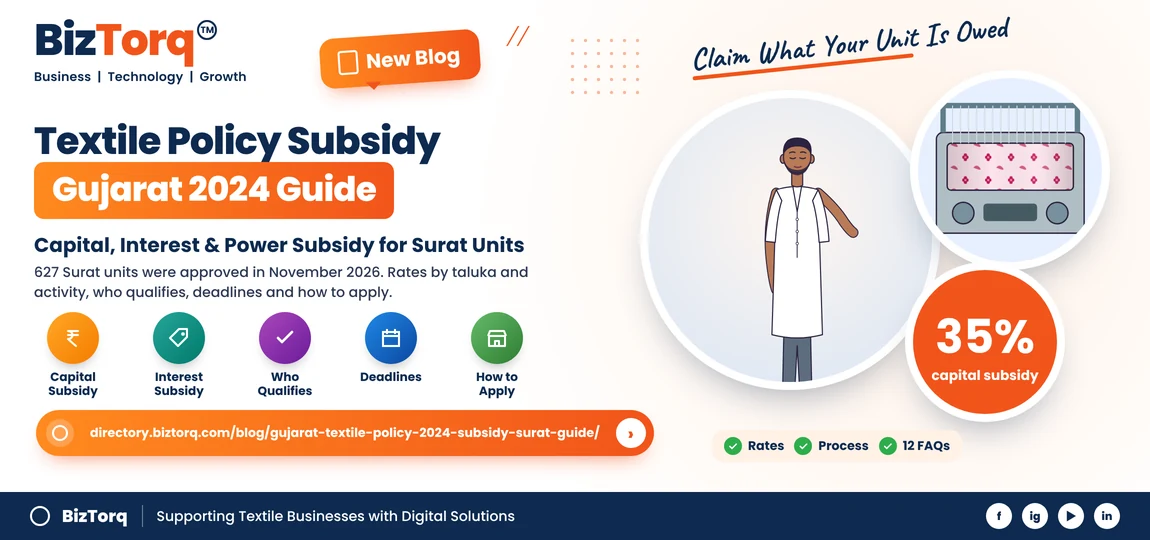
The Gujarat Textile Policy 2024 (1 October 2024 to 30 September 2029) pays new and expanding textile units a capital subsidy of 10% to 35% of eligible fixed investment, an interest subsidy of 5% to 7% on term loans and a power tariff subsidy of ₹1 per unit for 5 years. Rates depend on the activity (garments and technical textiles get more than weaving, processing and embroidery) and the taluka category. Surat city falls in Category 3, where the capital subsidy is 20% for garments and 10% for weaving and embroidery. On 7 November 2026, Surat district approved 627 units with about ₹1,521 crore of investment under the policy. Claims are made through the District Industries Centre (DIC) or Industries Commissionerate, mostly within one year of the start of commercial production.
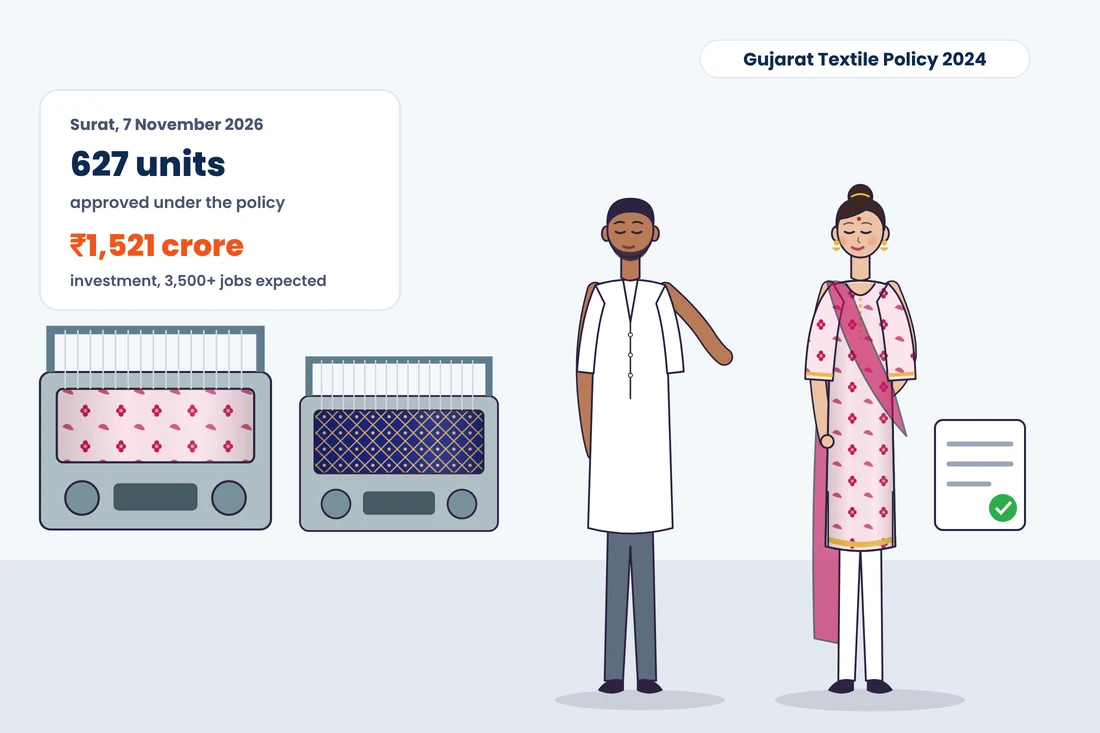
Yarn and grey fabric prices rose sharply before Diwali, and traders reopening after Labh Pancham reported losses of 25% to 30% (Loktej). Yet investment in new capacity continues: on 7 November 2026, a committee chaired by Surat district collector Tejas Parmar approved 627 textile manufacturing units with about ₹1,521 crore of investment under the Gujarat Textile Policy 2024. Support is put at about ₹300 crore over five years, and more than 3,500 jobs are expected, across weaving, technical textiles and embroidery (Textiles Resources, 10 November 2026).
If you are setting up or expanding a weaving shed, embroidery unit, process house or garment unit in Surat, this guide explains what you can claim, who qualifies and how to apply. It is a summary for planning: the official policy guidelines and your DIC decide.
Contents
- Which activities are covered
- Taluka categories in Surat district
- Capital subsidy
- Interest subsidy
- Power tariff subsidy
- Worked example for a Surat unit
- How to apply, step by step
- Mistakes that cost claims
- After the subsidy: finding buyers
- FAQs
Which Activities Are Covered
| Group | Activities | Typical Surat units |
|---|---|---|
| Activity 1 | Garments, apparel, made-ups and technical textiles, including composite units | Kurti, suit and lehenga makers; technical textile units |
| Activity 2 | Weaving, knitting, dyeing and processing, texturising, twisting, embroidery, and MMF spinning from PSF or VSF | Powerloom and waterjet sheds, process houses, embroidery units, texturisers |
Cotton spinning and synthetic filament yarn spinning are excluded. The policy covers new units and existing units that expand, diversify or modernise.
Taluka Categories in Surat District
| Category | Surat district talukas |
|---|---|
| Category 1 | Umarpada, Mahuva |
| Category 2 | Mandvi, Bardoli |
| Category 3 | Surat city and the other talukas |
Category 1 and PM MITRA Park locations get the highest rates, so a unit planned outside the city may qualify for much more support. Confirm your exact location's category with the DIC before you buy land.
Capital Subsidy
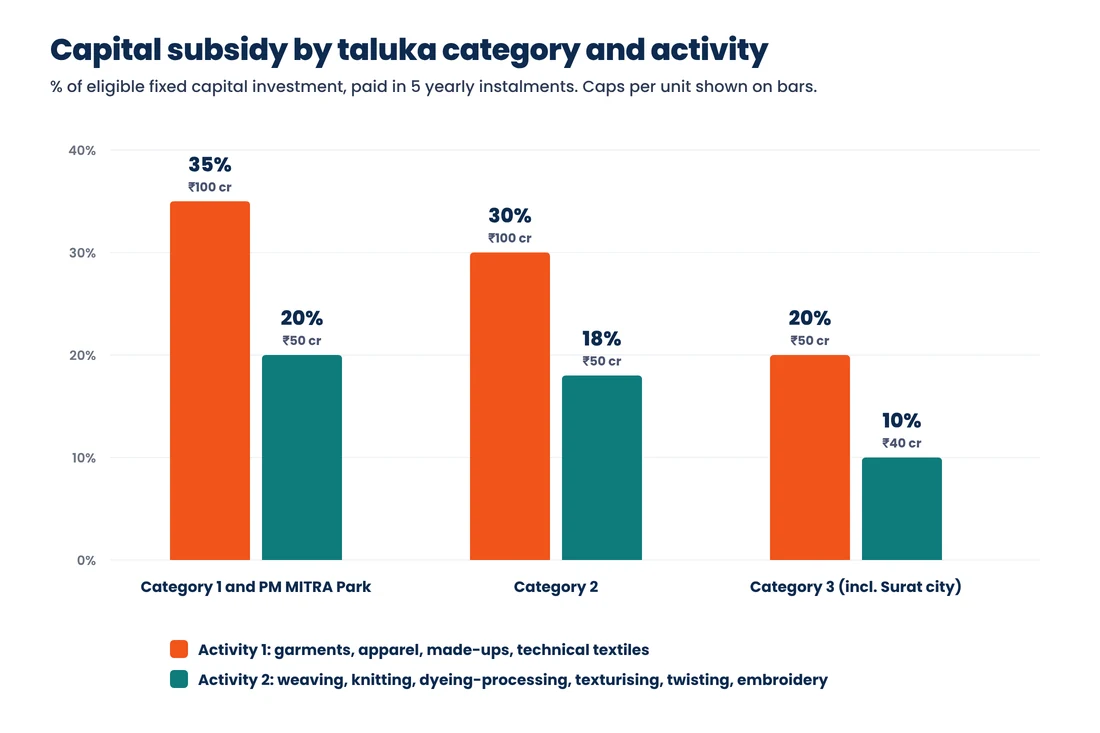
| Category | Activity 1 | Activity 2 |
|---|---|---|
| Category 1 and PM MITRA Park | 35%, up to ₹100 crore | 20%, up to ₹50 crore |
| Category 2 | 30%, up to ₹100 crore | 18%, up to ₹50 crore |
| Category 3 (incl. Surat city) | 20%, up to ₹50 crore | 10%, up to ₹40 crore |
- Calculated on eligible fixed capital investment (eFCI) made during the investment period.
- Paid in 5 equal yearly instalments after commercial production starts.
- Needs a term loan for the project, and state plus central capital subsidy cannot exceed the term loan disbursed.
- Very large labour-intensive units (4,000 or more EPF-registered workers, at least 1,000 women) have a separate, higher capital subsidy track.
Source: scheme summaries on PublicServicesMap, which link to the official guidelines.
Interest Subsidy
| Category | Activity 1 | Activity 2 |
|---|---|---|
| Category 1 and PM MITRA Park | 7% for 8 years, max 3% of eFCI a year | 7% for 7 years, max 2% of eFCI a year |
| Category 2 | 7% for 8 years, max 2.5% of eFCI a year | 7% for 7 years, max 2% of eFCI a year |
| Category 3 (incl. Surat city) | 5% for 6 years, max 2% of eFCI a year | 7% for 5 years, max 2% of eFCI a year |
The unit must have a sanctioned term loan, repay instalments and interest regularly and pay at least 2% interest itself. Penal interest and bank charges are not covered, and default periods are deducted. The scheme summary's table is hard to read, so check these figures in the guidelines (PublicServicesMap).
Power Tariff Subsidy
- ₹1 per unit (kWh) for 5 years from the date of commercial production.
- Applies to power from the DISCOM or renewable power through open access; captive power does not qualify.
- Electricity bills must be in the unit's name.
- For an expanding unit, only consumption above the previous year's average counts.
For power-hungry looms and process houses this can be worth lakhs a year. Source: PublicServicesMap.
Worked Example for a Surat Unit
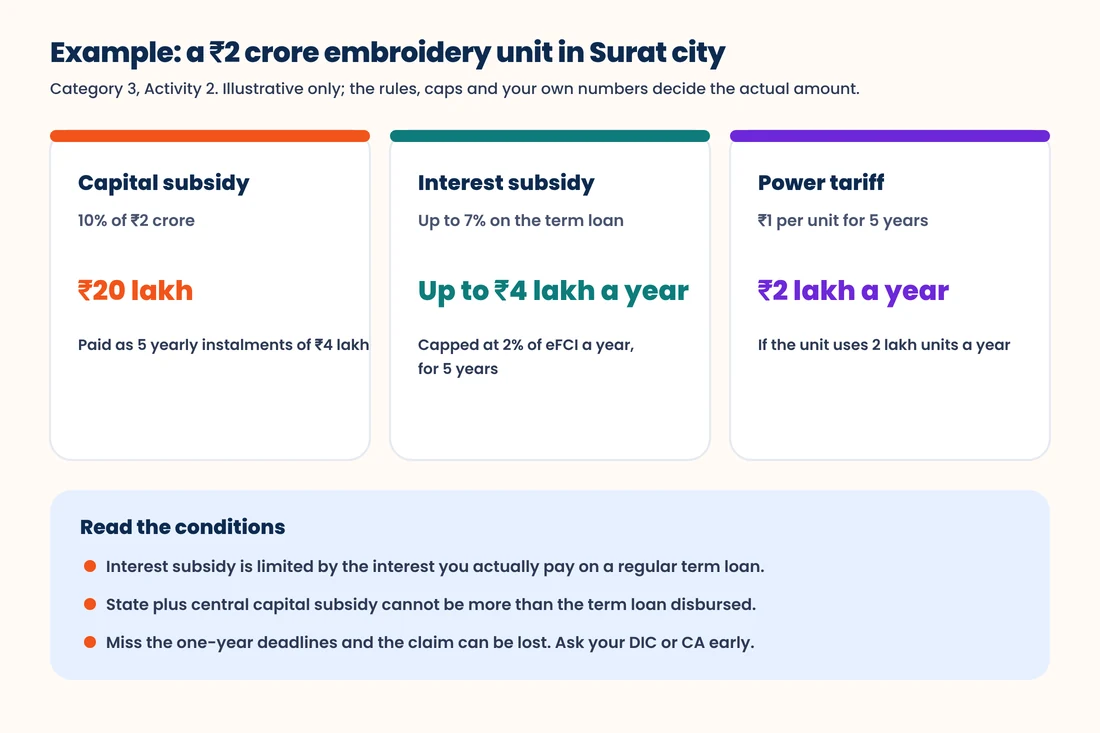
Take an embroidery unit in Surat city (Category 3, Activity 2) with ₹2 crore of eligible fixed investment and a term loan:
- Capital subsidy: 10% of ₹2 crore = ₹20 lakh, paid as ₹4 lakh a year for 5 years.
- Interest subsidy: up to 7% on the loan, capped at 2% of eFCI = up to ₹4 lakh a year for 5 years, and never more than the interest actually paid.
- Power: at 2 lakh units a year, ₹2 lakh a year for 5 years.
The same investment as a garment unit (Activity 1) would get 20% capital subsidy, ₹40 lakh, which is why many Surat traders are adding stitching to fabric businesses.
How to Apply, Step by Step
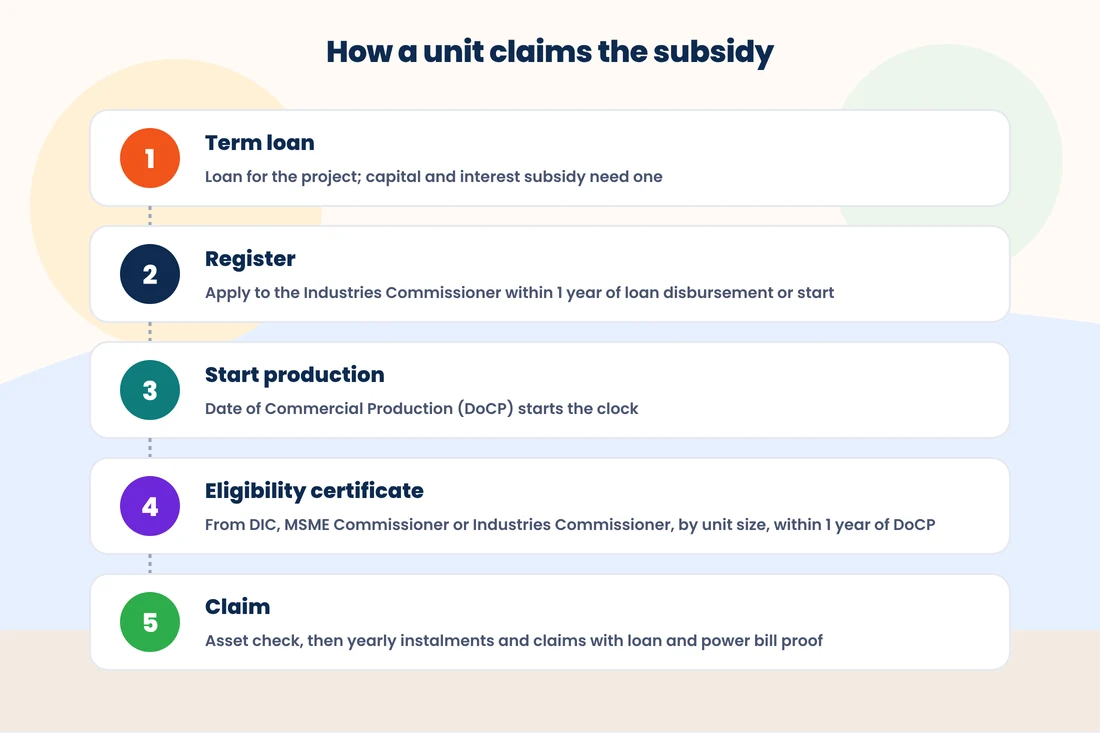
- Plan with your bank: take a term loan for the project; capital and interest subsidy depend on it.
- Register: apply to the Industries Commissioner in the prescribed form within one year of loan disbursement, start of production or the policy's operative date, whichever is later.
- Start production and record the Date of Commercial Production (DoCP).
- Get the eligibility certificate within one year of DoCP: from the DIC General Manager for MSMEs with investment up to ₹10 crore, the MSME Commissioner for ₹10 to 50 crore, and the Industries Commissioner for others.
- Asset verification by an inspection team, then the final eligibility certificate.
- Claim each year with loan statements, interest proof and power bills.
Keep GST registration, Udyam registration, the project report, machinery invoices and bank documents ready. Your CA or a consultant who files DIC claims regularly can save weeks.
Mistakes That Cost Claims
- Missing the one-year windows for registration and the eligibility certificate.
- No term loan, or a loan sanctioned too late, which can rule out capital and interest subsidy.
- Bills not in the unit's name, for power or machinery.
- Loan defaults, which reduce the interest subsidy period.
- Wrong activity or category, for example calling a fabric unit a garment unit.
- Second-hand or ineligible assets counted in eFCI without checking the rules.
After the Subsidy: Finding Buyers
A subsidy lowers your cost, but the new looms and machines only pay back when orders come in. Surat already has very high capacity, and our 2026 research found that 92.5% of 160 Surat textile businesses could only be found on listings made by other sites. New units that can be found online get the first calls.
- List your unit free on the BizTorq directory and add products to the wholesale catalog.
- Garment units that take export orders can join the make-to-order factory list for buyers abroad.
- Check where you stand with the free online readiness check.
- Read why Surat's textile industry keeps growing, why fabric prices rose in 2026 and the digital printing and dyeing guide.
- Price your output with the margin calculator and the GST and HSN finder.
Frequently Asked Questions
What is the Gujarat Textile Policy 2024?
A state scheme running from 1 October 2024 to 30 September 2029 that supports new and expanding textile units with capital subsidy, interest subsidy and a power tariff subsidy, among other incentives.
How many Surat units were approved under the policy?
On 7 November 2026, Surat district approved 627 textile manufacturing units with about ₹1,521 crore of investment, with support put at about ₹300 crore over five years and more than 3,500 jobs expected.
How much capital subsidy can a Surat city unit get?
Surat city is in Category 3: 20% of eligible fixed capital investment for garments, apparel, made-ups and technical textiles (up to ₹50 crore), and 10% for weaving, processing, embroidery and similar activities (up to ₹40 crore), paid over 5 years.
Which Surat talukas get higher subsidy?
Umarpada and Mahuva are Category 1, and Mandvi and Bardoli are Category 2, with higher rates than Surat city and the other talukas in Category 3. Confirm your location with the DIC.
Is embroidery covered by the Gujarat Textile Policy 2024?
Yes. Embroidery is listed under Activity 2 with weaving, knitting, dyeing and processing, texturising and twisting.
What is the interest subsidy under the policy?
Between 5% and 7% on the term loan, for 5 to 8 years depending on activity and category, capped at a share of eligible investment each year. For Surat city weaving and embroidery units the summary lists 7% for 5 years, capped at 2% of eFCI a year.
What is the power tariff subsidy?
₹1 per unit of electricity for 5 years from the start of commercial production, on power from the DISCOM or renewable open access. Captive power does not qualify, and expanding units get it only on extra consumption.
Do I need a bank loan to get the subsidy?
For capital and interest subsidy, yes: the unit needs a term loan for the project, and state plus central capital subsidy cannot exceed the loan disbursed.
Where do I apply for the textile policy subsidy?
Register with the Industries Commissioner first. Eligibility certificates come from the District Industries Centre for MSMEs up to ₹10 crore investment, the MSME Commissioner for ₹10 to 50 crore, and the Industries Commissioner for larger units.
What are the deadlines?
Registration is due within one year of loan disbursement, production start or the policy date, whichever is later, and the eligibility certificate within one year of the date of commercial production. Missing them can cost the claim.
Can existing units claim the subsidy?
Yes, if they expand, diversify or modernise under the policy. Benefits apply to the new investment, and the power subsidy only to consumption above the previous year's average.
How can a new textile unit find buyers?
Get found online: list your unit free, add products to the wholesale catalog and take the online readiness check. A wholesale website lets buyers in other cities see your range and order.
New Unit? Get Found by Buyers
List your unit free, add your range to the wholesale catalog and take the online readiness check.
Ready to sell direct? BizTorq builds OpenCart wholesale websites for Surat manufacturers, with catalogues, MOQ, dealer rates and WhatsApp ordering.
This is a plain-language summary for planning, not legal or financial advice. Rates, caps and procedures are summarised from scheme pages and news reports checked on 17 November 2026; the official Gujarat Textile Policy 2024 guidelines and the Industries Commissionerate decide. Confirm eligibility with your DIC, bank and CA before you invest.