Quick answer
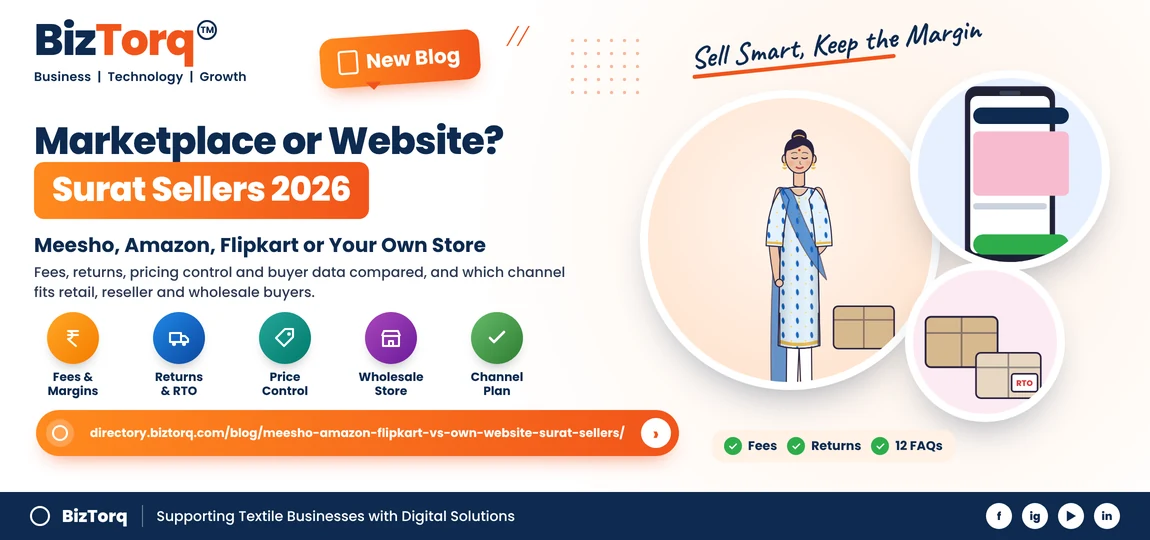
For a Surat textile seller, marketplaces such as Meesho, Amazon and Flipkart are the quickest way to reach retail shoppers across India, and in 2026 all three charge little or no commission on low-priced items (Flipkart and Amazon on products under ₹1,000). The real costs are shipping, returns, ads and price pressure. Marketplaces also cannot sell wholesale sets, MOQ and dealer rates, and the buyer stays the platform's customer. Your own website costs more to start and needs you to bring traffic, but you set the price, keep buyer contacts and take repeat wholesale orders without fees. Most growing sellers use both: marketplaces for retail reach, and their own store plus WhatsApp for wholesale buyers.
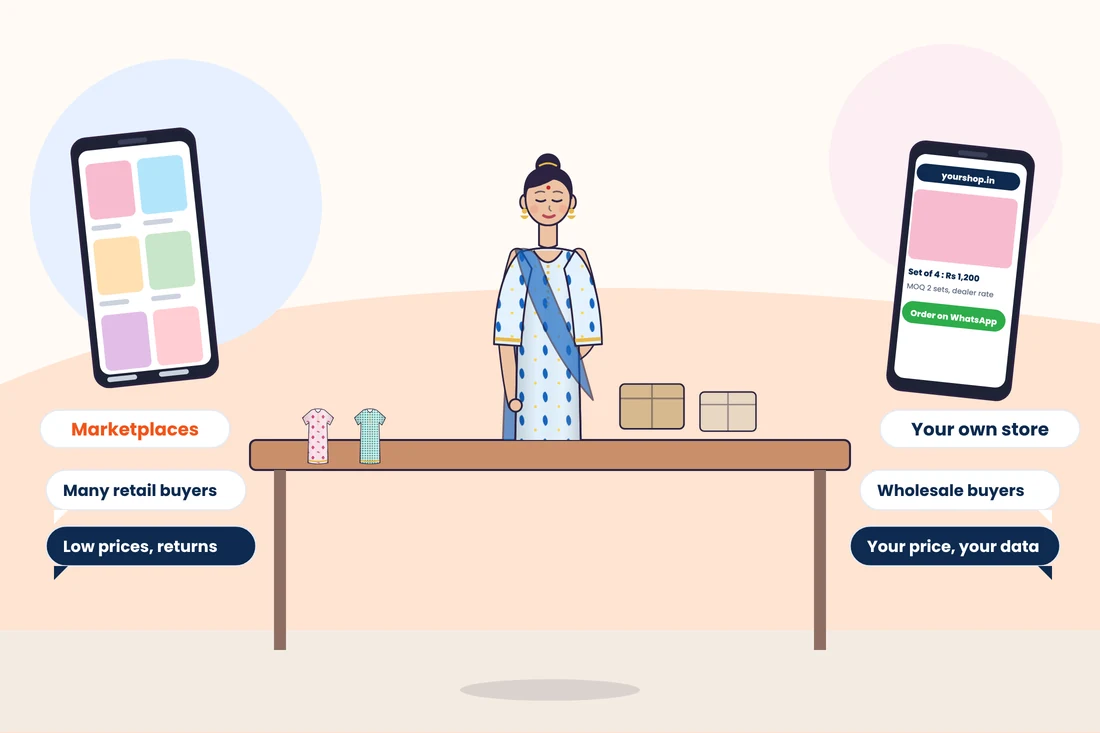
Every Surat wholesaler hears the same advice: "go online". But online can mean very different things. Listing on Meesho is not the same business as running a B2B catalogue site for shop owners, and both are different from selling to resellers on WhatsApp. This guide compares the main options as they stand in late 2026, with the costs that do not show up on the commission page, so you can choose where each part of your range should be sold.
Marketplace names here are trademarks of their owners. Fees and policies change often; check the current numbers in each seller panel before you price.
Contents
- 2026 fees at a glance
- The costs that commission tables leave out
- What you control on each channel
- Which buyer, which channel
- Why wholesale needs its own store
- How to cut returns
- A simple channel plan for a Surat seller
- What your own store needs
- FAQs
2026 Fees at a Glance
| Channel | Commission (2026) | What you still pay | Best for |
|---|---|---|---|
| Meesho | Zero or minimal product commission in many categories | Shipping set by weight and zone, return and RTO costs, ads, low price points | Low-priced retail volume, Tier 2 and 3 towns |
| Flipkart | Zero commission on products under ₹1,000 from November 2025 | Shipping and other fees, returns, ads; commission above ₹1,000 | Branded retail, festive sales |
| Amazon | Zero referral fee on products under ₹1,000 from 16 March 2026 | Shipping and closing or other fees, returns, ads; referral fee above ₹1,000 | Branded retail, repeat online shoppers |
| Your own website | None | Build and hosting, payment gateway (about 2% on common plans), shipping, marketing | Wholesale buyers, repeat customers, export, your brand |
| WhatsApp and Instagram | None | Your time; no checkout, catalogues get lost in chats | Resellers and regular buyers |
Sources: Amazon and Flipkart changes as reported by YourStory (Amazon says the zero fee covers more than 12.5 crore products) and Outlook Business; Meesho's fee model as described by Shiprocket (February 2026). Exact categories and conditions are in each seller panel.
The Costs That Commission Tables Leave Out
- Shipping: on Meesho, shipping is calculated by the system from packed weight and delivery zone, and you cannot edit it. A Shiprocket summary of seller-reported rates puts a parcel up to 500 g at roughly ₹35 to ₹90 depending on distance. A saree or kurti set that tips over 500 g in its packing moves into the next slab.
- Returns and RTO: when an order comes back, the forward shipping is already spent and reverse shipping is added, and sometimes the piece returns damaged or not at all. For low-priced ethnic wear, returns can take away more margin than any commission.
- Ads: zero commission brings more sellers onto the same search page, so paid visibility becomes the new fee.
- Price pressure: buyers compare near-identical Surat designs side by side, so the lowest price wins the click.
- Payment cycle: you are paid on the platform's schedule, after the return window, which ties up working capital in festive months.
- GST and compliance: marketplace sellers usually need GST registration, and e-commerce operators collect TCS. Ask your CA what applies to you. Check the right HSN codes in the GST and HSN finder.
Run your real numbers, with shipping and an allowance for returns, in the margin calculator before you list a single design.
What You Control on Each Channel
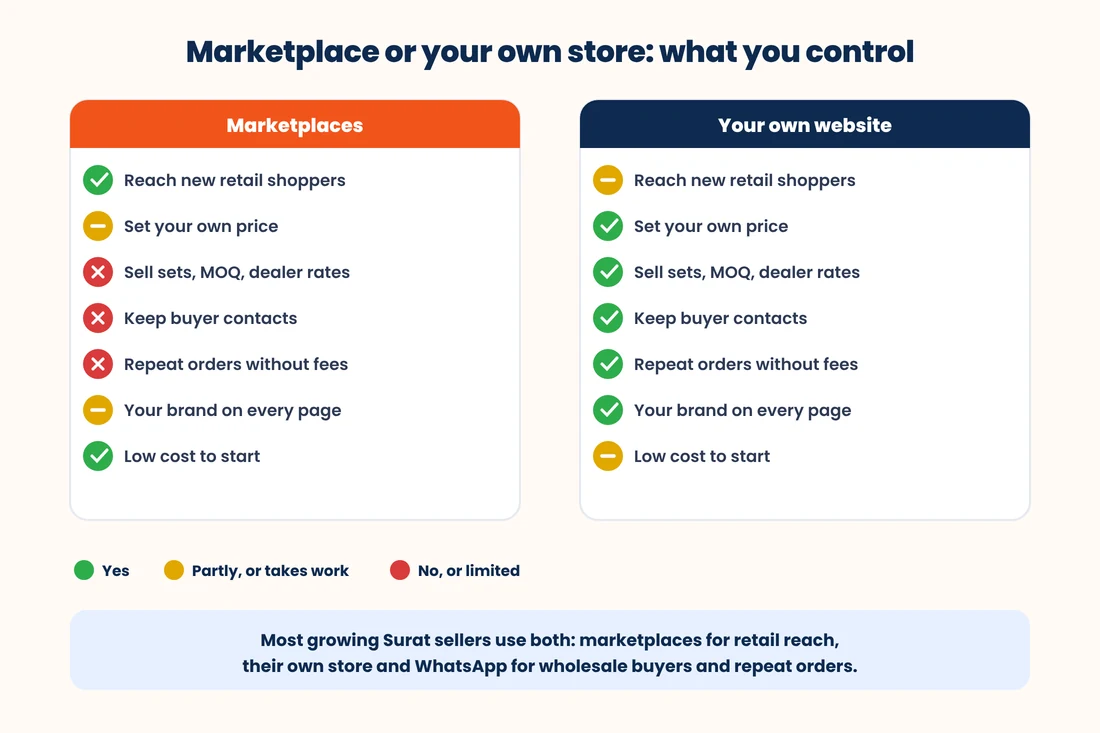
The biggest difference is ownership. On a marketplace the shopper is the platform's customer: you rarely get a phone number to sell to again, your listing sits beside competitors, and rules on pricing, returns and display can change with little notice. On your own website the buyer contacts, the order history and the brand are yours, so a repeat order costs nothing extra to win.
Which Buyer, Which Channel
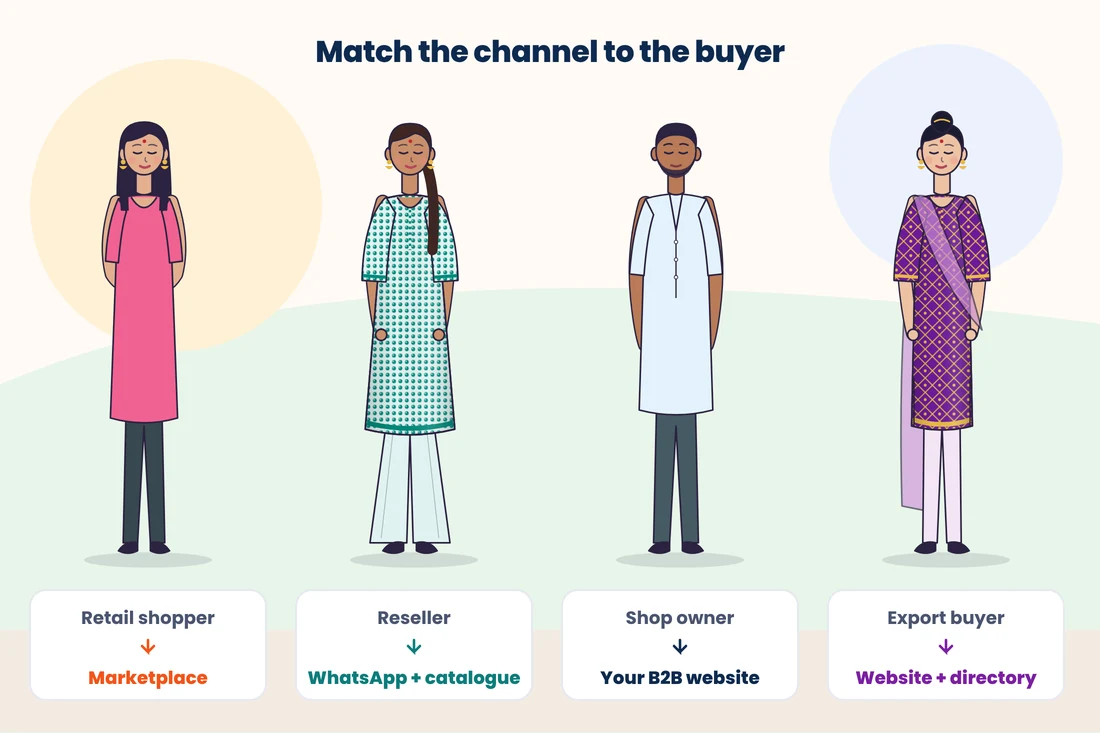
| Buyer | What they need | Best channel |
|---|---|---|
| Retail shopper | One piece, low price, easy returns | Marketplaces |
| Reseller | Photos to forward, quick rates, small lots | WhatsApp plus an online catalogue |
| Boutique and shop owner | Full range, set prices, MOQ, credit, repeat orders | Your own B2B website |
| Export buyer | Trust, specs, export packing, a site to check | Your website plus directory listings |
If you sell to resellers, read how to start a saree reselling business. If you want export buyers, see how to export textiles from Surat and the UAE ethnic wear guide.
Why Wholesale Needs Its Own Store
Surat's real business is wholesale: catalogue sets, size sets, MOQ and different rates for different buyers. Consumer marketplaces are built for single pieces sold to the public, so they cannot show a dealer rate to one buyer and a retail price to another, enforce "minimum 2 sets", or let a trusted shop order on credit. That is why wholesale buyers still end up on the phone and WhatsApp.
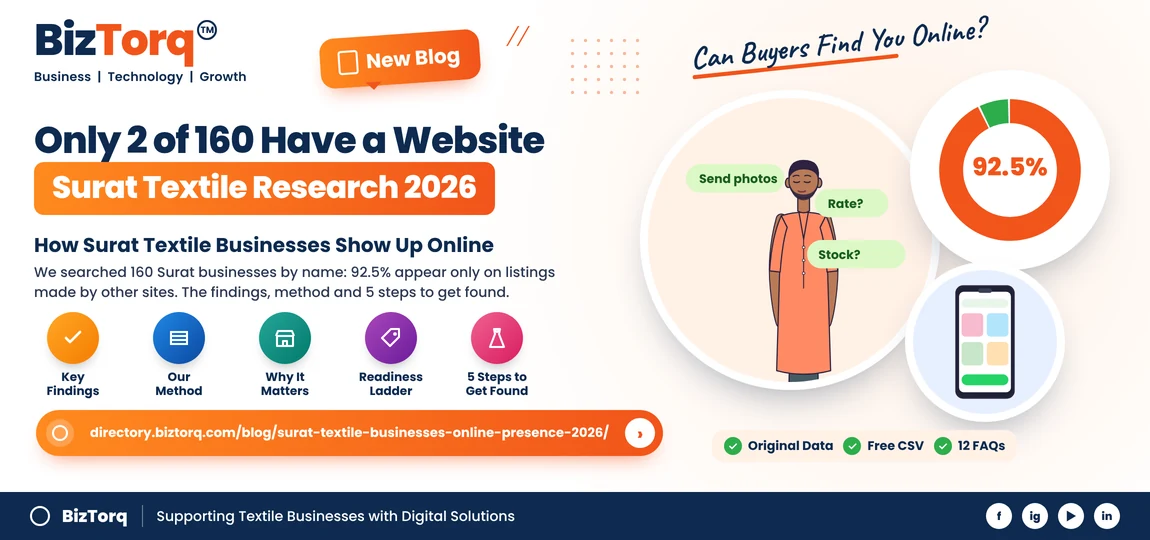
A wholesale website does that work for you. Approved buyers log in and see their rate, order full sets, and reorder from their history at any hour. It also gives search engines and AI assistants a page about your business to read, which a marketplace listing does not. Our 2026 research found that 92.5% of 160 Surat textile businesses could only be found on listings that other sites had made about them, so a store of your own is still rare among Surat sellers. Learn how set pricing works in how Surat wholesale pricing works.
How to Cut Returns
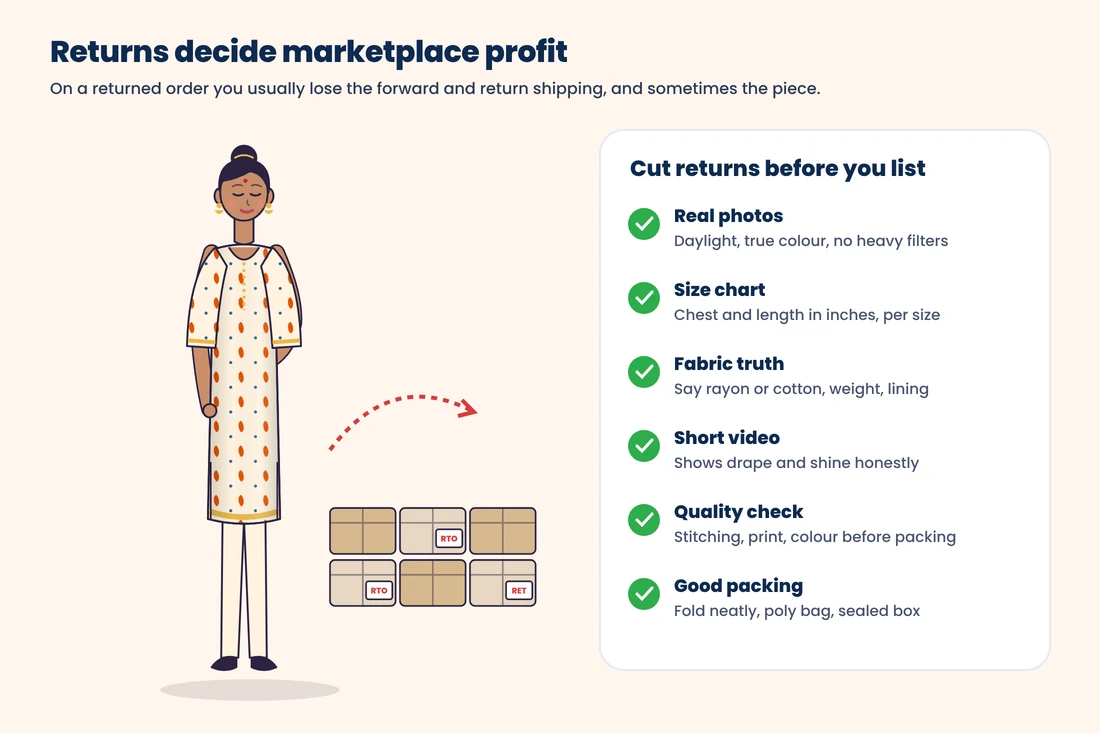
- Use real photos in daylight with true colour. Catalogue renders that look richer than the fabric are the top reason for "not as shown" returns.
- Publish a size chart with chest and length in inches for every size.
- Describe the fabric honestly: rayon or cotton, georgette or chiffon, with or without lining.
- Add a short video that shows drape and shine.
- Check every piece for stitching, print and colour before packing.
- Pack well: neat fold, poly bag, sealed box, invoice inside.
The same checks help wholesale buyers trust you; see how buyers verify a Surat supplier and how to send textile parcels from Surat.
A Simple Channel Plan for a Surat Seller
| Stage | Do this |
|---|---|
| Starting out | List free on the BizTorq directory and add designs to the wholesale catalog. Set up a Google Business Profile. Use WhatsApp for regular buyers. |
| Testing retail | Put 20 to 50 tested designs on one marketplace. Track returns per design and drop the ones that come back. |
| Growing wholesale | Build your own catalogue or B2B website with set prices, MOQ and dealer login. Send every WhatsApp enquiry to it. |
| Scaling | Add export pages, multi-currency prices and the catalog listings for buyers abroad. Keep marketplaces for clearance and retail reach. |
Not sure where you stand? Take the free online readiness check; it scores your business out of 100 and gives next steps.
What Your Own Store Needs
- Catalogue sets and size sets, priced per piece and per set.
- MOQ rules by set, quantity or order value.
- Customer groups: dealer, retailer and guest prices from one product.
- Login-to-see-price if you do not want rates public.
- WhatsApp ordering and enquiry buttons on every product.
- GST invoices with the buyer's GSTIN and HSN codes.
- Fast mobile pages, WebP images and product structured data for search.
BizTorq builds these on OpenCart for Surat and Ahmedabad sellers. See wholesale website development, the guide to textile eCommerce website cost in India and the textile eCommerce SEO guide.
Frequently Asked Questions
Is Meesho really zero commission?
Meesho describes its model as zero or minimal product commission in many categories. Sellers still bear shipping set by weight and zone, the cost of returns and RTO, and any ads they run, so check the full settlement for each order.
Do Amazon and Flipkart charge commission on low-priced clothes?
In 2026 both waive their main fee on products under ₹1,000: Flipkart from November 2025 and Amazon from 16 March 2026. Other fees such as shipping still apply, and items above ₹1,000 pay the normal fee. Check your category in the seller panel.
Which is better for a Surat saree seller, Meesho or Amazon?
Meesho suits low-priced, high-volume sarees for smaller towns. Amazon and Flipkart suit branded sarees at higher price points with good photos. Test 20 to 50 designs on one platform first and track returns per design.
Why are returns so costly for textile sellers?
On a returned order the forward shipping is already spent, reverse shipping is added and the piece may come back damaged. For a low-priced kurti or saree, a few returns can wipe out the profit on many orders.
Can I sell wholesale sets on Meesho, Amazon or Flipkart?
Consumer marketplaces are built for single pieces sold to the public. They cannot show dealer rates to approved buyers, enforce set-wise MOQ or offer credit, which is why wholesale needs your own B2B store or catalogue.
Do I need GST to sell on marketplaces?
Marketplace sellers usually need GST registration, and e-commerce operators collect TCS on sales. Rules and exemptions change, so confirm with your CA. Find HSN codes in the GST and HSN finder.
Is my own website worth it if marketplaces are free?
For wholesale, yes. Your own website lets you set prices, sell sets with MOQ, keep buyer contacts and win repeat orders without fees, and it is what search engines and AI assistants read about your business. You do need to bring traffic through WhatsApp, Google and directories.
How much does a payment gateway cost on my own website?
Common Indian payment gateways charge about 2% per transaction on standard plans, with lower rates negotiated at higher volumes. Many wholesale buyers also pay by bank transfer against invoice.
Should I sell on WhatsApp only?
WhatsApp is the best tool for conversations with regular buyers, but it is not searchable and catalogues get lost in chats. Use it with an online catalogue or website that holds your current designs, rates and stock.
Can I sell on marketplaces and my own website at the same time?
Yes, and most growing sellers do. Keep marketplaces for retail reach and clearance, and send wholesale and repeat buyers to your own store, where you control price and keep the relationship.
How do I reduce returns on ethnic wear?
Use real daylight photos, a size chart in inches, honest fabric details, a short drape video, a quality check before packing and neat packing. Track returns per design and stop listing the designs that keep coming back.
How do I start selling online from Surat for free?
List your business on the BizTorq directory, add designs to the wholesale catalog, create a Google Business Profile and take the online readiness check for next steps.
Sell Wholesale Online on Your Own Terms
Start free: list your shop, add designs to the wholesale catalog and check your online readiness score.
Ready for your own store? BizTorq builds OpenCart wholesale websites with catalogue sets, MOQ, dealer rates and WhatsApp ordering, so your buyers order without waiting for you.
Marketplace fees, shipping rates and policies change often and differ by category; figures here were checked in November 2026 from the sources linked above. Check the current terms in each seller panel and confirm GST and TCS treatment with your CA. Meesho, Amazon and Flipkart are trademarks of their respective owners; BizTorq is not affiliated with them.