Quick answer
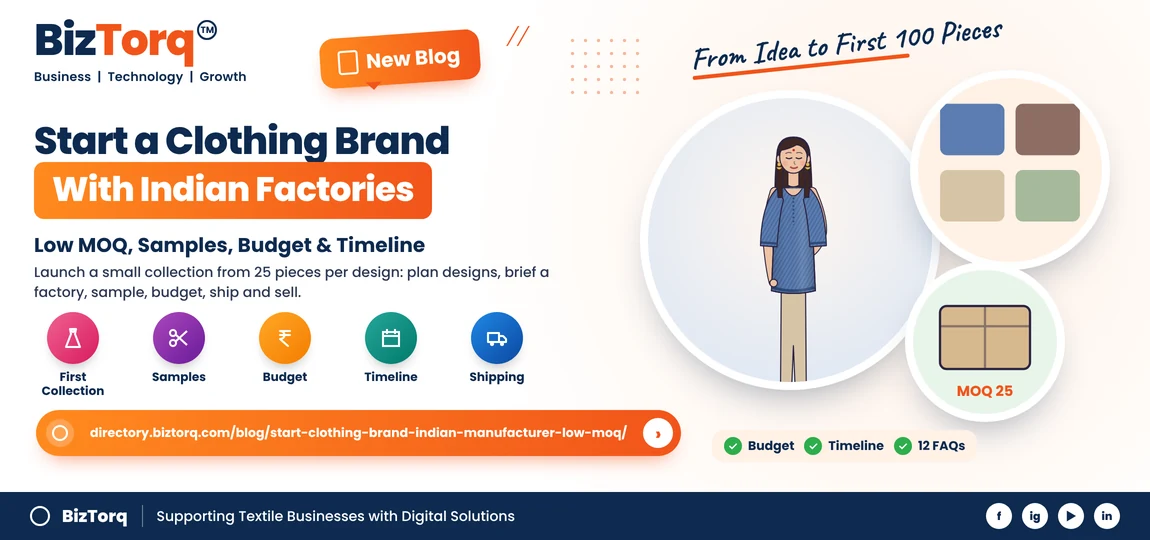
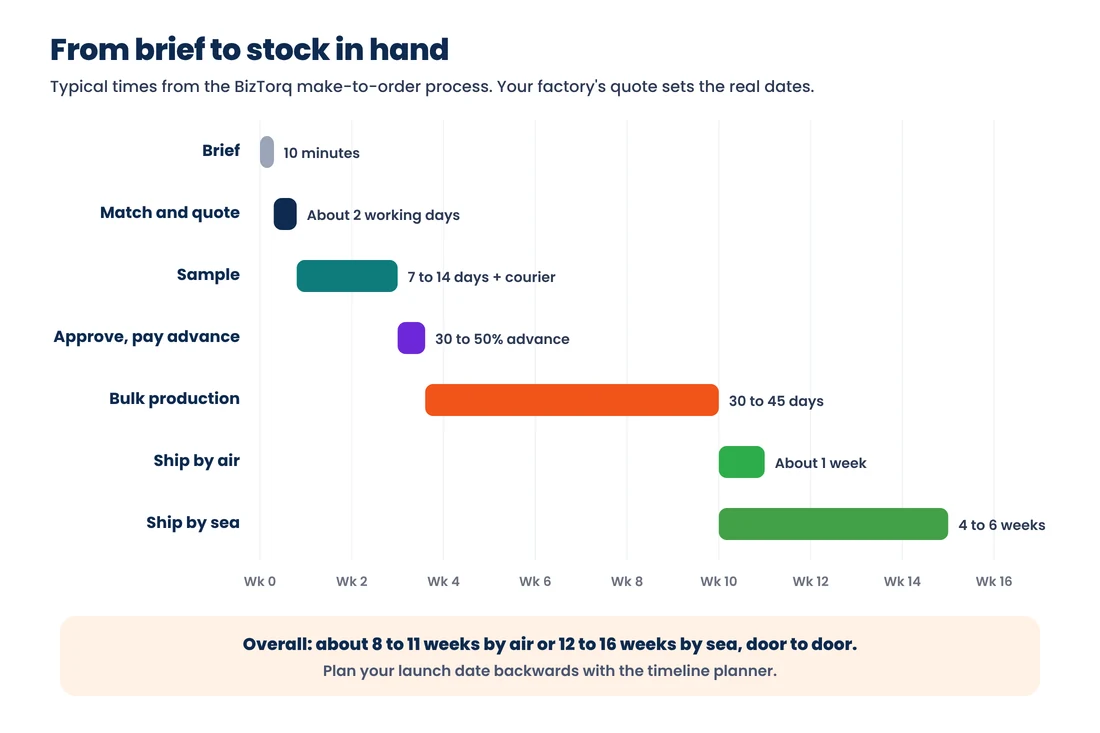
You can start a clothing brand with an Indian factory on a small budget by ordering a small first collection: for example 4 designs at 25 pieces each, the minimum many make-to-order factories in Surat and Ahmedabad accept. The steps are: plan the designs and target price, send a brief or tech pack, approve a sample (usually 7 to 14 days), pay a 30 to 50% advance, wait 30 to 45 days for bulk, then ship by air or sea. Expect about 8 to 11 weeks door to door by air or 12 to 16 weeks by sea. Budget for more than the factory price: samples, freight, duty, labels, photos and marketing can add as much again.
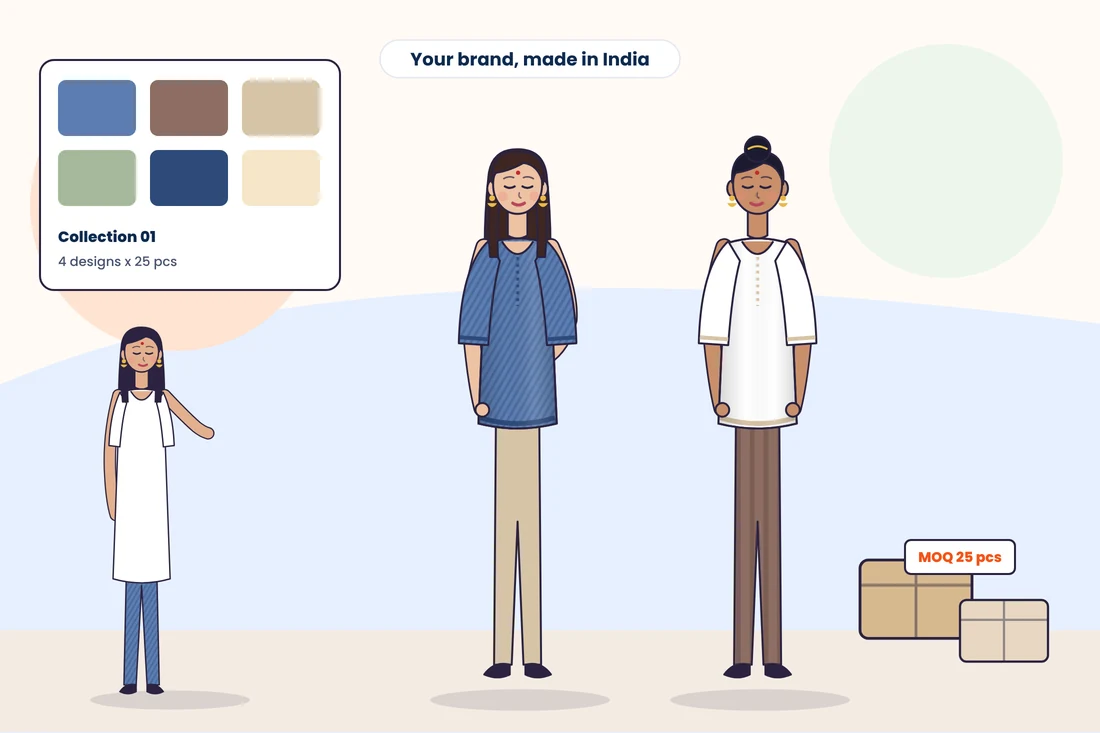
Many new brands stall at the first factory email: large exporters often ask for 500 to 1,000 pieces per style, which ties up too much cash before you know what sells. A growing group of Indian make-to-order units, many in Surat's garment clusters, work in smaller batches. That makes it realistic to test a brand with a few hundred pieces, sell through, and reorder what works.
This guide is for founders in the USA, UK, Canada, Australia, the UAE and beyond who want to launch with Indian manufacturing. It covers planning the first collection, briefing and sampling, budget and cash timing, labels, shipping and duty, and how to sell the first 100 pieces. To send a brief, start at make-to-order clothing from India.
Contents
- 1. Plan a small first collection
- 2. Work out your target price
- 3. Brief the factory
- 4. Sample and approve
- 5. Bulk production and payments
- 6. Labels, tags and packaging
- 7. Shipping, duty and landed cost
- 8. Your launch budget
- 9. Selling the first 100 pieces
- Mistakes first-time brands make
- FAQs
1. Plan a Small First Collection
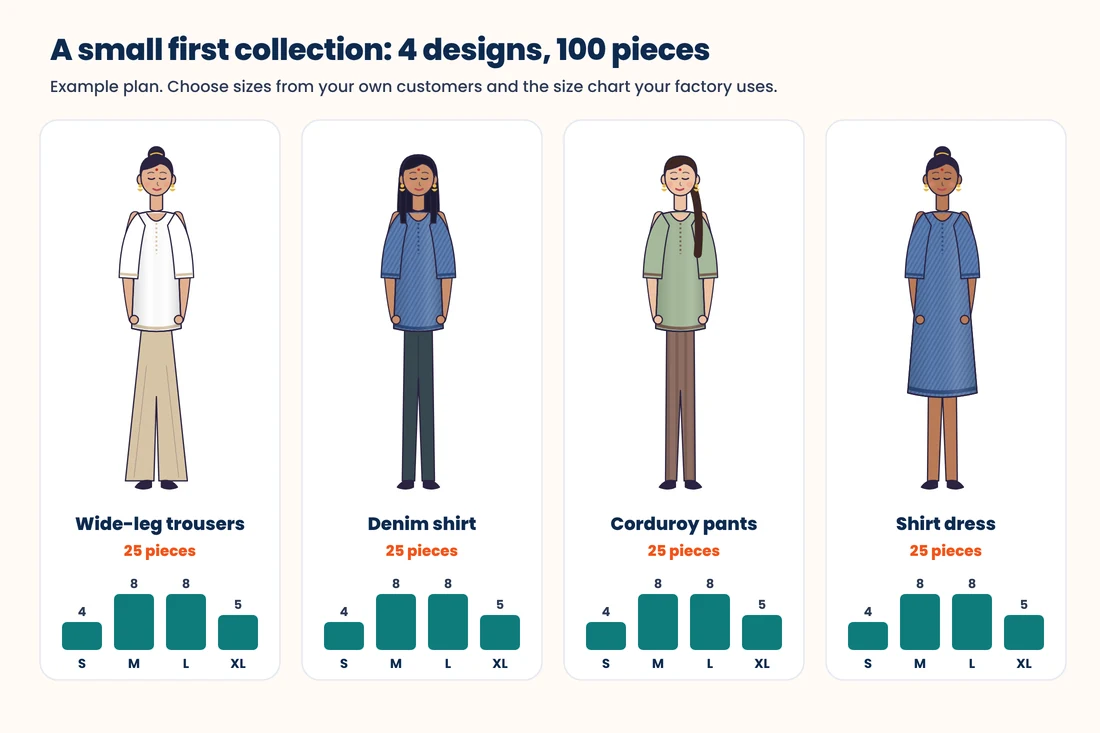
- Pick 3 to 6 designs that belong together and can be worn together, so one shopper buys two pieces.
- Start with what factories do well: trousers, denim, shirts, tops, dresses and co-ord sets. Browse trousers and pants, jeans and denim, tops and blouses, dresses and co-ord sets.
- Keep colours to 1 or 2 per design at first. Each extra colour usually counts against the minimum.
- Spread sizes sensibly: most of the 25 pieces in the middle sizes, fewer at the ends.
- Write down the customer: who buys, what they pay elsewhere and where they shop. It decides fabric and price.
2. Work Out Your Target Price
Work backwards from the shelf price. If you want to sell a pair of trousers at a set retail price, your landed cost per piece (factory price plus freight, duty and fees) usually needs to be well under half of it to leave room for marketplace or payment fees, returns and profit. Put your numbers into the landed cost calculator and the export duty calculator before you ask for quotes, and give the factory a target price in the brief. It saves rounds of back and forth.
| What changes the factory price | Why |
|---|---|
| Fabric | The biggest single cost; weight, fibre and finish all count |
| Quantity | Set-up time is shared over fewer pieces in small batches |
| Details | Pockets, pleats, embroidery, washes and trims add labour |
| Sizes and colours | More of each means more cutting and changeovers |
| Labels and packing | Branded labels, hang tags and polybags are extra |
3. Brief the Factory
A short brief is enough to get a quote: product, quantity per design, colours, sizes, target price, destination country and the date you need stock. A tech pack (flat sketch, measurements, fabric, trims and labels) gets you more accurate quotes and fewer sampling rounds. Download the free tech pack template and read the tech pack guide.
Through BizTorq you send one brief, it is matched to suitable factories, and you get a written quote in about two working days. You then contract and pay the factory directly. See how make-to-order works and the listed manufacturers.
4. Sample and Approve
- A pre-production sample usually takes 7 to 14 days, plus courier time.
- Sample terms differ by factory: some charge a fee that is credited against the bulk order, others ask only for courier. The quote should say which.
- Check fit on a real person, measurements against your spec, fabric feel, colour in daylight, stitching and a wash test.
- Send clear written comments with photos. Approve only when it is right; changes after bulk starts are costly.
5. Bulk Production and Payments
- Proforma invoice first: confirm sizes, colours, labels, packing and delivery date in writing.
- Advance: commonly 30 to 50% to start production; the balance before shipping or against documents.
- Bulk takes about 30 to 45 days. Ask for photos at cutting and stitching, and a final check before packing.
- Inspection: for larger orders, book a third-party inspector before you pay the balance.
- Check the factory before paying an advance; our supplier check lists what to ask for.
Plan your launch date backwards with the timeline planner.
6. Labels, Tags and Packaging
- Care and fibre labels: most countries require fibre content, care instructions and country of origin on clothing, and some also need the importer's or brand's name. Rules differ by country; see the import checklist for the USA, UK and Canada.
- Brand label and hang tag: send artwork early; small label runs can have their own minimums.
- Packing: agree folding, polybags, size stickers and carton markings, especially if you sell on Amazon or through a 3PL.
7. Shipping, Duty and Landed Cost
- Air is faster and suits a first order of a few hundred pieces; sea is cheaper per kilo for larger volumes but slower.
- Price terms: FOB (you arrange freight), CIF (freight to your port included) or DDP (delivered and cleared to your door). DDP is simplest for a first order if the factory or forwarder offers it.
- Duty and tax depend on your country, the product's HS code and fibre. Estimate them with the export duty calculator and check with a customs broker.
- Country guides: USA, UK, Canada, Australia, UAE, Germany and more.
8. Your Launch Budget
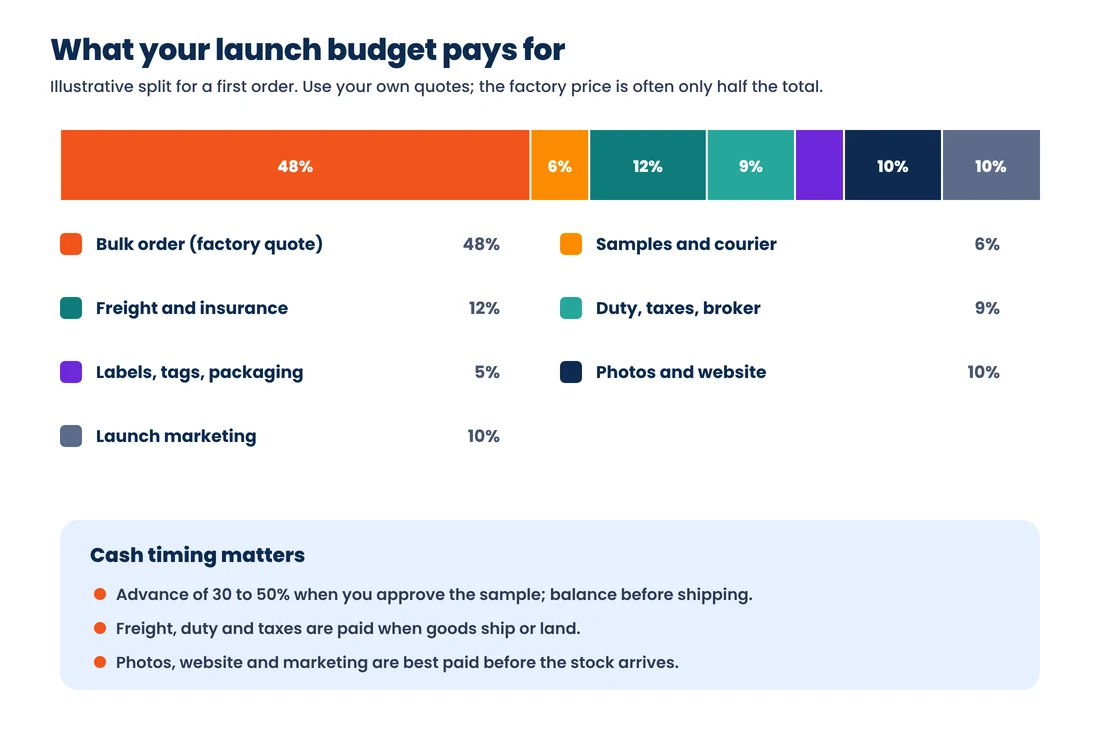
The split above is an example to show where money goes, not a price guide. The point is that the factory invoice is often only around half of what a first launch costs, and cash goes out in stages: the advance at sample approval, the balance before shipping, freight and duty on arrival, and photos, website and marketing before the first sale. Keep a reserve for a reorder of the best seller.
9. Selling the First 100 Pieces
- Pre-sell: show the approved samples on Instagram or to your mailing list and take pre-orders while bulk is in production.
- Your own store first: keep the margin and the customer data; add marketplaces later for reach.
- Photograph the samples so your product pages are ready when stock lands.
- Track sell-through by design and size and reorder only what sells.
If you also want Indian ethnic wear for your range, see how to import from Surat and the UAE ethnic wear guide.
Mistakes First-Time Brands Make
- Too many designs and colours, so every one misses the minimum or the budget.
- No target price in the brief, then quotes that do not fit the retail price.
- Approving a sample without a wash test or fit on a real person.
- Forgetting labels and country rules until the goods are packed.
- Planning launch from the factory date instead of the door-to-door date.
- Spending everything on stock and nothing on photos and marketing.
Frequently Asked Questions
Can I start a clothing brand with a small order from India?
Yes. Many make-to-order factories in Surat and Ahmedabad accept about 25 to 50 pieces per design, so a first collection of 4 designs can be around 100 to 200 pieces.
What is the minimum order quantity for Indian clothing manufacturers?
Large exporters often ask for 500 to 1,000 pieces per style. Small-batch make-to-order factories listed on BizTorq start from 25 pieces per design, depending on the factory and fabric.
How long does it take to make my first collection in India?
Typically a quote in about 2 working days, a sample in 7 to 14 days, bulk in 30 to 45 days, then shipping. Door to door is about 8 to 11 weeks by air or 12 to 16 weeks by sea.
Do I need a tech pack to get a quote?
No. A short brief with product, quantity, colours, sizes, target price and destination is enough for a first quote. A tech pack gives more accurate prices and fewer sample rounds; use the free tech pack template.
How much does a sample cost?
Sample terms differ by factory. Some charge a fee that is credited against the bulk order, and others ask only for courier costs. The written quote should state the terms before you pay.
How do I pay an Indian garment factory?
Commonly a 30 to 50% advance after sample approval, and the balance before shipping or against documents. Pay only against a written quote and a proforma invoice.
How much budget do I need to launch?
It depends on your designs, fabric and quantities. Plan for more than the factory price: samples, freight, duty, labels, photos, website and marketing can together cost as much as the stock itself.
Should I ship by air or by sea?
Air is faster and usually better for a first order of a few hundred pieces. Sea costs less per kilo for larger orders but takes several weeks longer.
What is the difference between FOB, CIF and DDP?
FOB means you arrange freight from the Indian port, CIF includes freight to your port, and DDP means goods are delivered and cleared to your door with duty paid.
What labels do clothes need?
Most countries require fibre content, care instructions and country of origin, and some need the brand or importer name. See the import checklist and confirm with a customs broker.
How do I calculate my landed cost?
Add the factory price, freight and insurance, duty and taxes, broker and delivery fees, then divide by the pieces. The landed cost calculator and export duty calculator help.
How do I find a make-to-order clothing manufacturer in India?
Send a brief on the BizTorq make-to-order page. It is matched to suitable factories, you get a written quote, and you contract and pay the factory directly.
Start Your First Collection
Send a brief for make-to-order clothing from India, plan dates with the timeline planner, check costs with the landed cost calculator and download the tech pack template.
Are you a factory? List your factory to receive briefs from brands abroad.
Timelines, MOQs and payment terms are typical figures from the BizTorq make-to-order process and vary by factory, fabric and order. The budget split is illustrative. Confirm duty, labelling and import rules with a customs broker in your country.