
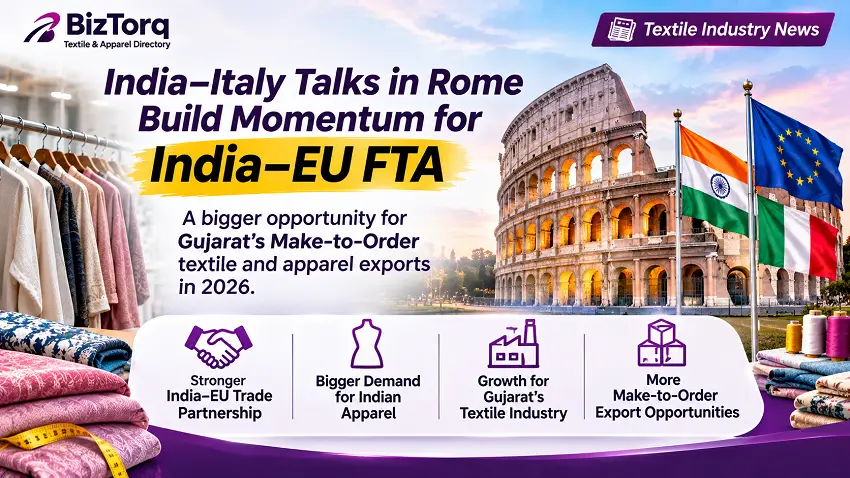
India’s push to capture high-value European fashion and textile supply chains gained fresh diplomatic momentum this week. During bilateral trade and investment talks in Rome reported on 19 November 2026, Union Commerce and Industry Minister Piyush Goyal met with Italian ministers and corporate leaders alongside a business forum drawing roughly 80 Indian delegates and 12 startups.
Concluded India–EU FTA Talks Unlock European Supply Chains
Both nations reviewed industrial cooperation and welcomed the concluded India–EU Free Trade Agreement (FTA) talks, emphasizing stronger supply-chain integration and expanded bilateral market access. With the European Union economy projected to grow 1.4% annually through 2027 and Indian exporters actively diversifying 10% to 15% of shipments away from US Section 301 tariff exposure, Italy—Europe’s premier luxury apparel, knitwear, and textile machinery hub—represents a high-margin strategic partner.
- Direct Sourcing for European Fashion Houses: Italian and EU garment labels increasingly seek vertically integrated make-to-order (MTO) fabric and private-label apparel partners capable of handling certified organic cotton, sustainable viscose, digital prints, and precision embroidery.
- Machinery & Tech Tie-Ups: Closer Indo-Italian industrial cooperation also benefits Gujarat mills upgrading shuttleless looms, rotary/digital printing lines, and eco-friendly finishing machinery ahead of India ITME 2026 next month.
How Surat & Ahmedabad Units Can Capture EU Make-to-Order Runs
Gujarat’s twin textile capitals are uniquely positioned to fulfill European buyer requirements:
- Ahmedabad Mills: High-count combed cotton shirting, zero-waste 3D-woven and enzyme-washed denim, and GOTS-certified woven garments.
- Surat Mills: Recycled polyester (rPET) filament fabrics, wide-width digital prints, jacquard upholstery/curtains, and multi-head Schiffli embroidery trims.
European buying offices, Italian apparel converters, and D2C brands seeking verified Indian factories can submit custom fabric specs and tech packs directly via the BizTorq Make-to-Order & Export Sourcing Portal, while exporters can check HSN classifications on the Textile GST & HSN Finder and model export pricing with the Fabric Margin Calculator.