
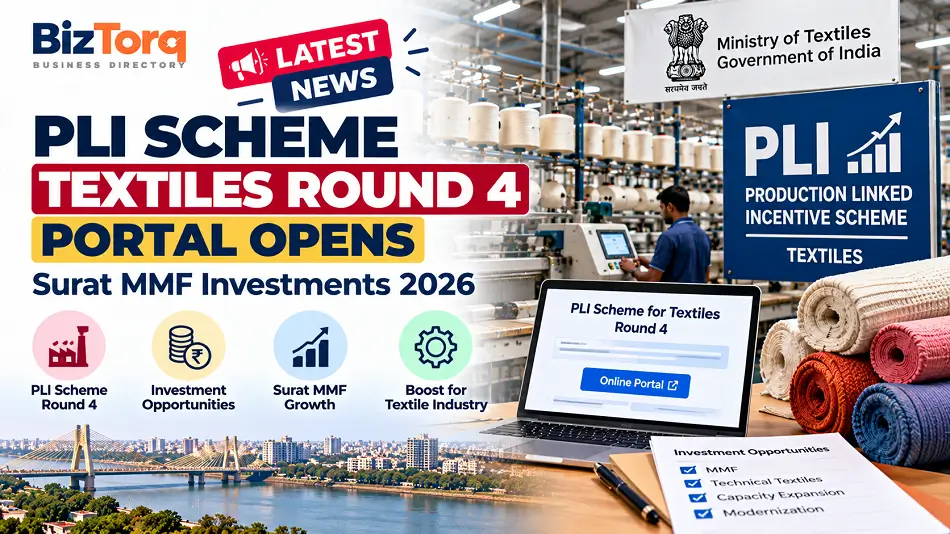
In a major policy boost for India’s man-made fibre (MMF) and technical textile manufacturers, the Union Ministry of Textiles has announced that it will reopen the application window for the Production Linked Incentive (PLI) Scheme for Textiles commencing 1 November 2026. The fourth application round introduces crucial operational flexibility, allowing non-incentivized participants from earlier phases to migrate into refined investment categories.
Tailored for Man-Made Fibre & Technical Textiles
Unlike conventional textile subsidy programs centered on cotton spinning, the central government’s ₹10,683 crore PLI framework focuses specifically on two segments where Surat holds national dominance: MMF fabrics and high-performance technical textiles. Under the guidelines, qualifying manufacturing investments will receive fiscal incentives ranging between 3% and 11% on incremental turnover over a five-year period.
Industry bodies including the Southern Gujarat Chamber of Commerce and Industry (SGCCI) and MANTRA have welcomed the portal reopening. Association leaders note that with over 100 modern technical textile enterprises already active in Sachin GIDC, Pandesara, and Palsana—and large-scale garmenting hubs coming up near the PM MITRA Park at Vansi-Borsi—Surat manufacturers are well-positioned to scale operations to meet scheme investment thresholds.
Migration Facility for Earlier Applicants
A key procedural highlight of the notification is the formal migration pathway. Participant companies approved under Rounds 1, 2, or 3 that have not yet claimed or received disbursements are permitted to withdraw existing submissions and migrate to Round 4. This enables businesses that faced project execution delays due to global supply chain snags or machinery delivery lags to reset their investment schedules without forfeiting participation.
Application Window & Synergy with Gujarat State Subsidies
The Ministry has confirmed that the online portal will accept fresh corporate proposals through November and December 2026. Financial consultants in Surat point out that PLI benefits can be combined strategically with the Gujarat Textile Policy (2024–2029), which already provides up to 35% capital subsidy on eligible plant and machinery, creating an attractive dual-subsidy structure for integrated synthetic weaving, processing, and garmenting setups.