Quick answer
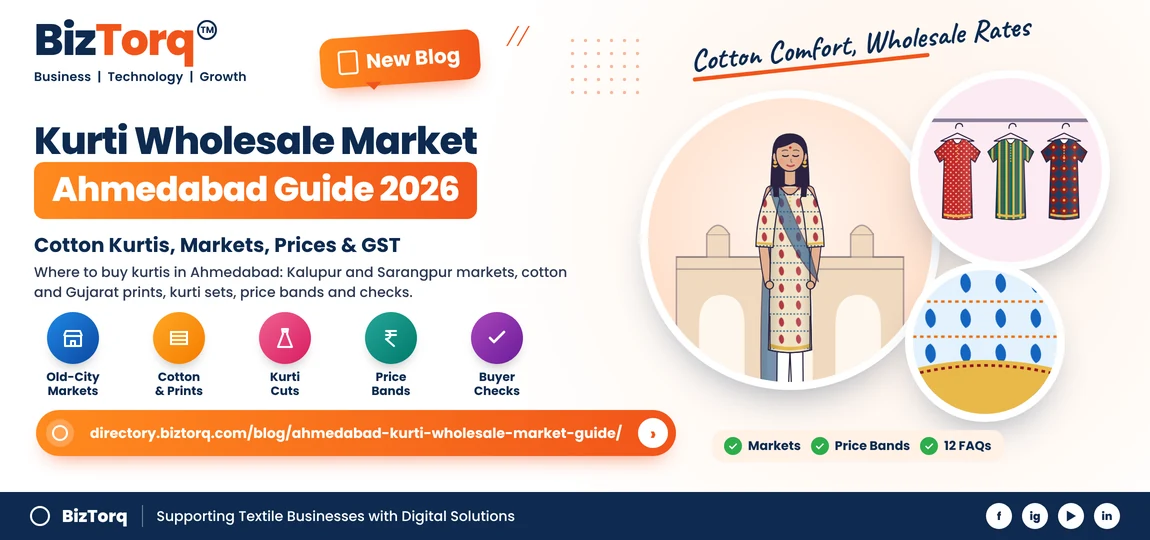
The main kurti wholesale market in Ahmedabad is Sindhi Market (Revdi Bazaar) beside Kalupur Gate. Kurti makers and traders also work from Ghantakarna Mahavir Market and New Cloth Market in Sarangpur, and fabric comes from Maskati Cloth Market nearby. Ahmedabad is strongest in cotton and rayon daily-wear kurtis and Gujarat-style prints such as block print, bandhani and Ajrakh-style. Most kurtis are sold in size sets (for example M, L, XL, XXL) or colour sets. Reported wholesale rates in the Revdi Bazaar area run from about ₹150 to ₹1,200 a piece. GST on kurtis is 5% up to ₹2,500 a piece and 18% above. Most old-city markets close on Sunday.
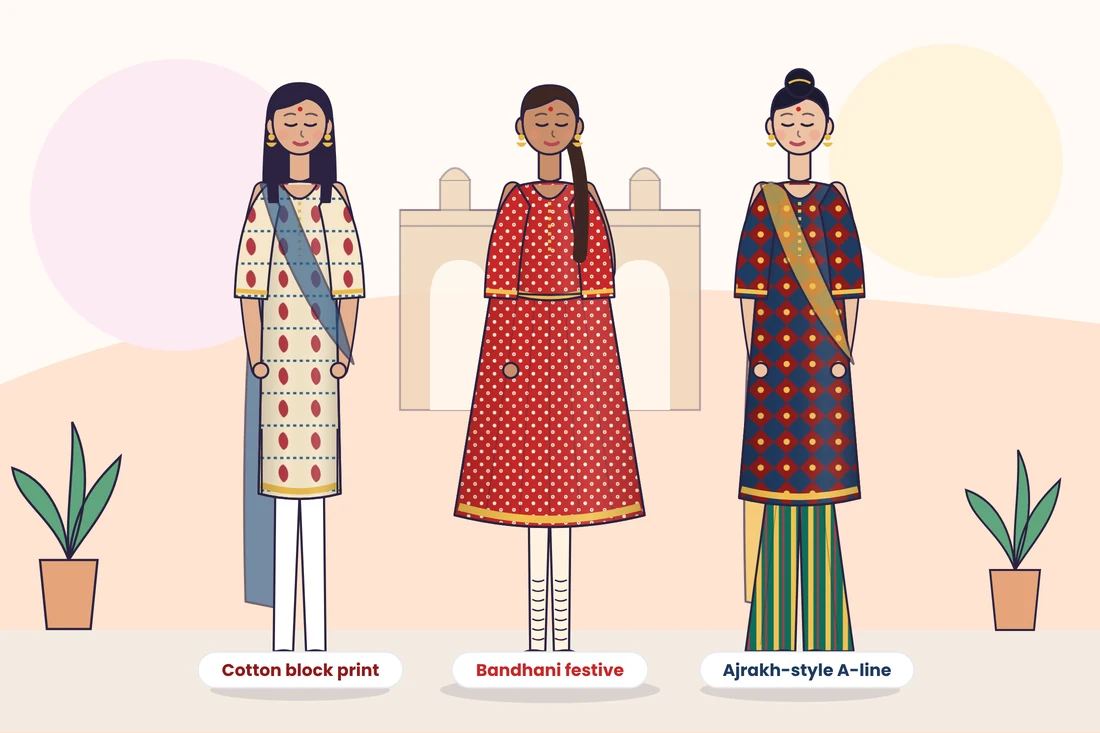
Ahmedabad built its name on cotton. The city's first mill opened in 1861, and it was later called the "Manchester of the East". The mills are mostly gone, but the old-city cloth markets around Kalupur still trade huge volumes of fabric and ready-made garments, and the kurti is one of their biggest lines. For a boutique, reseller or online seller, Ahmedabad is the place to buy comfortable cotton kurtis, Gujarat prints and value-priced daily wear, often in smaller lots than big catalogue houses ask for.
This guide covers where the kurti markets are, a one-day buying route, the kurti cuts and fabrics you will be offered, how sets and MOQ work, price bands and GST, how to check quality, and how to buy without visiting.
Contents
- Kurti wholesale markets in Ahmedabad
- A one-day kurti buying route
- Kurti cuts buyers ask for
- Cotton fabrics and Gujarat prints
- How kurti sets, sizes and MOQ work
- Kurti wholesale price range and GST
- Ahmedabad or Surat for kurtis?
- How to check kurtis before you pay
- How to buy kurtis wholesale from Ahmedabad
- When to stock which kurtis
- FAQs
Kurti Wholesale Markets in Ahmedabad
Most of the kurti trade sits in the old city on the east bank of the Sabarmati, in a belt that starts at Kalupur railway station and runs through Sarangpur and Khadia. The markets are close enough to cover several in one day. Factory production of garments is spread across industrial areas such as Narol, Vatva, Odhav and Naroda.
| Market or area | Where | What to buy there |
|---|---|---|
| Sindhi Market (Revdi Bazaar) | Beside Kalupur Gate | The best-known kurti wholesale lane; also sarees, bedsheets and household fabric. Budget to mid-range rates |
| Ghantakarna Mahavir Market | Sarangpur, near New Cloth Market | Kurti makers and cotton kurti suppliers in a multi-shop complex |
| New Cloth Market | Sarangpur | Fabric, dress material, sarees, kurtis and ready-made garments |
| Maskati Cloth Market | Kalupur | Fabric, sarees and dress material; useful if you get kurtis stitched to your own design |
| Gheekanta | Old city, near Relief Road | Ready-made garment and kurti wholesalers |
| Ratanpole | Khadia | Ethnic and bridal wear, fancy kurtis and fabric |
| Dhalgarwad and Rani no Hajiro | Khadia, near Manek Chowk | Bandhani, Patola-style, Ajrakh and mashru fabrics, chaniya cholis |
| Lal Darwaja | Near Bhadra | Budget cloth and small-lot buying |
| Narol, Vatva, Odhav, Naroda | Industrial areas | Garment factories for bulk and private-label orders |
Find addresses, landmarks and what each market sells in the Ahmedabad textile market directory, or browse by area: Kalupur, Sarangpur, Ratanpole, Lal Darwaja and the manufacturing clusters. For the wider city, read the Ahmedabad textile market guide.
A One-Day Kurti Buying Route
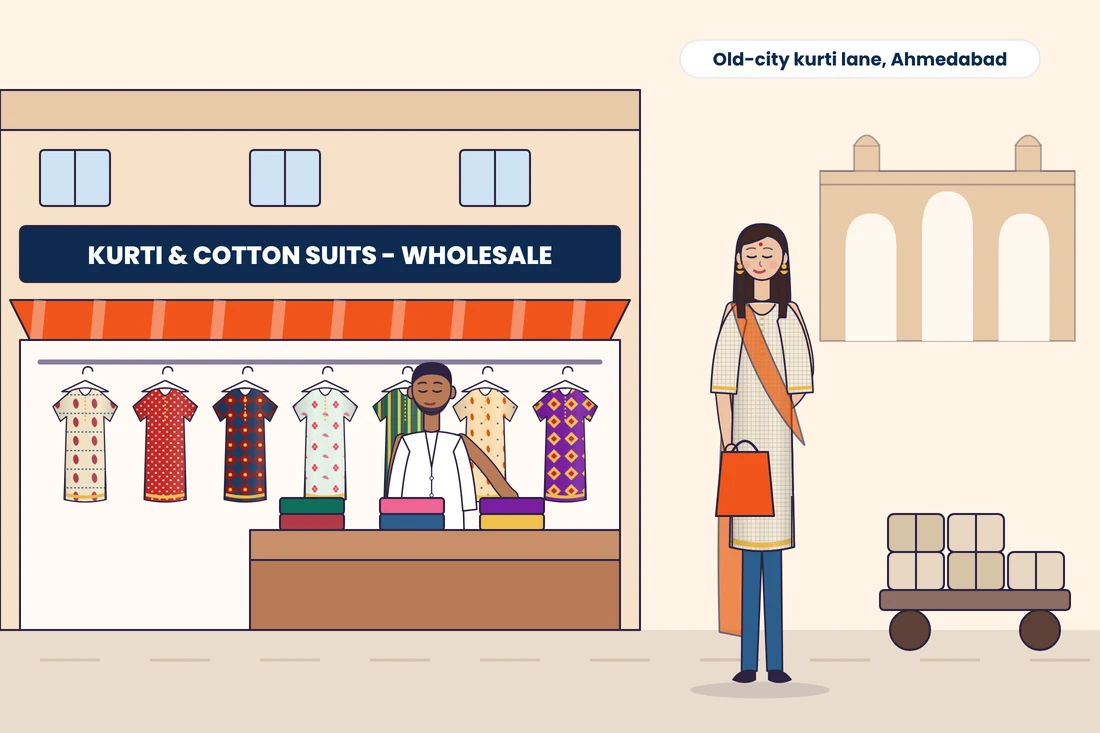
- Morning, Sindhi Market (Revdi Bazaar). Start here, close to Kalupur station. Market guides suggest going before noon for the newest stock. Shortlist designs and note each shop's set size and minimum order.
- Late morning, Sarangpur. Walk to New Cloth Market and Ghantakarna Mahavir Market to compare kurti makers and cotton qualities with what you saw in the morning.
- After lunch, Maskati. If you plan your own designs or private label, check fabric rates by the metre here.
- Afternoon, Khadia. For festive and craft prints, visit Ratanpole, Dhalgarwad and Rani no Hajiro. Finish before the evening crowd at Manek Chowk.
- Evening. Confirm orders, rates, GST bills and the transporter before you leave the city.
Most old-city markets trade Monday to Saturday from about 10 am to 8 or 9 pm and close on Sunday, but timings differ by market and shop, and some lanes slow down around Friday afternoon prayers. Check the Ahmedabad market open today page before you travel.
Kurti Cuts Buyers Ask For
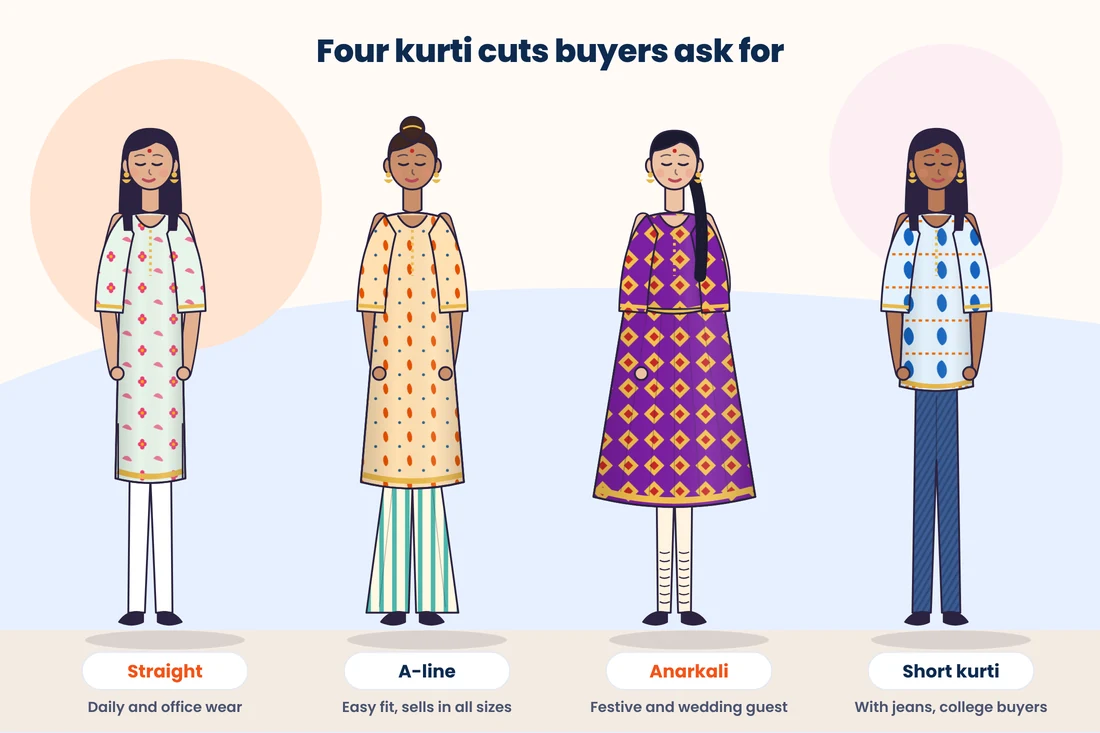
| Cut | What it looks like | Who buys it |
|---|---|---|
| Straight | Knee to calf length, straight side seams with slits | Daily and office wear; the steadiest seller |
| A-line | Fitted at the chest, widening to the hem | Easy fit across sizes; good with palazzo |
| Anarkali | Fitted bodice with a flared, panelled skirt | Festive, Navratri and wedding-guest buyers |
| Short kurti | Hip length, worn as a top | College buyers; worn with jeans |
| Kurti sets | Kurti with pant or palazzo, sometimes with dupatta | Buyers who want a full outfit at one price |
| Front-slit, kaftan, angrakha | Fashion cuts that change by season | Boutiques that refresh stock often |
Kurti sets with a dupatta are close to readymade suits; see the readymade suits catalog and our Pakistani suits guide for those. For co-ordinated top and bottom sets, browse co-ord sets.
Cotton Fabrics and Gujarat Prints
| Fabric or print | What it is | What to ask |
|---|---|---|
| Cotton cambric and printed cotton | Light, breathable cotton; the base of daily-wear kurtis | Pure cotton or blend? GSM, shrinkage, colour fastness |
| Cotton slub, flex or stretch cotton | Textured or slightly stretchy cotton blends | Fibre mix and how it washes |
| Rayon (viscose) | Soft, drapes well, prints sharply; a volume line all year | Rayon weight, shrinkage after first wash |
| Handloom and khadi | Hand-woven cotton with a natural texture | Handloom or mill-made look? Rate rises with genuine handloom |
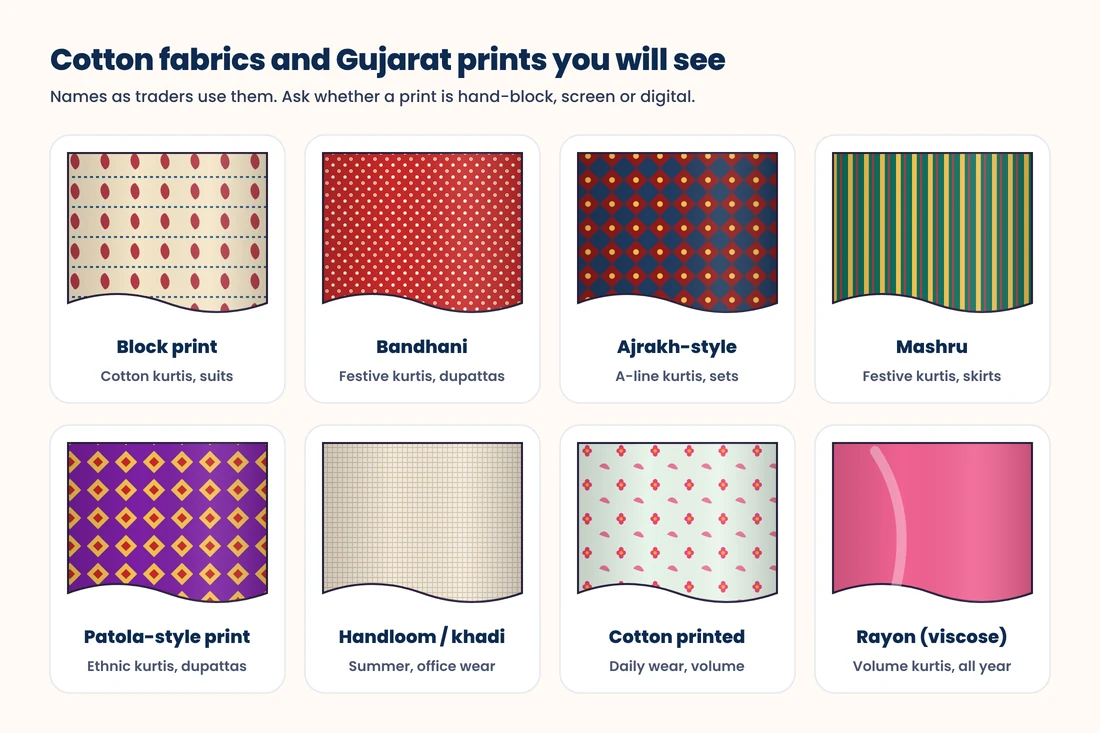
| Block print | Motifs printed with carved blocks; also copied by screen and digital print | Hand-block, screen or digital? Natural or chemical dyes? |
| Bandhani | Tie-dye with small dots, a Gujarat and Rajasthan tradition | Real tie-dye or bandhani print? |
| Ajrakh-style | Geometric resist prints in indigo and madder red, linked to Kutch | Hand-block Ajrakh or a printed look-alike? |
| Mashru | Striped weave with a silk-like face, traditionally from Patan and Kutch | Genuine mashru or a printed stripe? |
| Patola-style | Geometric patterns inspired by Patan Patola double ikat | Printed or woven? Genuine Patan Patola is far above kurti rates |
At wholesale kurti rates, most "Ajrakh", "Patola" and "bandhani" kurtis are printed versions of the craft, and that is fine as long as the bill and your product listing say so. Hand-made craft pieces cost more and are sold differently. Learn to judge fabric with our fabric quality guide, and if you want your own prints, see digital printing and dyeing. For fabric by the metre, browse the fabrics catalog.
How Kurti Sets, Sizes and MOQ Work
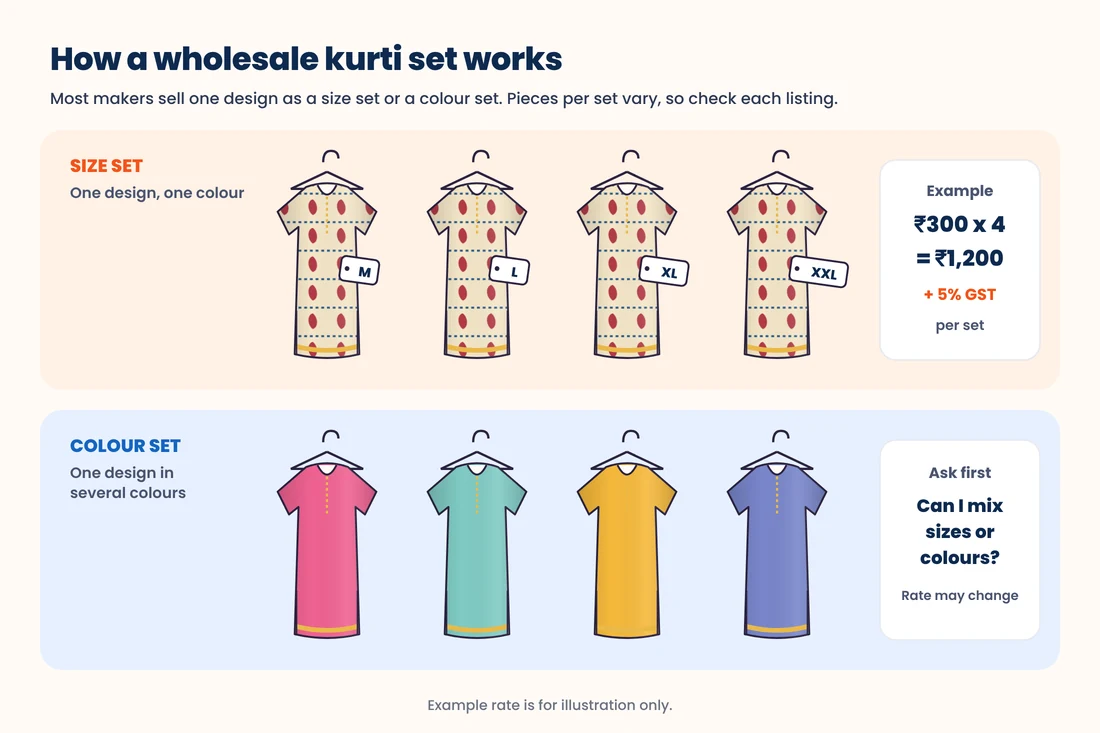
- Size set: one design in one colour, usually one piece each of M, L, XL and XXL. Some makers add S or XXXL, and plus-size ranges are often sold as their own sets.
- Colour set: one design in several colours, so a shop gets variety without buying many designs.
- Rate is per piece. Multiply by the pieces in the set. A ₹300 kurti in a 4-piece set is ₹1,200 a set before GST.
- MOQ is set by the seller: one set, a number of sets or a minimum bill value. Smaller old-city shops are often more flexible than factories.
- Mixing: ask whether you can mix sizes or colours, or buy loose pieces. Many allow it at a slightly higher rate.
- Size chart: ask for chest and length in inches for each size. Sizes are not the same across makers.
Every listing in the wholesale kurtis catalog shows pieces per set, price per piece and minimum order. Unsure of a term? See the trade glossary.
Kurti Wholesale Price Range in Ahmedabad and GST
Rates depend on fabric, print method, work, size range and order size. These bands come from public listings and market guides in November 2026 and are a starting point for planning, not a quote.
| Type | Indicative wholesale rate per piece |
|---|---|
| Basic printed cotton or rayon kurti | About ₹150 to ₹350 |
| Better cotton, flex cotton or plus-size kurti | About ₹280 to ₹450 |
| Kurti with pant or palazzo set | About ₹400 to ₹900 |
| Festive, Anarkali or embroidered kurti | About ₹500 to ₹1,200 and above |
| Hand-block or genuine craft pieces | Higher; priced piece by piece |
For reference, a market guide reports rates of about ₹150 to ₹1,200 a piece in the Revdi Bazaar area, and cotton kurti listings from Ahmedabad sellers on a large B2B marketplace showed about ₹279 to ₹371 a piece in November 2026.
GST: kurtis are ready-made garments, so GST is 5% when the sale value of a piece is up to ₹2,500 and 18% above. Fabric bought by the metre is 5%. Kurtis usually fall under HSN chapter 62 (woven) or 61 (knitted); look up the right code in the GST and HSN finder for garments and read our textile GST guide. Goods moving between states usually need an e-way bill when the consignment is above ₹50,000.
Margin example: you buy at ₹300, transport and packing add about ₹25, so your landed cost is about ₹325 before GST. Selling at ₹599 leaves about ₹274, or roughly 46% of the selling price, before GST and your shop costs. Run your own numbers, with GST, in the kurti margin calculator.
Ahmedabad or Surat for Kurtis?
| Ahmedabad | Surat | |
|---|---|---|
| Strength | Cotton and rayon daily wear, Gujarat prints, value pricing | Rayon, georgette and synthetic kurtis, embroidered and festive catalogues |
| How it is sold | Size and colour sets, often flexible lots in old-city shops | Numbered catalogues and sets from manufacturers |
| Best for | Summer and office ranges, craft-look prints, small boutiques | Festive ranges, large catalogue buyers, resellers |
Many shops buy cotton daily wear in Ahmedabad and festive kurtis in Surat. Compare both in our Surat vs Ahmedabad guide, and find Surat makers on the Surat wholesalers by product page.
How to Check Kurtis Before You Pay
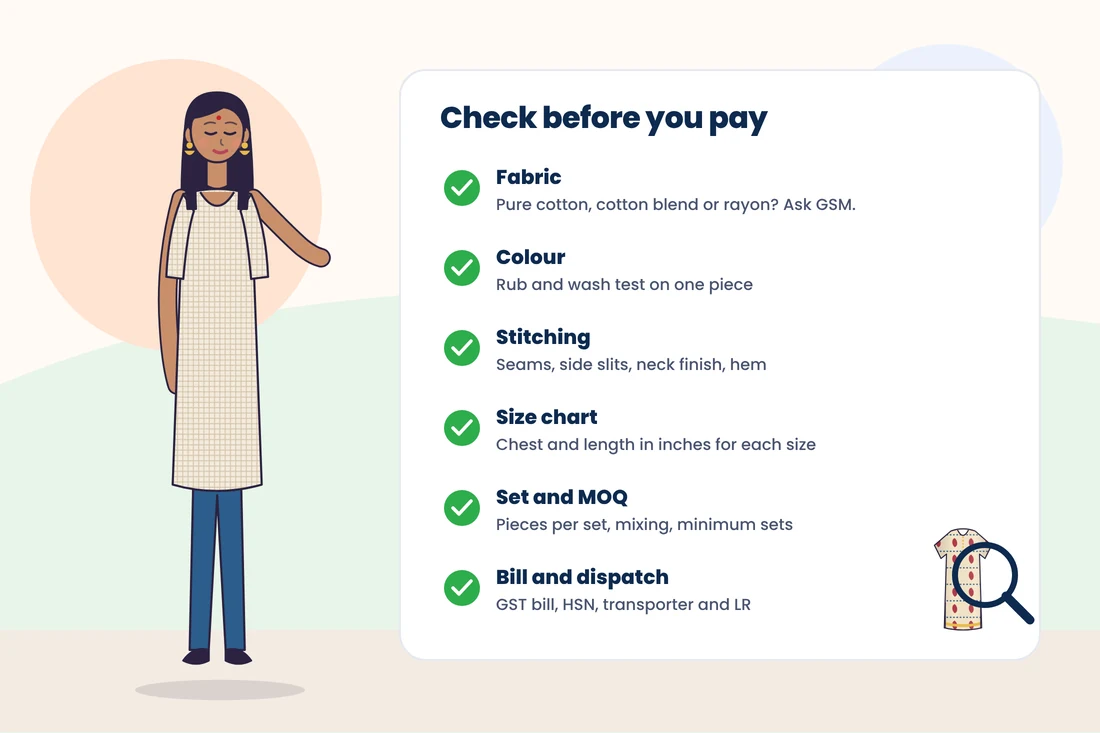
- Fabric: ask whether it is pure cotton, a blend or rayon, and feel the weight. Thin fabric shows through and gets returned.
- Colour: rub a damp white cloth on the print. Wash one piece before a big order, especially dark and red prints.
- Stitching: look at seams, side slits, neck finish and hem. Loose threads and uneven slits mean more rejects.
- Size chart: measure chest and length of each size against the maker's chart.
- Set and MOQ: write down pieces per set, mixing rules and the minimum order on the bill or chat.
- Bill and dispatch: get a GST bill with HSN, the transporter name and the LR (bilty) number.
Agree payment terms in writing before credit is offered; see our credit and payment terms guide and how to verify a supplier.
How to Buy Kurtis Wholesale from Ahmedabad
- Shortlist designs in the kurtis catalog and markets in the Ahmedabad directory.
- Ask for a video of the actual fabric in daylight, plus the size chart and set details, on WhatsApp.
- Order one sample set and wash one piece before a bulk order.
- Confirm the rate per piece, pieces per set, MOQ, GST and who pays freight.
- Pay against a GST bill and keep the chat as a record.
- Book transport through the seller's transporter or the transporter finder, and keep the LR number.
Buying without travelling? The steps in how to buy wholesale online work for Ahmedabad too. Starting out? Read how to start a saree and kurti boutique or how to start reselling on WhatsApp and Instagram.
When to Stock Which Kurtis
| Season | What sells | Order by |
|---|---|---|
| Summer (about March to June) | Light cotton, khadi, pastel and block prints | Late winter |
| Monsoon | Rayon and quick-dry prints, darker colours | Before the rains |
| Navratri and Diwali | Bandhani, mirror-work, Anarkali and festive sets | A few months before Navratri |
| Wedding season (often about November to February) | Festive and embroidered kurtis, kurti sets with dupatta | Before the season starts |
| All year | Straight cotton and rayon office kurtis | Reorder monthly |
Old-city markets slow down around Diwali and Uttarayan; plan around the market open today page and our market holidays guide. Selling abroad? Kurtis travel well; check our USA kurti export guide and the export duty calculator.
Frequently Asked Questions
Which is the main kurti wholesale market in Ahmedabad?
Sindhi Market, also called Revdi Bazaar, beside Kalupur Gate is the best-known kurti wholesale lane. Kurti makers also trade from Ghantakarna Mahavir Market and New Cloth Market in Sarangpur. See the Ahmedabad market directory.
Is Sindhi Market the same as Revdi Bazaar?
Yes. Both names are used for the same old market next to Kalupur Gate, close to Maskati Cloth Market and New Cloth Market.
What is Ahmedabad best known for in kurtis?
Cotton and rayon daily-wear kurtis and Gujarat-style prints such as block print, bandhani, Ajrakh-style and mashru, usually at value prices. Surat is stronger in georgette, synthetic and heavily embroidered festive kurtis.
What is the wholesale price of kurtis in Ahmedabad?
As a rough guide, basic printed cotton or rayon kurtis start around ₹150 to ₹350 a piece, kurti sets with pant or palazzo around ₹400 to ₹900, and festive or embroidered pieces ₹500 to ₹1,200 and more. Rates change with fabric, work and order size, so confirm with the seller.
What is the minimum order for kurtis in Ahmedabad?
It depends on the seller. Many sell one full size set (for example M, L, XL, XXL) as the minimum, others ask for several sets or a minimum bill value. Old-city shops are often more flexible than factories. Check the MOQ on each listing in the kurtis catalog.
Can I buy single kurtis or mixed sizes?
Some wholesalers allow mixed sizes, mixed colours or loose pieces, usually at a slightly higher rate. Many sell full sets only, so ask before you order.
What GST applies to kurtis?
Kurtis are ready-made garments: GST is 5% when the sale value of a piece is up to ₹2,500 and 18% above that. Fabric sold by the metre is 5%. Find the HSN code in the GST and HSN finder.
Are Ahmedabad kurti markets open on Sunday?
Most old-city wholesale markets, including Maskati and Revdi Bazaar, are usually closed on Sunday and trade Monday to Saturday from about 10 am. Timings vary by market and shop, so check market open today before you travel.
Are Ajrakh and bandhani kurtis at wholesale rates hand-made?
Usually not. At wholesale kurti rates most Ajrakh, bandhani and Patola designs are printed versions of the craft. Ask whether a piece is hand-block, tie-dyed, screen or digital printed, and describe it honestly when you resell.
Should I buy kurtis from Ahmedabad or Surat?
Buy cotton daily wear and Gujarat prints in Ahmedabad and festive, georgette or embroidered catalogues in Surat. Many shops buy from both. Compare them in our Surat vs Ahmedabad guide.
Can I buy Ahmedabad kurtis online without visiting?
Yes. Shortlist designs online, ask for a daylight video, the size chart and set details on WhatsApp, order one sample set, then pay against a GST bill and track the LR number from the transporter.
How can an Ahmedabad kurti maker get more wholesale buyers?
List your shop free, add your designs to the wholesale catalog and take the online readiness check. A wholesale website with size sets, MOQ and dealer rates lets buyers in other cities order without calling.
Find Kurti Wholesalers in Ahmedabad
Browse the wholesale kurtis catalog, explore the Ahmedabad textile markets and price your stock with the kurti margin calculator.
Do you make or sell kurtis in Ahmedabad? Add your designs to the wholesale catalog, list your shop free, check your online readiness score, or let BizTorq build your Ahmedabad wholesale website with size sets, MOQ, dealer rates and WhatsApp ordering.
Price bands, timings and seasons are indicative and for planning only. Rates, market hours, GST rules and practices change; confirm details with the seller and your CA before ordering. Sources: market guide for Revdi Bazaar (wholesalecatalogz.com) and Ahmedabad cotton kurti listings on IndiaMART, checked November 2026.