Quick answer
When you manufacture custom clothing in India through BizTorq make-to-order, you protect your order with a pre-shipment inspection based on AQL 2.5 (Acceptable Quality Limit). Instead of checking every piece, the inspector checks a random sample from the finished lot. For example, for a 500-piece lot the inspector checks 50 pieces: the lot passes with 3 or fewer major defects and fails at 4. Minor defects are usually judged at AQL 4.0. Critical defects, such as a broken needle or a sharp metal part, are not accepted at all, and many export buyers ask for every garment to pass a needle detector before packing.
For brands, boutique owners and D2C labels abroad, custom garments from Surat and Ahmedabad can carry strong margins. Those margins disappear if a 500-piece sea shipment reaches London or New York with twisted side seams, loose threads or the wrong size ratio. Once the goods have cleared customs in your country, sending them back to India is rarely worth the cost.
That is why professional importers use a pre-shipment inspection (PSI) based on AQL sampling. Whether you hire a third-party inspection agency or ask the factory's own QC team for a video inspection before you release the final payment, you need to know how sampling works and how defects are classified.
What Is AQL 2.5? How Garment Sampling Works
AQL (Acceptable Quality Limit) comes from the sampling standard ISO 2859-1 (ANSI/ASQ Z1.4 in the USA). It sets how many pieces to check from a lot, and how many defective pieces are allowed in that sample before the whole lot fails. In apparel exports, the common choice is General Inspection Level II, with AQL 2.5 for major defects and AQL 4.0 for minor defects.
| Lot size (pieces) | Sample to inspect | Major defects: pass at | Major defects: fail at |
|---|---|---|---|
| 151 to 280 | 32 pieces | 2 or fewer | 3 or more |
| 281 to 500 | 50 pieces | 3 or fewer | 4 or more |
| 501 to 1,200 | 80 pieces | 5 or fewer | 6 or more |
| 1,201 to 3,200 | 125 pieces | 7 or fewer | 8 or more |
Example: you order 500 custom cotton kurtis from an Ahmedabad garment factory. The inspector picks 50 pieces at random. If 3 have open seams (a major defect), the lot passes. If 4 do, the whole lot fails and goes back for 100% sorting and rework, usually at the factory's cost, followed by a re-inspection.
Small make-to-order runs: many make-to-order orders start at 25 pieces per design. For lots under about 150 pieces, the sample is small and a single defect can decide the result, so many buyers simply ask the factory to check every piece and share photos or a video, then add a random check of their own.
The Three Defect Classes
Not every stitching mistake counts the same. Defects found during a pre-shipment inspection are classified like this:
| Defect class | Definition | Clothing examples | Usual limit |
|---|---|---|---|
| Critical | Could harm the wearer or break safety or import rules. | Broken needle in the garment, sharp metal edge, mould, missing country-of-origin label. | Zero. One critical defect fails the lot. |
| Major | Makes the garment unsellable or likely to be returned, or departs from the approved sample or tech pack. | Measurement outside tolerance, hole in fabric, open or broken seam, broken zip, colour bleeding, wrong size label. | AQL 2.5 (for example, 3 allowed in a sample of 50). |
| Minor | A cosmetic flaw that does not affect wear but lowers the finish. | Untrimmed thread over 1 cm, slightly uneven stitching inside a hem, a small mark that brushes off. | AQL 4.0 (for example, 5 allowed in a sample of 50). |
The 5-Step Pre-Shipment Inspection Checklist
When you order through BizTorq make-to-order, ask the factory, or your inspector, to carry out these five checks before the goods are packed into export cartons:
1. Measurements and Fit
The inspector lays each sample garment flat and measures the points of measure (POM): chest, waist, hip, length from the high point shoulder and sleeve length. These are compared with your approved size chart in the tech pack. A common tolerance for woven garments is about ±1 cm (3/8 to 1/2 inch) on main measurements, with tighter limits on small points such as collars. Agree the tolerances in writing; anything outside them is a major defect.
2. Fabric and Colour Fastness
The bulk fabric is checked for bowing, skewing and weaving faults. A dry and wet rub test (crocking) with a white cloth shows whether dark dyes such as indigo or maroon bleed. For cotton and rayon, shrinkage after washing is checked; many buyers set a limit of 3 to 5%. See the fabric quality guide for more checks.
3. Seams and Stitching
The inspector pulls gently at side seams and armholes to check for seam grinning (threads showing as the seam opens) and slipped stitches. Stitches per inch (SPI) should match the tech pack, for example about 12 SPI for fine woven shirts. Knitwear should use overlock and flatlock seams that stretch without breaking.
4. Zips, Trims and Embellishment
For embroidered or embellished pieces from Surat, the inspector checks that stones, sequins and beads are secure and that zips run smoothly without catching the lining. Zips, buttons and press studs are opened and closed several times to test them.
5. Needle Detection and Packing
Many retailers in the USA, UK and Europe require every finished garment to pass through a needle detector before packing, with a broken-needle log kept by the factory. Always ask for this on childrenswear. Finally, the inspector checks polybags, folding, labels, hang tags, carton markings and the size and colour breakdown against the packing list.
How to Enforce Quality on Your India Orders
You do not need to fly to India. For small boutique orders, ask for a live video inspection, where the factory measures random pieces in each size on camera against your size chart. For larger export orders, hire a third-party inspection agency to visit the factory in Gujarat. Inspection is usually priced per inspector-day, typically a few hundred US dollars, and you receive an AQL report with photos of every defect.
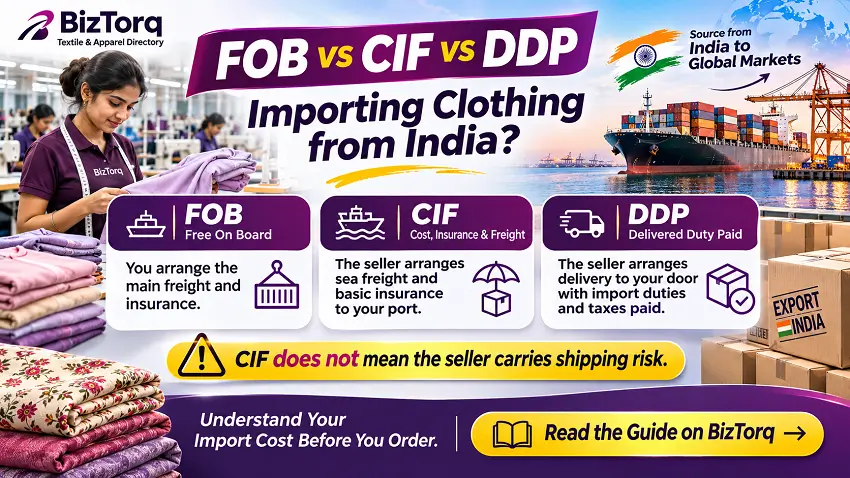
Release the final payment only after the inspection report says PASS, or after the factory has reworked and re-inspected a failed lot. Agree this in writing before production starts. Add the inspection fee to your landed cost with the landed cost calculator, and see FOB vs CIF vs DDP for how shipping terms affect what you pay.
Frequently Asked Questions
What is AQL 2.5 in garment manufacturing?
AQL means Acceptable Quality Limit. AQL 2.5 is the sampling level most apparel buyers use for major defects: it sets how many pieces to inspect from a lot and how many defective pieces are allowed before the whole lot fails.
How many pieces are inspected for a 500-piece order?
Under General Inspection Level II, a lot of 281 to 500 pieces needs a sample of 50. At AQL 2.5 the lot passes with up to 3 major defects and fails at 4.
What is a critical defect in clothing exports?
A defect that could harm the wearer or break safety or import rules, such as a broken needle in the garment, a sharp metal edge, mould, or a missing country-of-origin label. One critical defect fails the lot.
What happens if a lot fails AQL inspection?
The factory sorts all the garments, repairs or replaces the defective pieces, and the lot is inspected again. The cost of rework and re-inspection is usually the factory's, if your contract says so.
What is the difference between a major and a minor defect?
A major defect, such as an open seam, hole or wrong size label, makes a garment unsellable or likely to be returned. A minor defect, such as a loose thread or a small mark that brushes off, is cosmetic and does not affect wear.
What measurement tolerance is normal for garments?
A common tolerance for woven garments is about plus or minus 1 cm on main measurements, with tighter limits on small points. Agree the tolerances in your tech pack; measurements outside them count as major defects.
Is needle detection required for clothing exported to the USA and UK?
Many retailers in the USA, UK and Europe require it, especially for childrenswear. Ask the factory to pass every garment through a needle detector before packing and to keep a broken-needle log.
What is a pre-shipment inspection?
The final quality check, done when production is finished and most of the goods are packed. The inspector checks a random sample for measurements, workmanship, fabric, labels and packing before the goods leave the factory.
How can I inspect an India order without travelling?
Ask the factory for a live video inspection, measuring random pieces in each size on camera, or hire a third-party inspection agency in India to visit the factory and send an AQL report with photos.
How much does a third-party garment inspection cost in India?
Inspections are usually priced per inspector-day, typically a few hundred US dollars, plus travel in some cases. Ask for a fixed quote that covers the report.
How do I set quality standards with an Indian manufacturer?
Put them in your tech pack and purchase order: the AQL levels (2.5 major, 4.0 minor), measurement tolerances, shrinkage limit, needle detection and who pays for re-inspection.
Do I pay Indian GST on custom clothing exports?
No. Exports are zero-rated, so a registered Indian exporter can ship under a Letter of Undertaking (LUT) without charging IGST on the export invoice. Import duty and taxes in your own country still apply.
Make Quality Custom Clothing in India
Send your tech pack, quantities and target price through BizTorq make-to-order to get written quotes from garment factories in Surat and Ahmedabad, or browse ready designs from 25 pieces.
Explore the Surat and Ahmedabad textile markets, or list your factory if you are an exporter.
AQL figures follow ISO 2859-1 General Inspection Level II, single sampling, normal inspection. Tolerances, defect lists and inspection terms vary by buyer; agree them in writing with your factory before production.