Quick answer
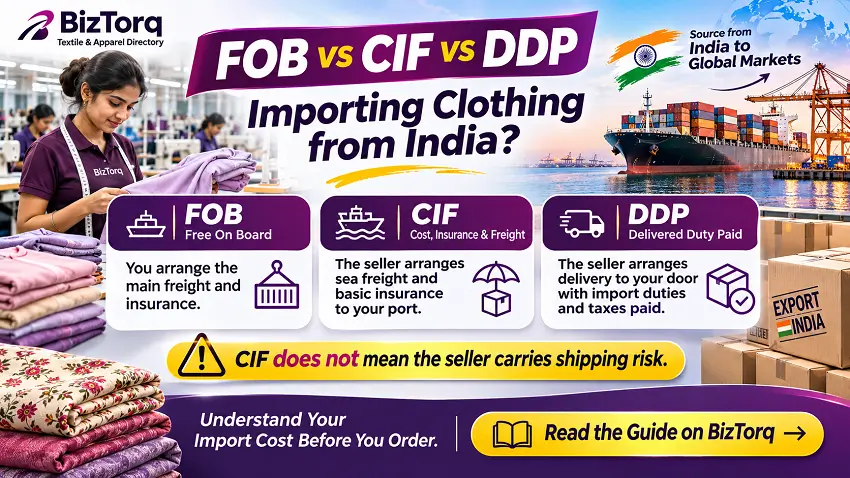
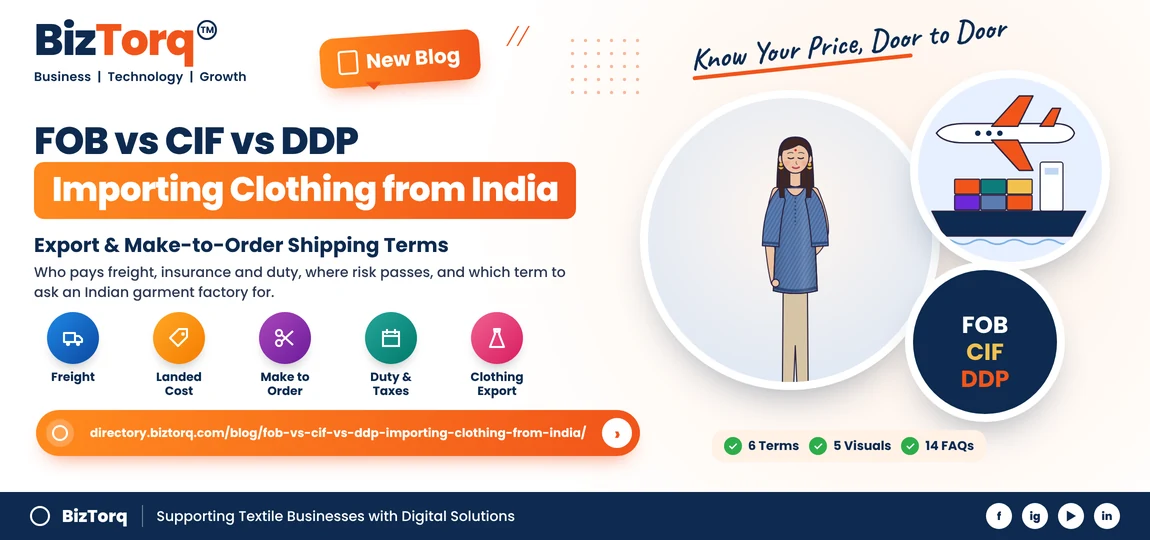
When you import clothing from India, the Incoterm on the quote tells you what the price includes and where the goods become your risk. FOB (Free On Board) covers the goods cleared for export and loaded on the ship in India. You pay sea freight, insurance, import duty and delivery, and the risk is yours once the goods are on board. CIF (Cost, Insurance and Freight) adds sea freight and minimum insurance to your port, but the risk still passes to you in India. DDP (Delivered Duty Paid) means the seller delivers to your door with import duty and taxes paid, so it is the simplest for you but the hardest for a small factory to offer. Most Indian make-to-order garment factories quote FOB, and FCA is the correct term for air shipments. Compare quotes on a landed-cost basis, not on the headline price.
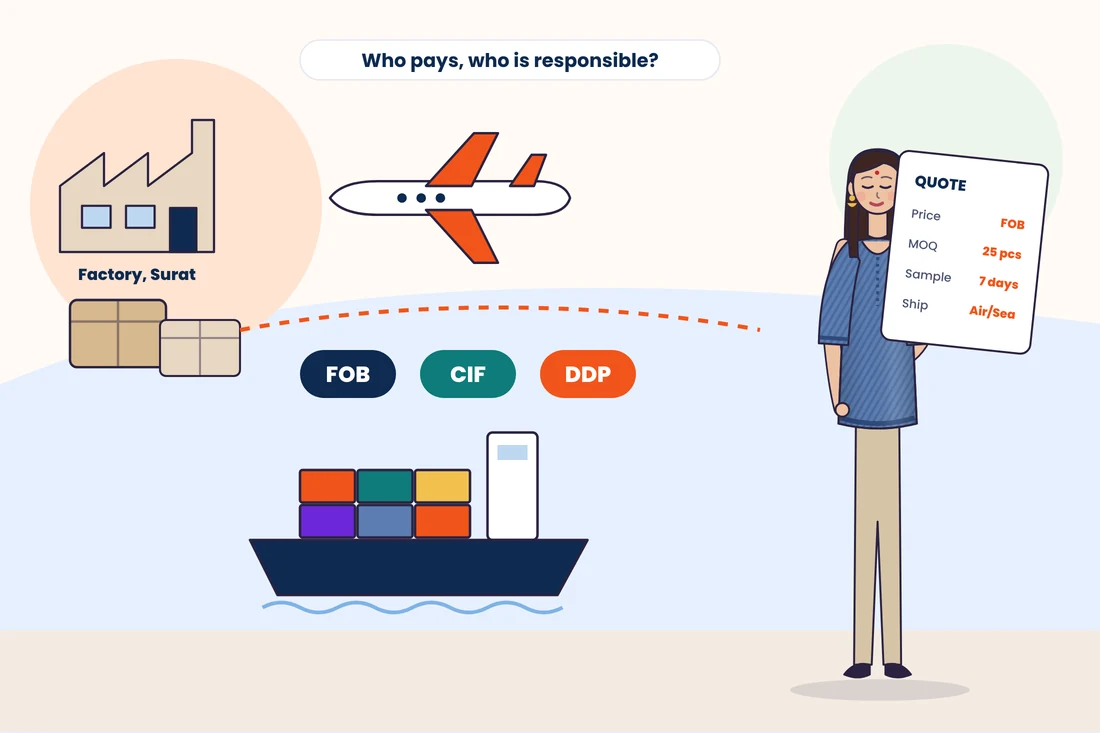
You have found a factory, approved a sample and received a quote: "USD price per piece, FOB Nhava Sheva". Or "CIF Felixstowe", or "DDP your warehouse". These three letters change what you really pay by 20 to 50% or more, and they decide who is responsible if a carton goes missing at sea. This is where many first-time importers get caught out.
This guide explains the shipping terms (Incoterms) you will see on export quotes from Indian garment manufacturers, with a focus on make-to-order clothing from Surat and Ahmedabad. It covers who pays for what, where the risk passes, how to compare quotes, which documents to expect, and which term to choose for your first order.
Contents
- What Incoterms are and why they matter
- Who pays for what: EXW, FCA, FOB, CIF, DAP, DDP
- FOB explained
- CIF explained
- DDP explained
- Air shipments: why FCA beats FOB
- Where the risk passes
- Comparing quotes: FOB price to landed cost
- Export documents to expect
- Which term should you choose?
- Shipping terms on BizTorq make-to-order quotes
- Common mistakes
- FAQs
What Incoterms Are and Why They Matter
Incoterms are standard trade terms published by the International Chamber of Commerce (ICC). The current version is Incoterms 2020, with 11 rules. Each rule answers three questions in one short code:
- Costs: who pays for export clearance, freight, insurance, import duty and delivery.
- Risk: at what point loss or damage becomes the buyer's problem.
- Tasks: who books the shipment and who handles customs at each end.
An Incoterm should always name a place, for example FOB Nhava Sheva, FOB Hazira, CIF Jebel Ali or DDP Toronto. Write "Incoterms 2020" next to it on the proforma invoice. Incoterms do not cover payment terms, ownership of the goods or quality. Those belong in your purchase order.
Who Pays for What: EXW, FCA, FOB, CIF, DAP, DDP
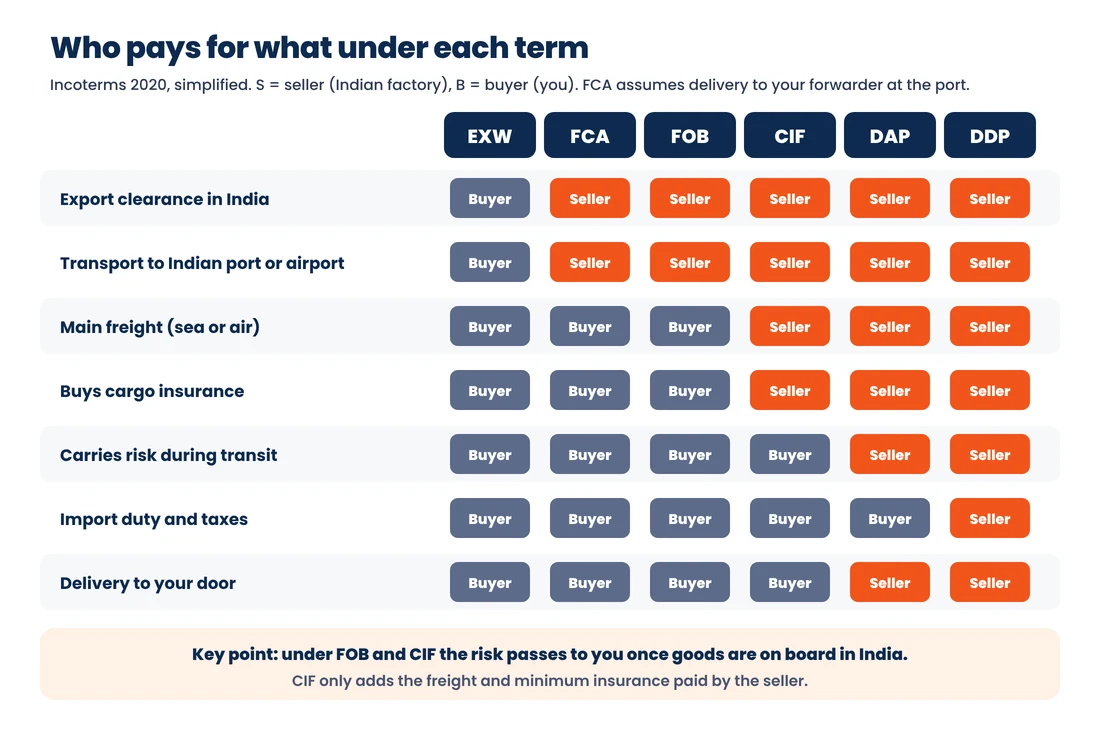
Six of the 11 rules cover almost every clothing quote from India:
| Term | Full name | Price includes | Risk passes to you | Use it for |
|---|---|---|---|---|
| EXW | Ex Works | Goods ready at the factory | At the factory | Rarely suitable for exports from India |
| FCA | Free Carrier | Export-cleared goods handed to your forwarder or airline | At handover | Air cargo and containers |
| FOB | Free On Board | Export-cleared goods loaded on the ship in India | On board in India | Sea freight; the usual factory quote |
| CIF | Cost, Insurance and Freight | FOB plus sea freight and minimum insurance to your port | On board in India | Sea freight when the seller books the ship |
| DAP | Delivered At Place | Delivery to your address, before import duty | At your address | Courier and door-to-door shipments |
| DDP | Delivered Duty Paid | Delivery to your address with duty and taxes paid | At your address | Small parcels, samples, buyers who want one price |
FOB Explained: The Standard Factory Quote
FOB (Free On Board) is the most common term on export quotes from Indian garment factories. Under FOB [Indian port], the factory:
- packs and labels your cartons;
- moves them to the port, for example Nhava Sheva (JNPT), Hazira or Mundra;
- files the export declaration (shipping bill) and clears Indian customs;
- pays to load the goods onto the vessel.
From that point, you pay the ocean freight, insurance, destination charges, import duty, taxes and delivery, and the goods are at your risk.
Why Indian factories prefer FOB: the factory does what it knows well (production, packing and Indian export formalities), and Indian export values, such as duty drawback and RoDTEP benefits, are usually calculated on the FOB value. It also keeps the quote stable, because sea freight rates change week to week.
Why buyers like FOB: you choose your own freight forwarder, compare freight rates, and keep control of the shipment and its timing. Once you ship regularly, FOB with your own forwarder is usually the cheapest route.
CIF Explained: Freight Paid, Risk Not
CIF (Cost, Insurance and Freight) means the factory also books and pays the sea freight and cargo insurance to your destination port, for example CIF Felixstowe, CIF Jebel Ali or CIF Los Angeles.
The catch: under CIF, the risk still passes to you when the goods are loaded on board in India, exactly as under FOB. If cartons are damaged at sea, you claim on the insurance policy the seller bought. Under Incoterms 2020, CIF only requires minimum cover (Institute Cargo Clauses C) for 110% of the contract value. That cover is limited, so ask for all-risks cover (Clauses A) in writing, or buy your own.
CIF also does not include destination port charges, customs clearance, import duty or delivery to your warehouse. Budget for these separately, because they can be a big share of the cost for a small shipment.
CIF and its sister term CFR (freight but no insurance) are meant for sea freight. For air cargo or courier, the matching terms are CPT and CIP. Under Incoterms 2020, CIP requires the higher all-risks level of insurance.
DDP Explained: One Price to Your Door
DDP (Delivered Duty Paid) puts the most work on the seller. The factory or its logistics partner handles freight, insurance, import customs clearance, duty and import taxes, and delivery to your address. You receive the goods with nothing more to pay, apart from charges the contract excludes.
DDP sounds ideal, but it has limits with small Indian factories:
- The seller must act as, or appoint, the importer of record in your country. Many small make-to-order units cannot, so DDP is often arranged through a courier or freight partner, and the price includes their margin.
- Duty rates and rules change. In the USA, the USD 800 de minimis exemption for low-value parcels has been suspended for all countries since August 2025, and in June 2026 CBP made the suspension indefinite. Even small courier shipments now face duty and formal entry costs. A DDP price quoted months ago may no longer cover the duty.
- Import VAT or GST: under DDP the seller pays import VAT or GST. If you are VAT-registered, you may not be able to reclaim it, as you could if you had imported the goods yourself. Many buyers prefer DAP plus their own clearance for that reason.
DDP works well for samples, small courier orders and buyers who want one all-in price. For bulk orders, compare a DDP quote against FOB plus your own forwarder before you decide.
Air Shipments: Why FCA Beats FOB
Many first orders of a few hundred pieces go by air, from Mumbai or Ahmedabad airport, because transit takes days instead of weeks. Quotes still often say "FOB Mumbai airport". Strictly, FOB, CFR and CIF are sea-only terms. For air cargo and containers, the ICC recommends:
- FCA [airport or forwarder's warehouse] in place of FOB;
- CPT in place of CFR;
- CIP in place of CIF.
In practice, ask the factory to write "FCA Mumbai Air Cargo Complex, Incoterms 2020", or name your forwarder's facility. That makes it clear where its job ends and yours begins.
Where the Risk Passes
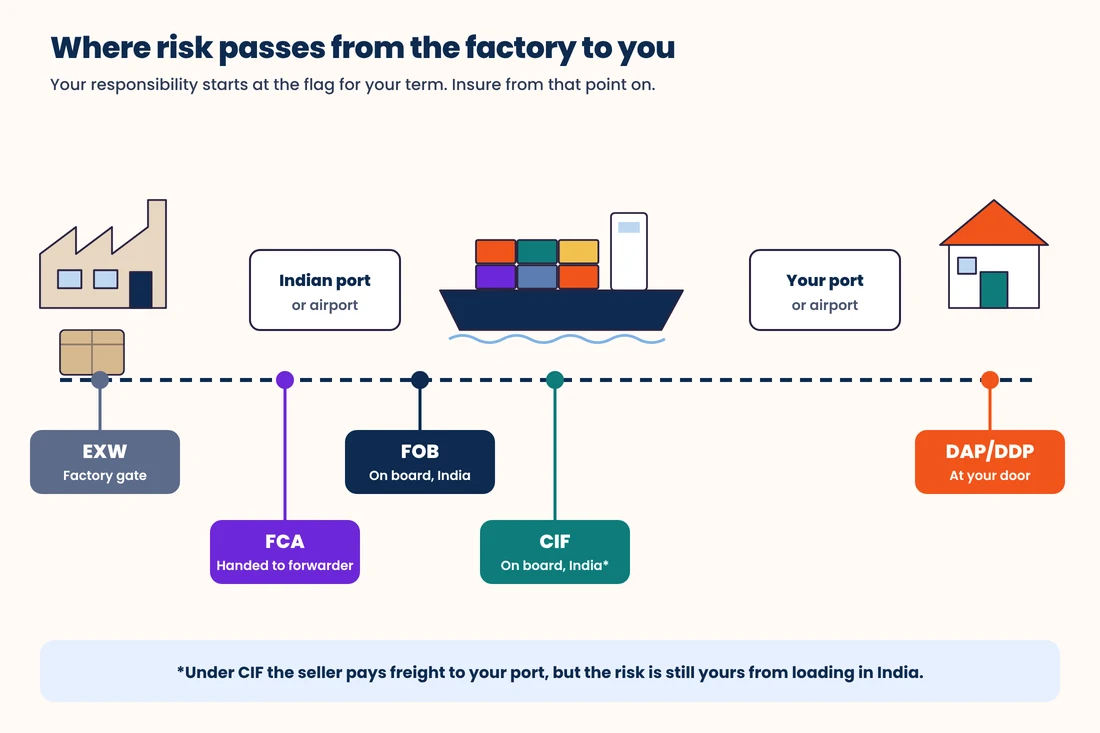
The most misunderstood point is that paying for freight and carrying the risk are not the same thing. Under CIF the seller pays freight, but you carry the risk from loading in India. Under DAP and DDP, the seller carries the risk until the goods reach your address. Whatever the term, make sure someone insures the goods from the point where the risk passes to you.
Comparing Quotes: From FOB Price to Landed Cost
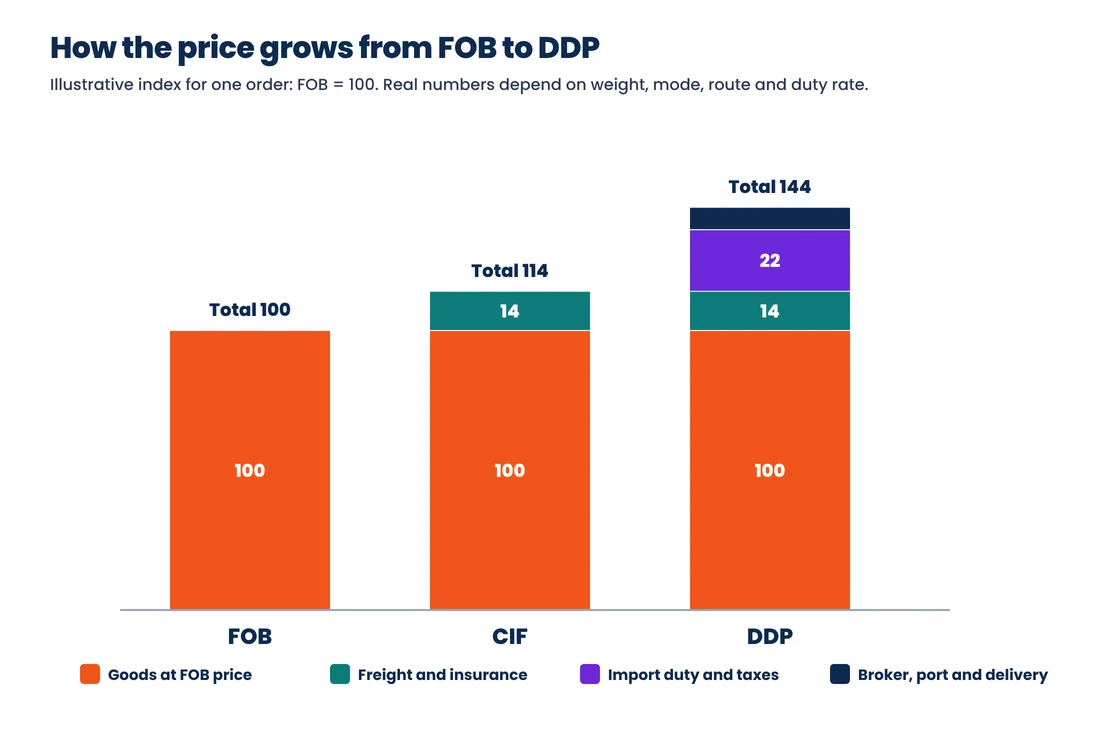
A quote that looks cheaper may not be. To compare an FOB quote from one factory with a CIF or DDP quote from another, convert both to a landed cost per piece:
| Cost line | FOB quote | CIF quote | DDP quote |
|---|---|---|---|
| Garments (factory price) | In quote | In quote | In quote |
| Export clearance in India | In quote | In quote | In quote |
| Sea or air freight | You add | In quote | In quote |
| Cargo insurance | You add | In quote (minimum cover) | In quote |
| Destination port or terminal charges | You add | You add | In quote |
| Customs broker fee | You add | You add | In quote |
| Import duty and tariffs | You add | You add | In quote |
| Import VAT, GST or sales tax | You add (often reclaimable) | You add | In quote (often not reclaimable) |
| Delivery to your warehouse | You add | You add | In quote |
Then divide the total by the number of pieces. The free landed cost calculator does this for you, and the export duty calculator estimates duty for clothing by country. Always confirm the duty rate and HS code with a customs broker, because rates for garments differ by fabric (cotton, synthetic, denim) and by product.
Export Documents to Expect
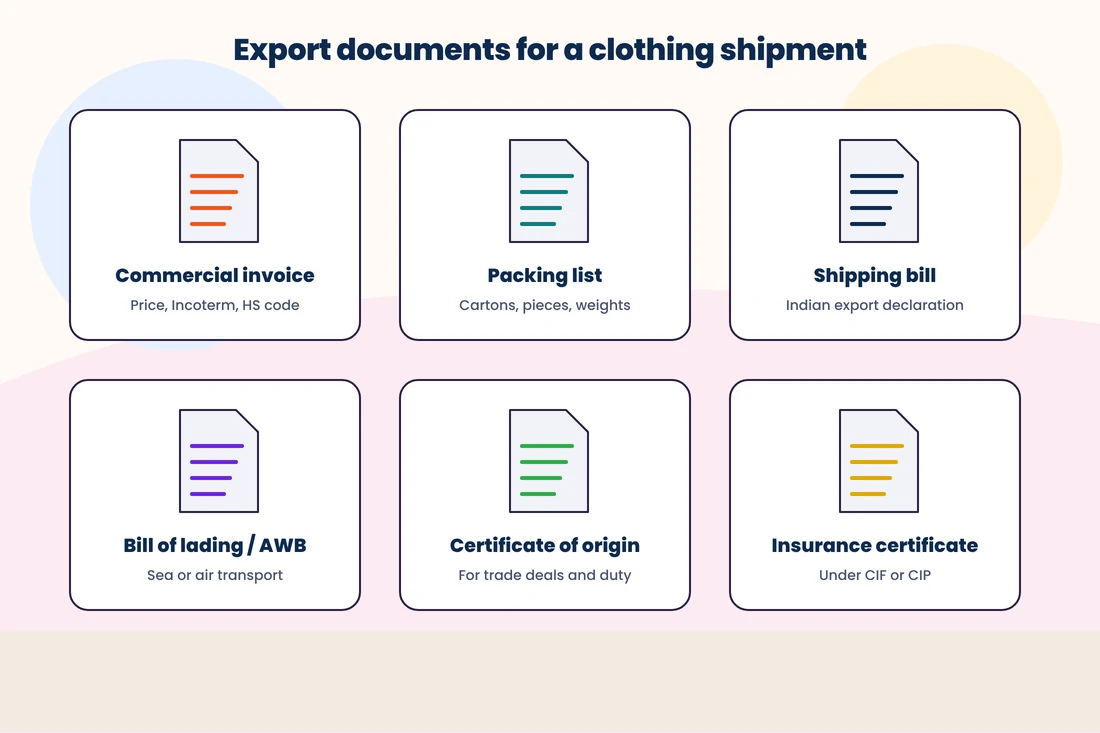
- Commercial invoice: buyer, seller, description, HS code, quantity, unit price, currency and the Incoterm with its named place.
- Packing list: carton numbers, pieces per carton by size and colour, and net and gross weights. Brokers and warehouses depend on it.
- Shipping bill: the Indian export declaration, filed by the exporter or its customs agent. It is the factory's job under FCA, FOB, CIF, DAP and DDP.
- Bill of lading (sea) or air waybill (air): the transport document. Under FOB, your forwarder usually issues it.
- Certificate of origin: needed to claim lower duty under trade agreements, for example the India-UAE CEPA or the India-UK trade agreement once it is in force. Ask for it before shipping.
- Insurance certificate: provided by the seller under CIF or CIP.
Check the labelling and paperwork rules for your market in the import clothing from India checklist.
Which Term Should You Choose?
| Your situation | Best fit | Why |
|---|---|---|
| Samples and very small orders by courier | DAP or DDP | One price, little paperwork |
| First bulk order by air, no forwarder yet | FCA airport, with a forwarder the factory or BizTorq suggests | Fast; you still see the freight cost |
| Regular sea shipments, with your own forwarder | FOB Indian port | Usually the lowest total cost and the most control |
| Sea shipment where the factory gets a good freight rate | CIF, with all-risks insurance requested | Convenient, but compare the freight with your own forwarder |
| You cannot or do not want to clear customs yourself | DDP through a courier or freight partner | Simplest, but usually costs more; check VAT reclaim |
Shipping Terms on BizTorq Make-to-Order Quotes
On BizTorq make-to-order, you send one brief and are matched with verified garment factories in Surat and Ahmedabad. You receive a written quote, then contract with and pay the factory directly. The how it works page explains that orders can ship FOB, CIF or DDP. The designs in the make-to-order range, such as wide-leg trousers, denim and shirt dresses from 25 pieces, are quoted FOB on their design pages.
In your brief, tell the factory:
- Your destination country and city, so it can suggest a port or airport.
- Your preferred term: FOB or FCA if you have a forwarder, CIF or DDP if you want the factory to arrange shipping.
- Air or sea, and your target in-store date. The timeline planner works back from your launch date.
- Insurance: who buys it and what cover.
For country-specific duty, labelling and shipping notes, see the make-to-order guides for the USA, UK, Canada, Australia, UAE, Germany, Singapore, Malaysia and South Africa.
Common Mistakes When Importing Clothing from India
- Comparing FOB with DDP prices directly. Always convert to landed cost per piece.
- Assuming CIF means the seller carries the risk. It does not; the risk is yours from loading in India.
- Accepting EXW from an Indian factory. Under EXW you would need to handle Indian export clearance, which a foreign buyer usually cannot do easily. Ask for FCA instead.
- No named place. "FOB" alone is unclear. Write "FOB Nhava Sheva, Incoterms 2020".
- Forgetting destination charges. Terminal handling, delivery orders and broker fees can be large on a small sea shipment. Air can be cheaper door to door for a few cartons.
- Relying on old duty assumptions. Tariffs and low-value rules have changed sharply, especially for the USA. Check the current rate before you price your range.
- Paying before you check the factory. Read how to verify a Surat textile supplier and pay only against a written quote and a proforma invoice.
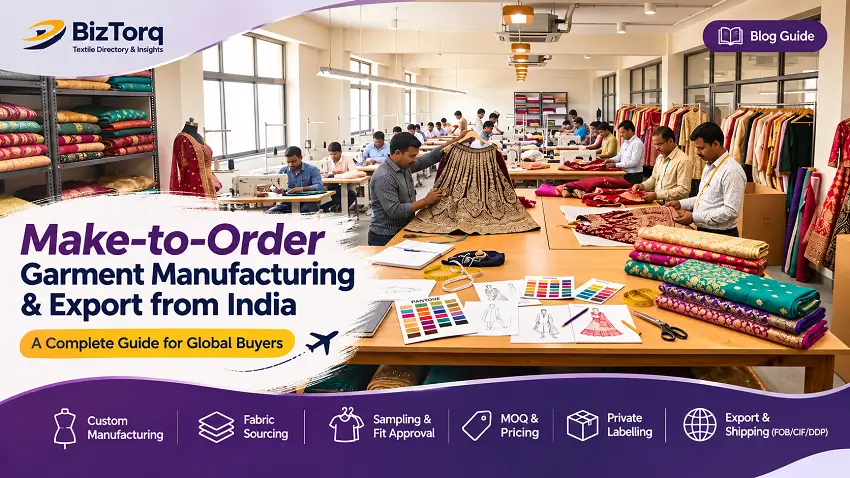
For the full make-to-order process, read the make-to-order garment manufacturing export guide and how to start a clothing brand with an Indian manufacturer.
Frequently Asked Questions
What is the difference between FOB, CIF and DDP?
FOB covers the goods loaded on the ship in India; you pay freight, insurance, duty and delivery. CIF adds sea freight and minimum insurance to your port. DDP delivers to your door with import duty and taxes paid. Under both FOB and CIF, the risk passes to you once the goods are on board in India.
Which Incoterm do Indian garment factories usually quote?
Most quote FOB at an Indian port such as Nhava Sheva, Hazira or Mundra, because they handle production, packing and Indian export clearance, and export benefits are usually calculated on the FOB value. Many can also arrange CIF or DDP through partners.
Is FOB or CIF better when importing clothes from India?
FOB is usually cheaper once you have your own freight forwarder, and you keep control of the shipment. CIF is convenient for a first sea order, but compare the freight with your own forwarder and ask for all-risks insurance, because CIF only requires minimum cover.
Who carries the risk under CIF?
The buyer. Under CIF the seller pays freight and insurance to your port, but the risk passes to you when the goods are loaded on board in India. If goods are damaged at sea, you claim on the insurance the seller bought.
Is DDP a good option for a small clothing order?
For samples and small courier orders, DDP or DAP is often the easiest option. For bulk orders, compare a DDP quote with FOB plus your own forwarder, because DDP usually includes a margin, and import VAT paid by the seller may not be reclaimable by you.
Can I use FOB for air shipments?
FOB is meant for sea freight. For air cargo, the correct term is FCA (Free Carrier) at the airport or your forwarder's facility, with CPT and CIP in place of CFR and CIF. Many quotes still say FOB airport, so confirm in writing where the seller's job ends.
Why should I avoid EXW from an Indian factory?
Under EXW the buyer must handle Indian export clearance, which a foreign buyer usually cannot do easily. FCA gives you almost the same price and control, with the factory clearing the goods for export.
What does landed cost mean?
The total cost of getting goods to your warehouse: factory price, freight, insurance, destination charges, broker fee, import duty, taxes and delivery, divided by the number of pieces. Use the landed cost calculator to work it out.
Do small clothing parcels to the USA still enter duty-free?
No. The USA suspended the USD 800 de minimis exemption for all countries in August 2025, and CBP made the suspension indefinite in June 2026. Small courier shipments of clothing from India now face duty. Check the current rules with your courier or customs broker.
Which documents come with a clothing export from India?
A commercial invoice, packing list, shipping bill (the Indian export declaration), bill of lading or air waybill, and, where needed, a certificate of origin and an insurance certificate.
How do I find the import duty on clothing from India?
Find the HS code for your garment and fabric, then check your country's tariff. The export duty calculator gives an estimate by country, and a customs broker can confirm the exact rate.
Which ports and airports do Surat and Ahmedabad factories ship from?
Sea shipments commonly leave from Nhava Sheva (JNPT) near Mumbai, Hazira near Surat or Mundra in Kutch. Air cargo usually leaves from Mumbai or Ahmedabad airport. The factory or your forwarder will suggest the best route.
Can BizTorq make-to-order factories ship FOB, CIF or DDP?
Yes. Orders through BizTorq make-to-order can ship FOB, CIF or DDP depending on the factory, and the ready designs are quoted FOB. Name your preferred term in your brief, and you agree the final terms directly with the factory.
Which term should a first-time importer choose?
For a first bulk order by air, ask for FCA at the airport and use a forwarder. For regular sea shipments, use FOB with your own forwarder. If you cannot handle customs, choose DDP and accept a higher price for the convenience.
Get a Make-to-Order Quote with Clear Shipping Terms
Send a brief for make-to-order clothing from India and name your preferred term (FOB, FCA, CIF or DDP). Then check your price with the landed cost calculator and the export duty calculator, or browse ready designs from 25 pieces.
Are you a garment exporter in Surat or Ahmedabad? List your factory to receive export briefs from brands abroad.
This guide gives a simplified summary of Incoterms 2020 for clothing buyers and is not legal or customs advice. The cost chart is illustrative. Confirm duty rates, HS codes, import VAT or GST, and low-value shipment rules with a licensed customs broker in your country before you buy.