Quick answer
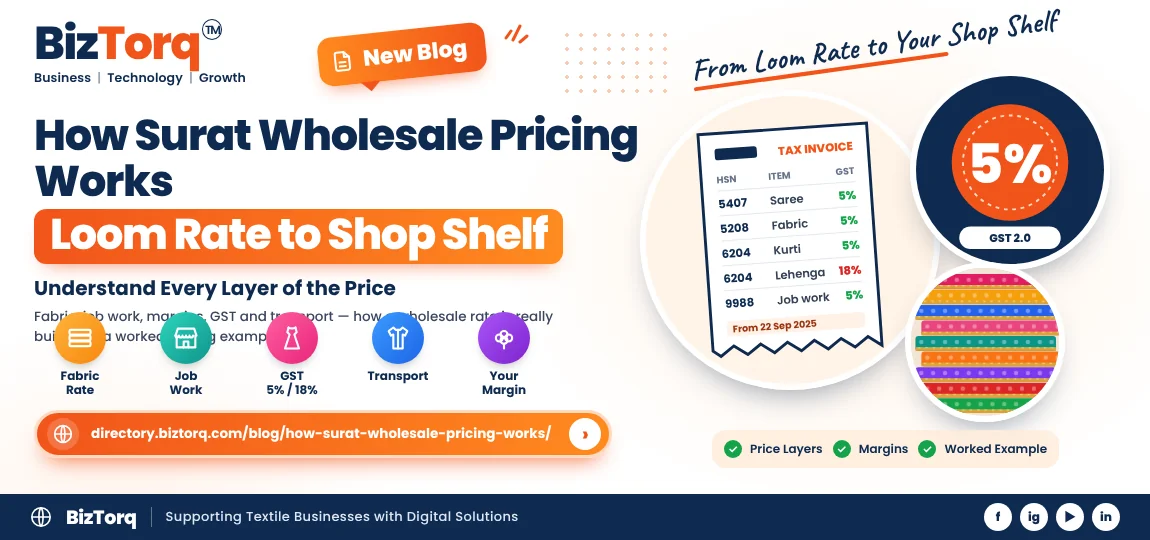
A Surat wholesale price is built in layers: the fabric or grey rate, plus job work (dyeing, printing, embroidery), plus the wholesaler’s margin, plus GST, plus transport and packing. A retailer then adds their own margin on top. The same catalogue can look cheaper or costlier depending on which of these the quoted rate already includes, so always ask a seller: “is GST included, and is this ex-Surat or delivered?”
New buyers often compare two rates from two different sellers and assume one is a better deal, when the real difference is what is included in the number. This guide walks through each layer of a Surat wholesale price, in the order it is actually built, so you can compare quotes properly and work out your own margin before you buy.
The Price Layers, Loom to Shelf
| Layer | What it covers | Who adds it |
|---|---|---|
| 1. Fibre and yarn | Raw polyester, viscose, cotton or silk yarn cost | Yarn supplier |
| 2. Weaving (grey fabric) | Turning yarn into unfinished grey (taka) fabric | Powerloom weaver |
| 3. Processing / job work | Dyeing, printing, finishing; sometimes embroidery or handwork | Processing house or job worker |
| 4. Manufacturer margin | Design, cutting, stitching (for garments), and profit | Manufacturer / brand |
| 5. Wholesaler margin | Stock holding, catalogue curation, credit risk, profit | Wholesaler |
| 6. GST | 5% on fabric/sarees always; garments 5% up to ₹2,500/piece, 18% above | Added on invoice |
| 7. Transport and packing | Freight, hamali (loading), parcel packing | Buyer usually, sometimes seller |
| 8. Retailer margin | Shop rent, staff, display, profit | Retailer (you, if reselling) |
Not every seller quotes at the same layer. A weaver quotes near layer 2, a processing house near layer 3, and a wholesaler’s catalogue rate is usually layers 1–6 combined. Knowing which layer you are buying at explains why rates vary so much between sellers for what looks like the same fabric.
Is the Rate GST-Inclusive or Exclusive?
This is the single most common confusion for new buyers. Always ask directly. If a wholesaler quotes ₹450 per piece and does not say, assume it is exclusive and confirm before ordering — a 5% or 18% difference changes your landed cost meaningfully on a bulk order. See our full GST on textiles guide for which rate applies to your product, including the ₹2,500 garment slab that pushes some kurtis and suits from 5% to 18%.
Ex-Surat vs Delivered Pricing
- Ex-Surat (ex-godown): the price at the seller’s shop or warehouse in Surat. You arrange and pay for transport separately.
- Delivered / door delivery: transport is already included in the quoted rate, usually only for larger orders or regular buyers.
Most catalogue wholesale rates in Surat are ex-Surat. Budget separately for freight using our Transporter Finder, and check typical costs on route pages such as Surat to Delhi or Surat to Kolkata.
How Wholesaler Margins Typically Work
Margins vary widely by product, season and relationship, and Surat wholesalers rarely publish a fixed percentage. As a rough starting point for your own planning, catalogue-based saree and kurti wholesalers commonly work on a margin in the region of 15–30% over their landed cost, with fast-moving fresh designs often priced tighter and slow season or clearance lots priced wider. These are general ranges, not quotes; always negotiate based on quantity, payment terms and repeat business.
Work out your own numbers — cost price, GST, transport per piece, and target margin — with the textile margin calculator. It has presets for sarees, kurtis, dress material, suits, lehengas and fabric, and flags the GST slab trap automatically.
Why Prices Change Through the Year
- Festive season (roughly July–October): demand rises ahead of Navratri, Diwali and wedding season; fresh catalogues launch at a premium.
- Post-festive clearance (November onward): leftover stock and cut pieces are often discounted.
- Market holidays: rates and dispatch can bunch up before long closures. Check the Is Surat Market Open Today tool before planning a buying trip.
- Raw material swings: polyester and viscose yarn prices move with crude oil and global fibre markets, which feeds into fabric rates over weeks, not days.
Common Pricing Terms You’ll Hear
If a rate quote uses words you do not recognise — net rate, lot, cut piece, udhaar — our Surat textile trade glossary explains over 60 of them in plain English.
A Simple Worked Example
| Step | Amount (₹, per piece) |
|---|---|
| Wholesaler catalogue rate (ex-Surat, before GST) | 480 |
| GST at 5% | 24 |
| Transport and packing (approx., bulk order) | 12 |
| Your landed cost | 516 |
| Target margin 25% | 129 |
| Suggested selling price | 645 |
This is illustrative only; your actual rate, GST slab and transport cost will differ by product and route. Recalculate with the margin calculator before quoting a customer.
Frequently Asked Questions
Is Surat wholesale rate inclusive of GST?
It depends on the seller, so always ask. Many catalogue wholesalers quote ex-GST rates and add GST on the invoice; some include it. Confirm before placing a bulk order.
What does ex-Surat pricing mean?
Ex-Surat (or ex-godown) means the price is for goods at the seller’s premises in Surat; you arrange and pay for transport to your location separately.
Why do two sellers quote different rates for similar fabric?
Rates can be quoted at different stages of production (weaver, processor, wholesaler), include different GST and transport treatment, or reflect different fabric GSM, finish quality or design exclusivity, even when the fabric looks similar.
How much margin do Surat wholesalers usually add?
There is no fixed figure; it varies by product, season and relationship. Fresh fast-moving catalogues are often priced tighter, while clearance stock carries wider margins. Negotiate based on your order size and payment terms.
Does the price change before Diwali or wedding season?
Yes. Demand rises ahead of major festive and wedding periods, and fresh catalogues often launch at a premium during that window, with discounts more common in the post-season clearance period.
How do I work out my own selling price?
Add the wholesale rate, applicable GST and your transport and packing cost per piece to get your landed cost, then apply your target margin. The margin calculator does this automatically and checks for the GST slab trap on garments.
Price with Confidence
Calculate your real cost and margin with the Textile Margin Calculator, check the exact GST rate with the GST & HSN finder, and plan dispatch with the Transporter Finder.
Selling online? A BizTorq wholesale website can apply tiered pricing, MOQ rules and GST automatically on every order.