Quick answer
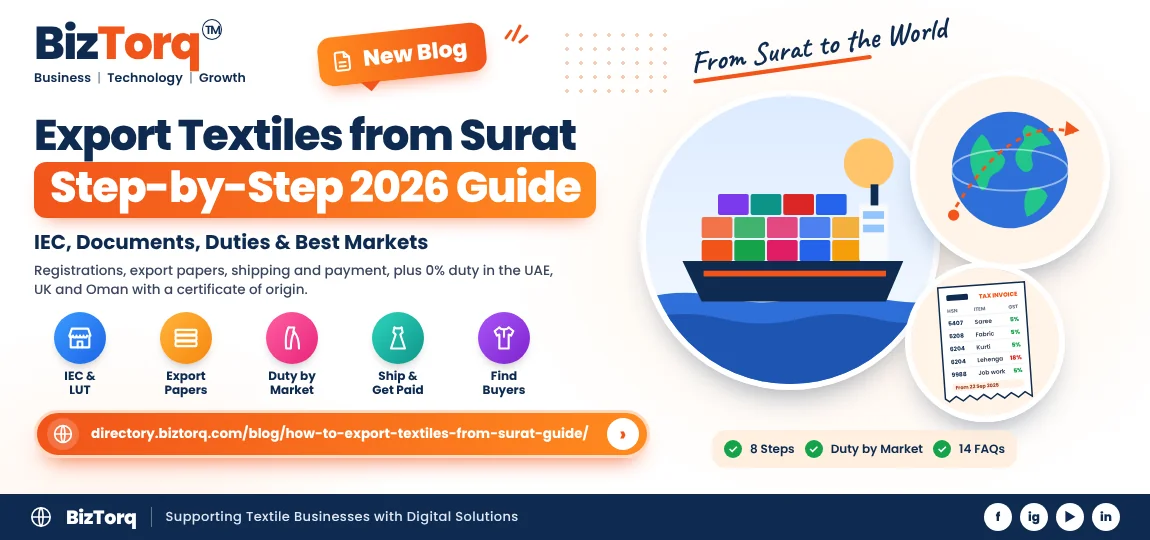
To export textiles from Surat, get an Import Export Code (IEC) from DGFT, keep GST active and file a Letter of Undertaking (LUT) to export without paying IGST, register your bank’s AD code at the port, and join the right export council (usually SRTEPC for man-made fibre fabric and sarees, or AEPC for garments). Then agree terms with a buyer, prepare the invoice, packing list and certificate of origin, ship by sea, air or courier, and receive payment through your bank. A preferential certificate of origin can bring your buyer’s import duty to 0% in the UAE, UK and Oman.
Surat already supplies sarees, dress materials and man-made fibre fabric to buyers worldwide, often through Mumbai traders. Selling directly abroad gives a Surat business better margins and its own overseas customers. This guide walks through the registrations, documents, shipping and payment steps, explains what duty your buyer pays in the main markets, and links to free BizTorq tools for each step.
Contents
- 8 steps to start exporting
- Registrations: IEC, GST and LUT, AD code, RCMC
- Export documents checklist
- What your buyer pays: duty by market
- Shipping options and ports
- Getting paid safely
- Choosing your first export market
- Finding overseas buyers
- FAQs
8 Steps to Start Exporting from Surat
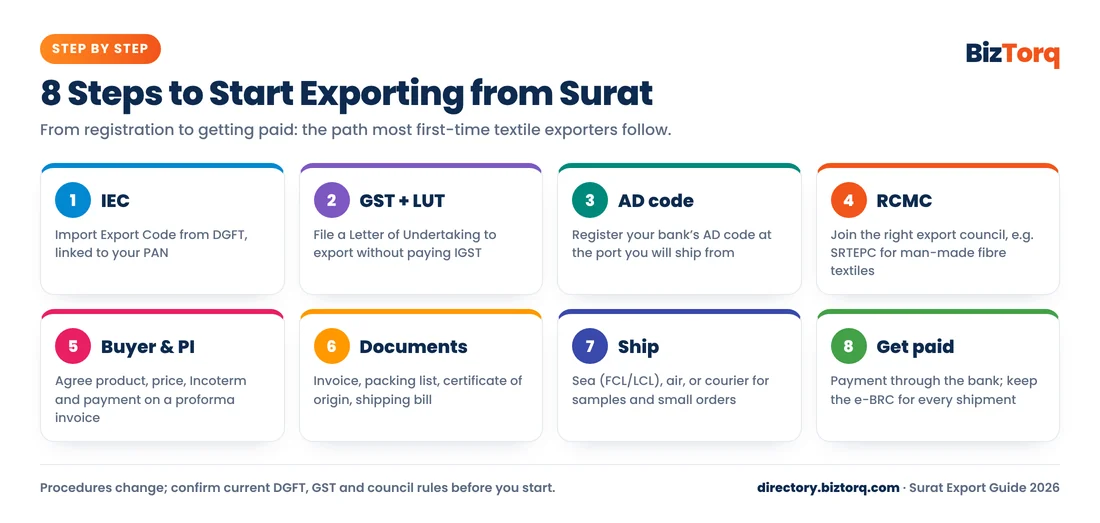
Registrations: IEC, GST and LUT, AD Code, RCMC
| Registration | What it is | Where |
|---|---|---|
| IEC | 10-character Import Export Code linked to your PAN | DGFT portal, online |
| GST and LUT | Letter of Undertaking to export without paying IGST | GST portal, renewed every financial year |
| AD code | Your bank’s Authorised Dealer code, registered at the export port | Your bank, then customs (ICEGATE) |
| RCMC | Registration-cum-Membership Certificate from an export council | SRTEPC for man-made fibre textiles; AEPC for garments |
Exports are zero-rated for GST. Most small exporters file an LUT and export without paying IGST; the alternative is to pay IGST and claim a refund. Make sure every export invoice carries the right HSN code; check yours in the GST & HSN finder, and see GST on textiles for domestic rates.
Export incentive schemes such as RoDTEP and RoSCTL change from time to time. Ask your export council or CA which applies to your product before you price an order.
Export Documents Checklist
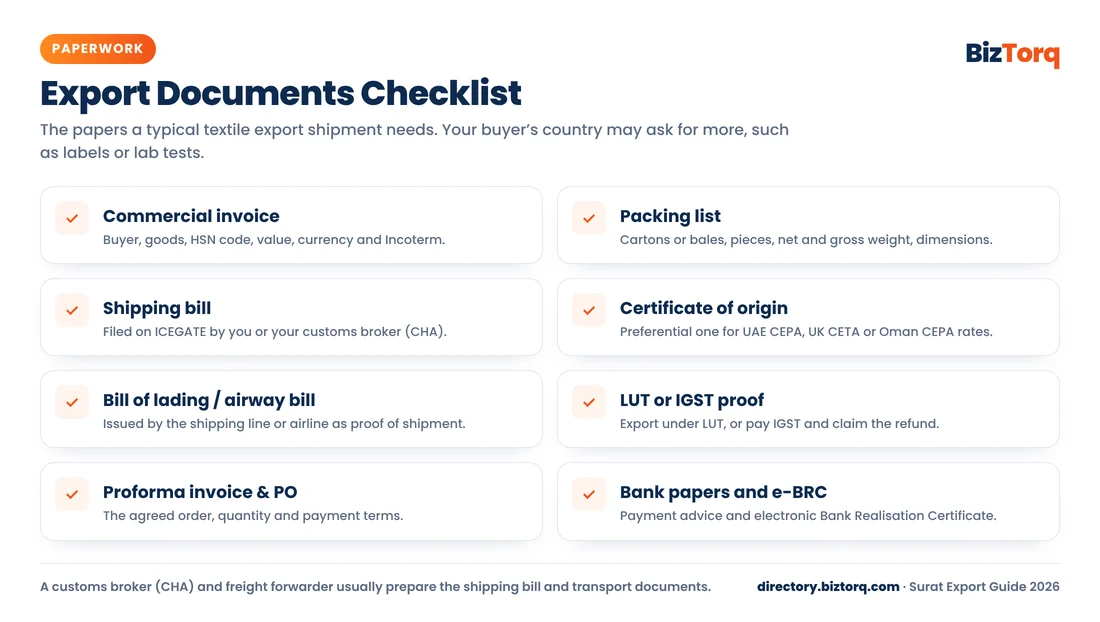
A customs broker (CHA) usually files the shipping bill on ICEGATE, and a freight forwarder books space and issues or collects the bill of lading. Your buyer’s country may also ask for care labels, fibre content, country-of-origin marking or test reports; each country guide covers these. If any trade terms are unfamiliar, see our trade glossary.
What Your Buyer Pays: Duty by Market
Your price is only half the story. A buyer compares your price plus their import duty and tax against other suppliers, so knowing their landed cost helps you win the order.
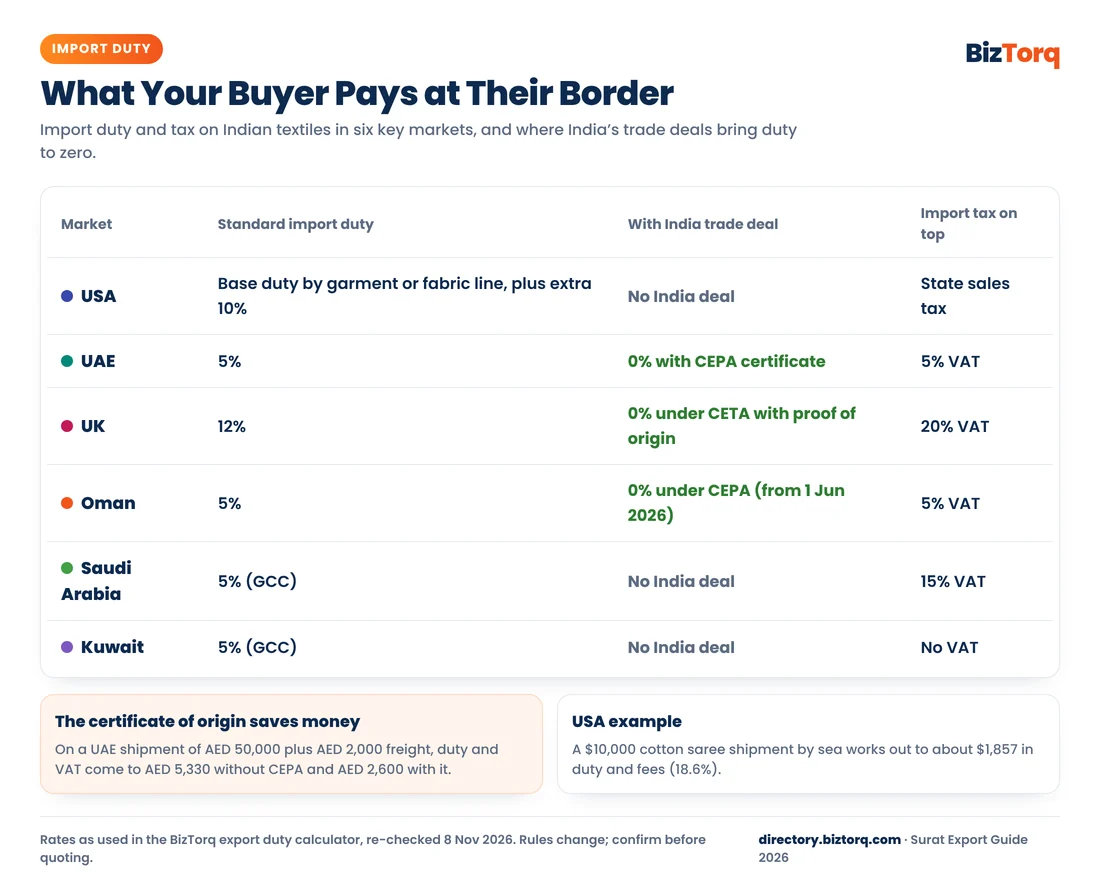
| Market | Standard duty | With India trade deal | Import tax |
|---|---|---|---|
| USA | Base rate for the tariff line, plus an extra 10% | No deal | State sales tax |
| UAE | 5% | 0% with CEPA certificate of origin | 5% VAT |
| UK | 12% | 0% under CETA with proof of origin | 20% VAT |
| Oman | 5% | 0% under CEPA (in force 1 June 2026) | 5% VAT |
| Saudi Arabia | 5% (GCC) | No deal | 15% VAT |
| Kuwait | 5% (GCC) | No deal | No VAT |
Two worked examples
- UAE: on goods worth AED 50,000 plus AED 2,000 freight, duty and VAT come to AED 5,330 without a CEPA certificate and AED 2,600 with one. The certificate alone saves the buyer AED 2,730.
- USA: a $10,000 cotton saree shipment by sea works out to about $1,857 in duty and fees, or 18.6% of the value.
Run your own numbers in the free export duty calculator for the USA, UAE, UK, Saudi Arabia, Kuwait and Oman. US tariff rules changed several times in 2026, so re-check before quoting a large order.
Shipping Options and Ports
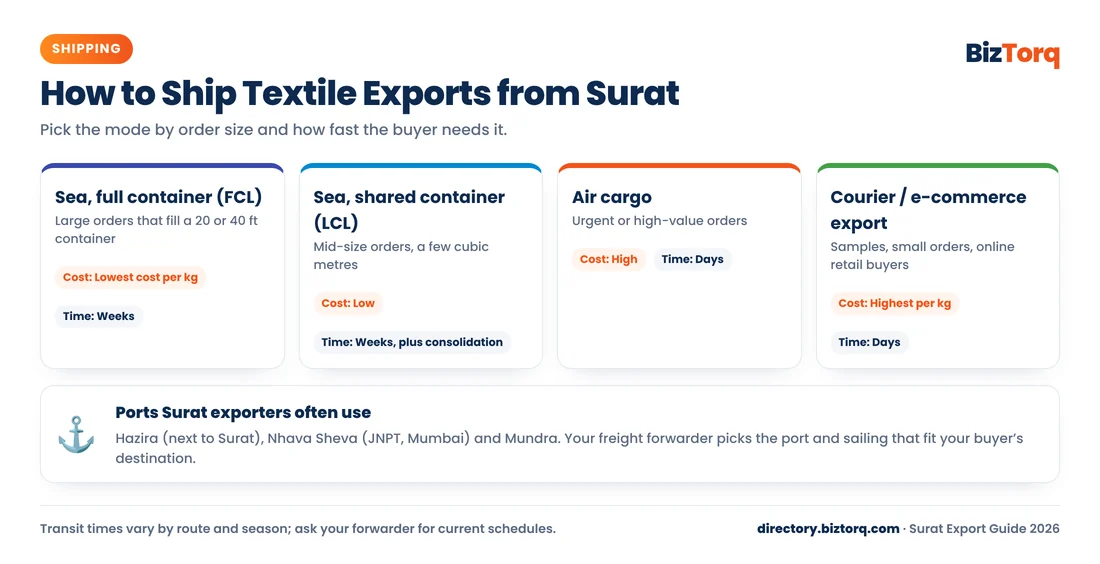
- Sea, full container (FCL): cheapest per kg for large orders; the norm for regular wholesale buyers.
- Sea, shared container (LCL): for mid-size orders; your goods share a container with others.
- Air cargo: for urgent or high-value orders such as bridal and festive collections.
- Courier or e-commerce export: for samples and small orders to boutiques and online sellers.
Agree the Incoterm (for example FOB, CIF or DAP) on the proforma invoice so both sides know who pays freight and insurance. For getting goods from your shop to the port or to a forwarder in Mumbai, use the Transporter Finder, such as Surat to Mumbai.
Getting Paid Safely
| Method | How it works | Risk for you |
|---|---|---|
| Advance payment | Buyer pays by bank transfer before dispatch | Lowest; common with new buyers |
| Part advance | For example 30–50% before, balance against documents | Low to medium |
| Letter of credit (LC) | Buyer’s bank promises payment when your documents match | Low, but paperwork must be exact |
| Documents against payment | Bank releases shipping documents only when the buyer pays | Medium |
| Open credit | Buyer pays after receiving goods | Highest; only for trusted buyers |
Receive every export payment through your bank and keep the e-BRC (electronic Bank Realisation Certificate) for each shipment; you need it for GST refunds and export benefits. Domestic credit habits do not carry over abroad, so read the risks in credit and payment terms with an export eye.
Choosing Your First Export Market
Start where you already have contacts or where Indian diaspora shops buy regularly. BizTorq’s country guides list where those shops are, what they sell, and import rules:
- USA: Indian ethnic wear markets in Edison, New York, Chicago, Artesia, Houston, Dallas and the Bay Area.
- UAE: Dubai, Sharjah and Abu Dhabi, with 0% duty under CEPA.
- UK: Leicester’s Golden Mile, Southall, Ealing Road and Birmingham’s Soho Road, with 0% duty under CETA.
- Saudi Arabia, Kuwait and Oman: Gulf markets in Riyadh, Jeddah, Kuwait City and Muscat.
- Canada and Australia: Toronto, Vancouver, Sydney and Melbourne.
A market with a trade deal (UAE, UK, Oman) gives your buyer a duty advantage straight away, which makes it an easier first step for many Surat exporters.
Finding Overseas Buyers
- Trade fairs and council meets: export councils run buyer-seller meets and overseas fair pavilions.
- Diaspora retailers: boutiques in the markets above already stock Surat products, often through middlemen.
- B2B portals: useful for leads; qualify each enquiry and verify the buyer.
- An export-ready website: overseas buyers want specs, MOQ, prices in their currency, payment terms and shipping options in one place. Overseas buyers also follow our guide to importing from Surat, so make sure your shop is listed and your designs are in the wholesale catalog.
Check how ready your business is with the free online readiness check, and see how to take a Surat textile business online.
Price for Export, Not for the Local Market
Export pricing should cover packing to export standard, inland freight to the port, forwarder and broker charges, bank charges and a margin for currency movement. Start from your cost price in the margin calculator, then add these export costs before you convert to the buyer’s currency. Product guides that help you choose export lines: sarees, dress materials, Pakistani-style suits and co-ord sets.
Frequently Asked Questions
How do I start exporting textiles from Surat?
Get an Import Export Code (IEC) from DGFT, keep your GST registration active and file a Letter of Undertaking (LUT), register your bank’s AD code at the port, join the relevant export promotion council, then find a buyer and agree terms on a proforma invoice. A customs broker and freight forwarder handle the shipping bill and transport.
What is an IEC and do I need one to export?
An Import Export Code is a 10-character code issued by DGFT and linked to your PAN. It is required for most commercial exports and imports from India. You apply online on the DGFT portal.
Do I have to pay GST on textile exports?
Exports are zero-rated. You can export without paying IGST by filing a Letter of Undertaking (LUT) on the GST portal, or pay IGST and claim a refund. Most small exporters use the LUT route.
Which export council should a Surat textile exporter join?
Man-made fibre fabrics and sarees usually fall under SRTEPC (Synthetic and Rayon Textiles Export Promotion Council). Readymade garment exporters usually join AEPC (Apparel Export Promotion Council). Membership gives you an RCMC, which you need for some export benefits.
What documents are needed to export textiles?
Usually a commercial invoice, packing list, shipping bill, bill of lading or airway bill, certificate of origin, LUT or IGST proof, and bank papers. Your buyer’s country may also need labels, fibre content or test reports.
What import duty does my buyer pay in the UAE?
Usually 5% customs duty plus 5% VAT. With a CEPA certificate of origin from India, the duty can be 0%. Work it out in the export duty calculator.
What duty applies to Indian textiles in the UK?
Our calculator uses 12% standard duty and 0% under the India-UK trade agreement (CETA) when the shipment has valid proof of origin, plus 20% import VAT. See the UK export guide.
How much duty does a US buyer pay on Indian textiles?
It depends on the exact tariff line for the garment or fabric, plus an extra 10% tariff and US customs fees, as applied in our calculator in November 2026. A $10,000 cotton saree shipment by sea works out to about $1,857 (18.6%). US rules changed often in 2026, so check the USA export guide.
What is a certificate of origin and why does it matter?
It proves the goods were made in India. A preferential certificate under a trade deal such as UAE CEPA, UK CETA or Oman CEPA lets your buyer claim lower or zero duty, which can make your price far more competitive.
How should a new exporter take payment?
Many start with advance payment by bank transfer for new buyers. Larger buyers may use a letter of credit or documents against payment through banks. Always receive export payments through your bank so you get the e-BRC.
Can I export small textile orders by courier?
Yes. Samples and small orders often go by courier or as e-commerce exports, which is faster but costs more per kg. Ask the courier about export paperwork for commercial shipments.
Which port do Surat exporters use?
Many use Hazira, near Surat, as well as Nhava Sheva (JNPT) in Mumbai and Mundra. Your freight forwarder chooses based on the destination and sailing schedules.
Which countries buy the most Indian textiles?
The USA, UAE, UK and Gulf countries are major buyers of Indian textiles and ethnic wear, along with markets with large Indian communities such as Canada and Australia. See BizTorq’s country guides for where buyers are and what they sell.
How can a Surat exporter find overseas buyers?
Trade fairs, export council buyer-seller meets, B2B portals and an export-ready website. Overseas buyers want clear specs, MOQ, prices in their currency and proof of quality, which a website shows better than WhatsApp alone.
Start Exporting from Surat
Work out your buyer’s duty in the export duty calculator, read the USA, UAE and UK export guides, and check HSN codes in the GST & HSN finder.
Want overseas buyers to find you? BizTorq builds export-ready wholesale websites with multi-currency prices, MOQ, catalogue selling and WhatsApp enquiries.
This guide is for general information. Export procedures, duty rates and incentive schemes change; confirm details with DGFT, your export council, customs broker and CA before shipping. Duty figures are as used in the BizTorq export duty calculator, re-checked 8 November 2026.