Quick answer
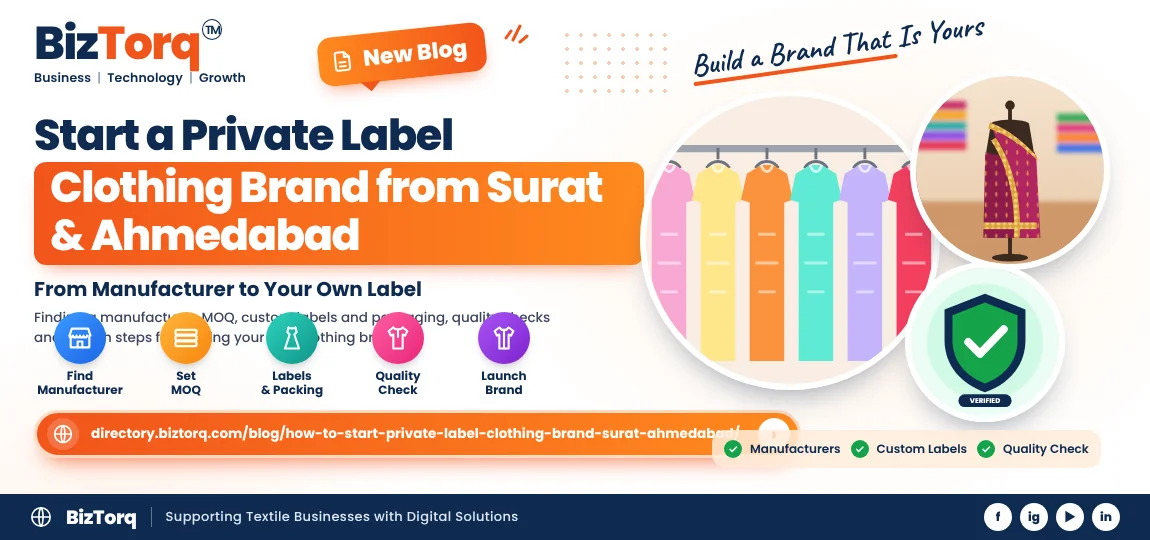
Launching a private-label ethnic or western apparel brand using Surat and Ahmedabad manufacturers follows two pathways: White-Label Relabeling (MOQ: 50–100 pieces per design, 7–10 days turnaround, attaching your custom woven neck labels and hangtags to open-stock manufacturer lots) or Full Custom OEM Cut-and-Sew (MOQ: 200–500 pieces per style, 25–40 days, based on your custom tech packs, custom mill dyeing, and exclusive grading). Ahmedabad specializes in pure 60x60 cotton kurtis, loungewear, and denims; Surat dominates rayon, festive Chinon, organza, digital printing, and computerized multi-head embroidery.
Selling wholesale catalogue boxes from open-market aggregators is great for retail footfall, but it forces you to compete directly with hundreds of local shops and Meesho resellers selling the identical product. The real long-term retail margin and customer loyalty lie in building your own Private-Label Clothing Brand—where designs carry your own woven labels, bespoke size charts, custom tags, and branded packaging.
Gujarat is India’s apparel engine: spinning yarn in Palsana, weaving greige cloth in Surat Ring Road powerlooms, dyeing in Narol and Pandesara process houses, and stitching finished garments across high-tech parks in Ahmedabad Raipur and Saroli. This step-by-step field manual explains how modern D2C brands, boutique founders, and export curators manufacture custom apparel across Gujarat.
White-Label Relabeling vs. Custom OEM Manufacturing
Before contacting garment units, decide which production model matches your working capital:
| Feature | White-Label Relabeling (Option A) | Full Custom OEM Cut-and-Sew (Option B) |
|---|---|---|
| Minimum Order Quantity (MOQ) | 50 to 100 pieces per design (across 4 sizes: M–XXL) | 200 to 500+ pieces per design (custom dye-lot minimum) |
| Development Investment | ₹25,000 to ₹60,000 | ₹1.5 Lakh to ₹5 Lakh+ per production collection |
| Production Lead Time | 7 to 10 Days | 25 to 45 Days (including fabric sourcing & sampling) |
| Design Exclusivity | Semi-exclusive (supplier’s base cut, your branding) | 100% Exclusive (your custom tech pack, cut, and prints) |
| Best Sourcing Hubs | Sumel Parks (Ahmedabad) & Millennium Market (Surat) | Odhav GIDC (Ahmedabad) & Saroli Garment Parks (Surat) |
Beginner Strategy: Start with White-Label Relabeling for your first 3 collections to test product-market fit and regional sizing preferences. Once steady repeat demand hits 300+ units monthly, transition that proven silhouette into Custom OEM cut-and-sew.
Ahmedabad vs. Surat: Which City Fits Your Apparel Line?
- Ahmedabad (The Natural Fiber & Casual Wear Capital): The undisputed center for pure 60x60 Cambric cotton kurtis, yarn-dyed stripes, Jaipuri-style rotary block prints, linen co-ord sets, office tunics, and stretch denim jeans. Concentrated around modern manufacturing hubs like Safal 1, Safal 2, and the Sumel Business Parks (1 to 11).
- Surat (The Synthetic, Fancy & Festive Wear Capital): The global hub for 14kg and 16kg Liva-certified Rayon, Chinon Anarkalis, digital floral organza, foil-print festive sets, sequins/zari neck embroideries, and heavy partywear gowns. Concentrated across Saroli New Textile Hub and specialized job-work parks in Katargam and Anjani.
The 6-Step Private Label Production Roadmap
Step 1: Build a Realistic Tech Pack
Garment factories do not work off screenshots from Pinterest. Provide a standardized tech pack containing:
- Flat Technical Sketch: Front and back CAD drawings indicating neckline drop, sleeve style, and slit length.
- Graded Measurement Sheet: Chest, waist, hip, garment length, shoulder width, and sleeve opening for standard sizes: 38 (M), 40 (L), 42 (XL), and 44 (XXL).
- Fabric Construction Specs: Specify yarn count and density (e.g., "100% Cotton 60x60 Cambric, 85 GSM, Reactive Print") rather than just "cotton". Use our Fabric Quality Inspection Guide to set quality control limits.
Step 2: Source Bulk Trim & Branding Assets
Garment factories charge high markups if they supply labels and packaging. Sourcing branding assets directly saves 40% on packaging overhead:
- Woven Damask Neck Labels: Order in minimum lots of 3,000 to 5,000 pcs (approx. ₹0.80 to ₹1.50 per label) from specialized label weavers in Surat or Ahmedabad.
- Wash-Care & Size Tabs: Satin or taffeta printed labels detailing wash symbols, fabric composition, and mandatory country-of-origin.
- Custom Hangtags & Packaging: Rigid 350 GSM paper tags with eyelets, paired with branded frosted ziplock EVA/PVC polybags.
Step 3: Sample Approval (The Counter Sample)
Never approve bulk production without inspecting a physical fit sample (Size L / 40). Expect to pay 2x to 3x the unit rate for a single sample piece (reputable factories deduct this sample charge from your bulk invoice). Check sleeve mobility, inner interlock stitching, and verify that at least 1.5 inches of side-seam alteration margin is left inside.
Step 4: Costing & Landed Margin Calculation
A typical factory costing for a 3-piece pure cotton kurti set (Kurti, Pant, Dupatta) in Ahmedabad:
| Cost Head | Meterage / Consumption | Unit Cost (₹) |
|---|---|---|
| Kurti Fabric (60x60 Cotton, 44" panna) | 2.10 Metres @ ₹75/m | 157.50 |
| Bottom Fabric (Cotton Solid) | 2.00 Metres @ ₹65/m | 130.00 |
| Dupatta (Pure Cotton Malmal) | 2.25 Metres finished | 85.00 |
| Stitching, Interlock & Finishing Labor | Cutting + tailoring + thread trim | 90.00 |
| Trims (Buttons, elastic, neck lace, brand labels) | Complete pack | 22.00 |
| Ironing, Tagging & Polybag Packing | Steam press + branded bag | 15.00 |
| Total Factory Production Cost | Ex-Factory (Surat / Ahmedabad) | ₹499.50 |
Add 5% GST (since unit cost is under ₹2,500) and road transport (₹12/piece) to get a true landed cost of ₹536. In your boutique or D2C store, this set commands a retail price of ₹1,199 to ₹1,499 (a healthy 55% to 64% gross margin!). Model your custom production batch using the Kurti Margin Calculator.
Step 5: Production Monitoring & AQL Quality Checks
During bulk stitching, perform or commission an AQL 2.5 (Acceptable Quality Limit) inline inspection before goods are packed into bales:
- Check measurement tolerances: finished garments should not deviate more than ±0.5 inches from the approved spec sheet.
- Verify bar-tacking on stress points: pocket corners, pant crotches, and side slit top corners.
- Ensure loose threads are cleanly trimmed and iron scorch marks are absent.
Step 6: Invoicing, Tax & Parcel Dispatch
Always demand a Pakka GST Tax Invoice listing the correct HSN classification code (HSN 6204 for woven women’s ethnic sets). Verify current rates on our Textile GST & HSN Finder. Consignments exceeding ₹50,000 require an electronic E-Way Bill. Book compressed moisture-proof bales with established parcel carriers via the Transporter Finder.
Frequently Asked Questions
What is the minimum budget required to start a private-label clothing brand in India?
You can start via white-label relabeling with a budget of ₹40,000 to ₹75,000, which covers 80 to 120 finished garments across 3 to 4 design lines, custom woven labels, and branded polybags. Full custom OEM manufacturing requires ₹1.5 Lakh to ₹3 Lakh to meet minimum dye-lot fabric requirements.
Can I put my own brand label on clothes bought from Surat or Ahmedabad wholesalers?
Yes. Many large garment manufacturers in Ahmedabad’s Sumel and Safal parks and Surat’s Saroli hub supply unbranded ready stock or provide in-house stitching services to attach your custom woven neck labels and hangtags prior to final packing.
What is the difference between HSN 6204 and HSN 5208 in clothing manufacture?
HSN 5208 applies to unstitched cotton fabrics (billed at a flat 5% GST), whereas HSN 6204 applies to finished woven readymade garments like stitched kurtis, suits, and dresses (taxed at 5% if billed up to ₹2,500/piece, and 18% above ₹2,500).
How do garment factories in India charge for sample pieces?
Factories typically charge 2x to 3x the estimated production price for an initial counter sample because patterns and cutting markers must be made manually. Most reputable manufacturers adjust the sampling fee against your account balance once you place the bulk production order.
How can an overseas NRI brand manufacture private-label ethnic wear in Gujarat?
Overseas boutique owners share digital tech packs on WhatsApp, approve physical fit samples sent via international courier (DHL/FedEx in 4–6 days), make payments via bank wire transfer (SWIFT) under Letter of Undertaking (LUT) zero-rated export procedures, and receive bulk consignments via sea freight or express air cargo.
Connect with Verified Apparel Manufacturers
Browse verified garment manufacturers and fabric mills across Ahmedabad textile business parks and Surat manufacturing clusters, verify freight carriers using the Transporter Finder, and model your garment production margins with the Textile Margin Calculator.
Are you an apparel manufacturer offering OEM stitching? List your garment factory for free on the BizTorq Directory, or let BizTorq build your custom B2B wholesale portal with private buyer logins, size-ratio ordering, and automated export inquiry routing.