Quick answer
To sell Indian ethnic wear in the UAE, start with the shops in Meena Bazaar and Karama in Dubai, Rolla in Sharjah and Hamdan Street in Abu Dhabi, and plan stock around Ramadan and Eid (Ramadan is expected around 8 February 2027 and Eid al-Fitr around 9 or 10 March), Diwali and Navratri, and the winter wedding season. Indian-made textiles and garments enter at 0% duty under the India-UAE CEPA if the shipment carries a CEPA Certificate of Origin; without it, duty is 5%. The UAE adds 5% VAT on import. Since the Strait of Hormuz disruption of 2026, sea cargo for Dubai is often landed at Khor Fakkan or Fujairah and trucked in, so plan for longer transit and land festive stock 8 to 10 weeks early.
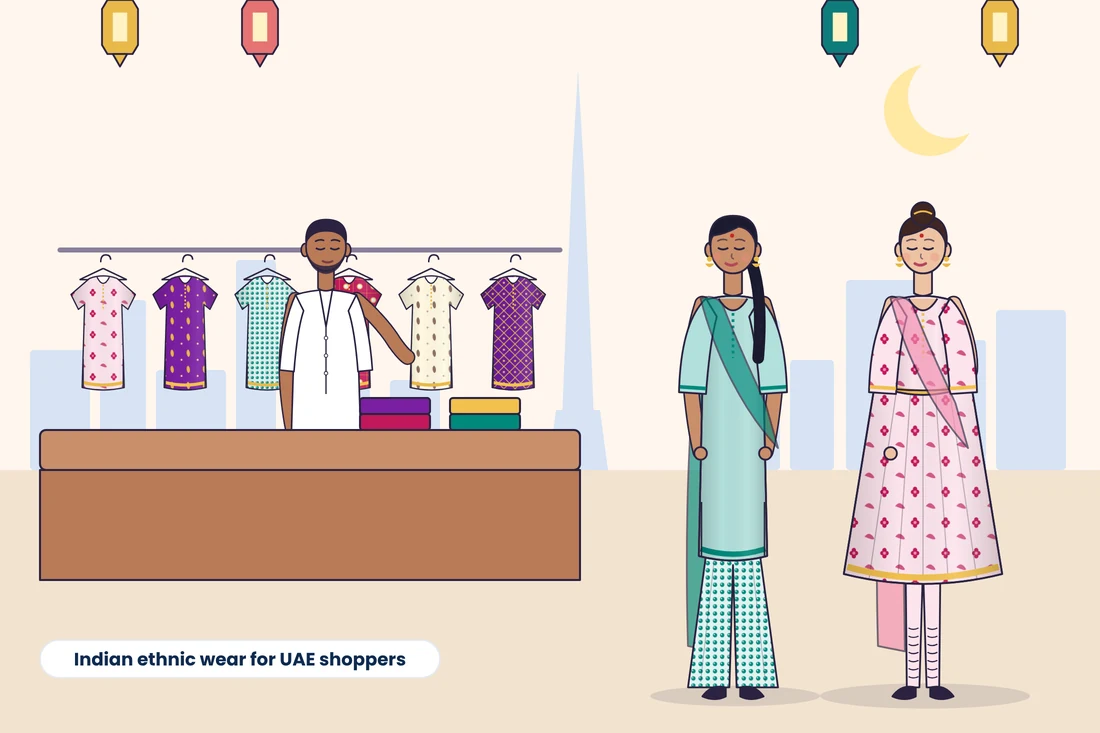
The UAE is one of the largest buyers of Indian clothing. In figures the Apparel Export Promotion Council quoted in 2022, India supplied $1,515 million of the UAE's $3,517 million apparel imports, a 43% share. A June 2026 market report valued the UAE ethnic wear market at about USD 804 million in 2026, with Arabic ethnic wear the largest segment and women buying about 62% of it (MarkNtel Advisors). Dubai also works as a trading hub, so stock that lands there can reach shops in Saudi Arabia, Oman and Kuwait.
For a Surat or Ahmedabad wholesaler this is close, familiar trade: the same sarees, suits, lehengas and kurtis, sold to Indian, Pakistani and Bangladeshi families and to Arab shoppers buying for Eid. This guide covers who buys, what sells and when, duty and VAT, labels, shipping in 2026-27, pricing, payment and how to find your first UAE buyer.
Contents
- Who buys Indian ethnic wear in the UAE
- Where UAE shops are
- UAE selling calendar 2027
- What sells
- Duty, CEPA and VAT
- Labels and the UAE textile scheme
- Shipping from India in 2026-27
- Landed cost and pricing
- Payment terms
- How to find UAE buyers
- Your first UAE order, step by step
- FAQs
Who Buys Indian Ethnic Wear in the UAE
| Buyer | What they want | How they buy |
|---|---|---|
| Ethnic wear shops in the old souks | Sarees, suits, lehengas, kurtis in mid-range prices | Repeat orders, catalogue sets, credit after trust is built |
| Boutiques and designer stores | Festive and bridal pieces, better finish, exclusive designs | Smaller lots, samples first, sometimes private label |
| Tailors and fabric shops | Unstitched dress material, fabric by the metre | Rolls and thaans, colour ranges |
| Online sellers and Instagram boutiques | Trend pieces, ready stock, good photos | Small, frequent orders; often air freight |
| Traders who re-export in the Gulf | Volume lines, stable quality | Containers, longer credit |
Where UAE Shops Are
| Market | City | Known for |
|---|---|---|
| Meena Bazaar (Al Fahidi Street) | Bur Dubai | Sarees, lehengas, salwar suits, fabric and tailors |
| Dubai Textile Souk | Bur Dubai, by the creek | Fabric and Indian and Pakistani clothes |
| Karama Market | Karama | Affordable everyday clothing and fabric |
| Rolla Cloth Market and Souq Al Ghuwair | Sharjah | Fabric, ready-made clothes, abayas; busy before Eid |
| Hamdan Street and Madinat Zayed | Abu Dhabi | Fabric, tailoring and Indian ethnic wear |
For addresses, metro stops and what each market sells, see the Dubai textile markets page and the full UAE export guide. Visiting these lanes, or asking a buyer to send a video of their shelves, shows you the price points and styles that move.
UAE Selling Calendar 2027
| Season | About when (2027) | Stock landed in UAE by |
|---|---|---|
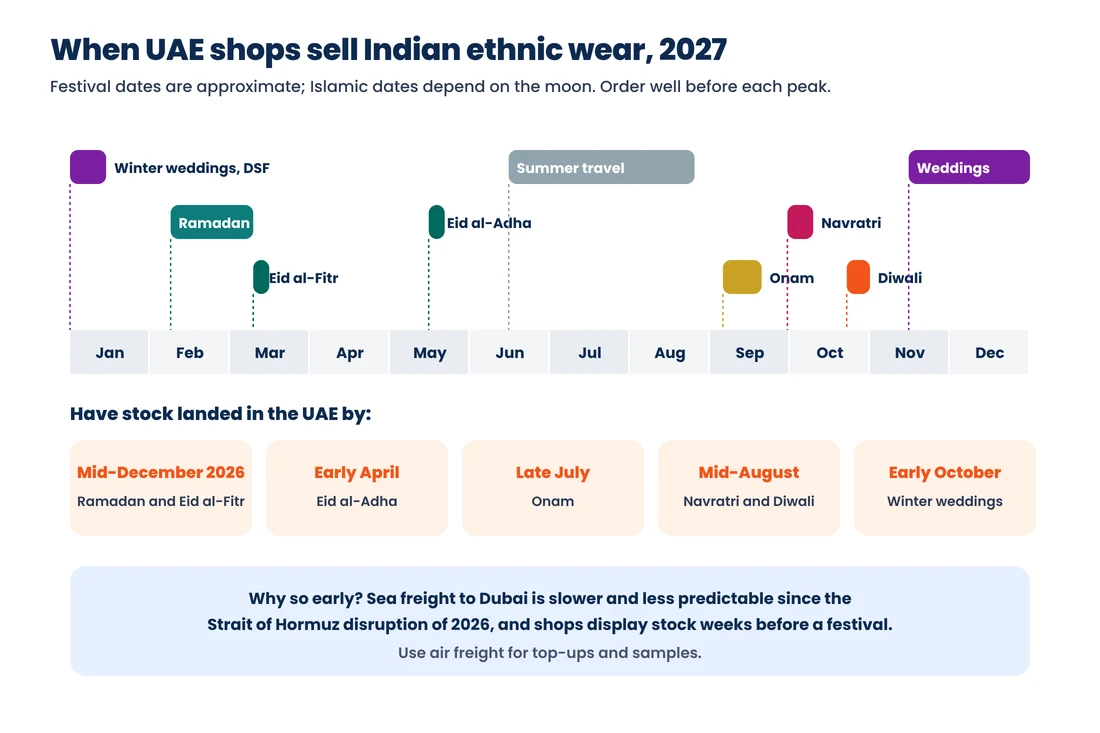
| Ramadan and Eid al-Fitr | Ramadan from about 8 Feb; Eid about 9 or 10 Mar | Mid-December 2026 |
| Eid al-Adha | About mid-May | Early April |
| Summer | June to August; many families travel home | Keep stock light |
| Onam | August or September | Late July |
| Navratri and Diwali | Navratri from 30 Sep; Diwali 29 Oct | Mid-August |
| Winter weddings and Dubai Shopping Festival | November to January | Early October |
Shops put festive stock on display weeks before the festival, and shipping now takes longer than it used to, so these dates are earlier than many Indian sellers expect. For India-side wedding dates, see our wedding season 2026-27 stock calendar.
What Sells
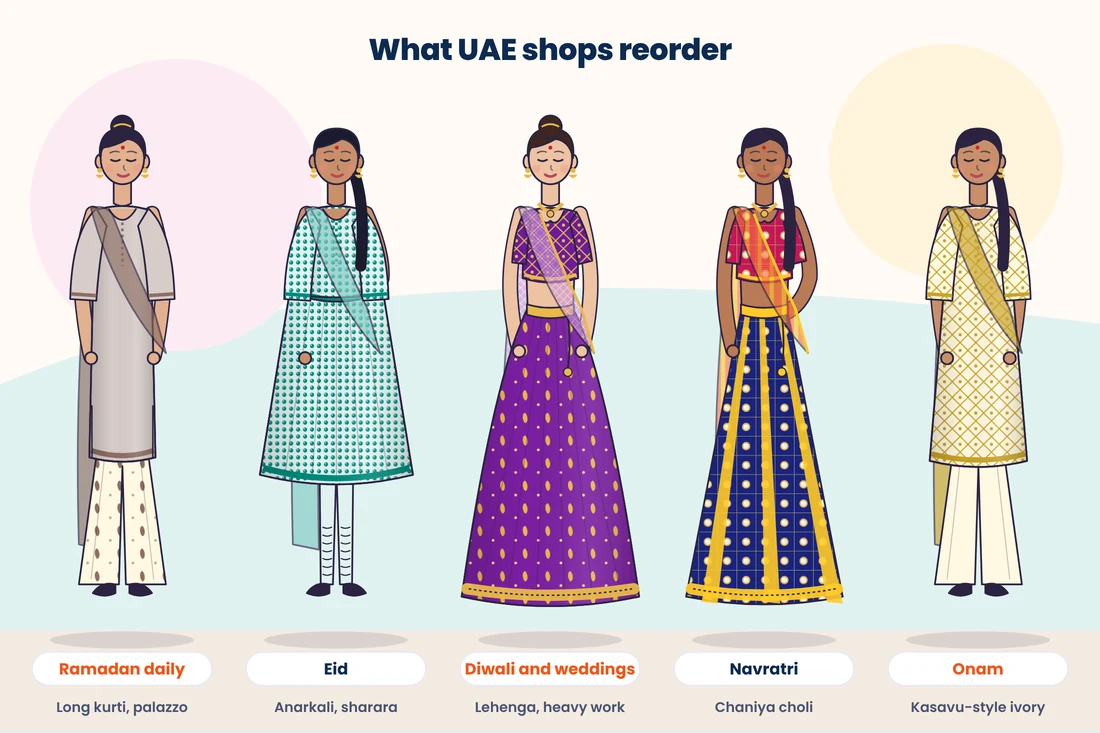
- Ramadan and Eid: long and full-length kurtis, kurti and palazzo sets, Anarkalis, sharara and gharara sets, Pakistani-style suits and embroidered dupattas. Modest cuts, longer lengths and sleeve options matter. Browse readymade suits and co-ord sets.
- Diwali, weddings and receptions: lehenga cholis, designer and silk-look sarees, gown-style suits. Read the lehenga choli guide.
- Navratri: chaniya cholis and mirror-work sets for Gujarati and other community events.
- Onam: ivory and gold kasavu-style sarees and sets. Traditional kasavu comes from Kerala, not Surat, so source it there or sell clearly labelled kasavu-style pieces.
- All year: cotton and rayon kurtis, co-ord sets (see the co-ord sets guide) and dress materials for tailors. The Ahmedabad kurti guide covers cotton daily wear.
Two points matter more in the UAE than at home. The climate is hot most of the year, so light, breathable fabrics sell outside the winter months. And buyers expect a cleaner finish, consistent sizing and good packing, because they compare Indian stock with Pakistani, Turkish and Chinese goods on the same street.
Duty, CEPA and VAT
| Item | What applies (checked November 2026) |
|---|---|
| Normal UAE duty | 5% on most textiles and garments |
| India-UAE CEPA | 0% on Indian-origin goods that meet the rules of origin, in force since 1 May 2022 |
| Proof needed | CEPA Certificate of Origin from a DGFT-authorised agency, such as AEPC, TEXPROCIL, FIEO or a designated chamber |
| UAE VAT | 5% on customs value plus duty, normally paid by the importer; VAT-registered buyers can usually recover it |
| Indian GST on exports | Exports are zero-rated; most exporters file a Letter of Undertaking (LUT) to ship without paying IGST |
| Exporter code | An Importer Exporter Code (IEC) from DGFT |
Apply for the CEPA certificate before the goods leave; one guide advises at least 5 working days. Without it the buyer pays 5% duty, which is a real cost, while VAT is usually recovered by a registered buyer. Estimate the numbers for your shipment with the export duty calculator, and confirm your HS code and GST treatment with your CA or customs broker.
Labels and the UAE Textile Scheme
The UAE's Cabinet Resolution on the control of textile products covers ready-to-wear clothing, fabrics and home textiles. In short:
- Label content: garment type, fibre content, size, maker or brand, care instructions and country of origin, in Arabic or in Arabic and English.
- Registration: the resolution text refers to registration under the Emirates Conformity Assessment Scheme (ECAS) and the Emirates Conformity Mark. Agree with your buyer who handles this before you ship.
- Chemical limits: keep dye and finish test reports from your mill.
- Consistency: fibre content, quantities and values must match on the invoice, packing list and label.
Print bilingual labels in the production run; relabelling at the port costs time and storage. The regulator's current text decides, so check with your buyer or the Ministry of Industry and Advanced Technology (MoIAT).
Shipping from India in 2026-27
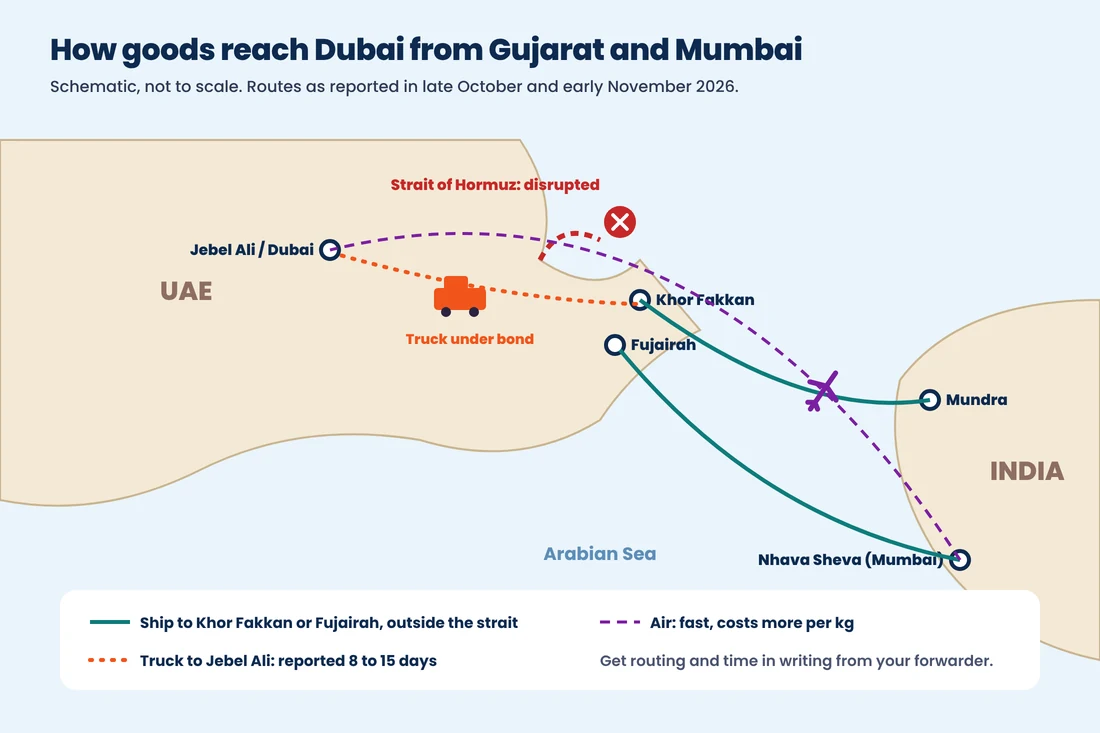
In normal times a container from Mundra or Nhava Sheva reached Jebel Ali in about 5 to 7 days. That changed in 2026:
- The Strait of Hormuz has been effectively closed to commercial container ships since the regional escalation of 28 February 2026, and Jebel Ali sits inside it.
- Cargo is landed outside the strait at Khor Fakkan or Fujairah and trucked to Jebel Ali under bond. A carrier source told S&P Global the inland move was taking 8 to 10 days, and bonded transfers were reported at 12 to 15 days in early November 2026.
- Freight is expensive: S&P Global assessed West Coast India to Middle East spot rates at $5,500 per 40-foot container on 28 October 2026, a five-year high and roughly 1,900% above late February (S&P Global).
- Ports outside the strait are congested, with waits and surcharges reported at Khor Fakkan and Fujairah (Tradlinx).
- Air cargo to Dubai is fast and suits samples, Eid top-ups and high-value bridal pieces, but costs more per kilo.
The situation can change quickly, in either direction. Ask your forwarder for the routing, transit time and total cost in writing before you quote a delivery date, and agree the Incoterm (FOB, CIF or delivered) so both sides know who carries the surcharges.
Landed Cost and Pricing
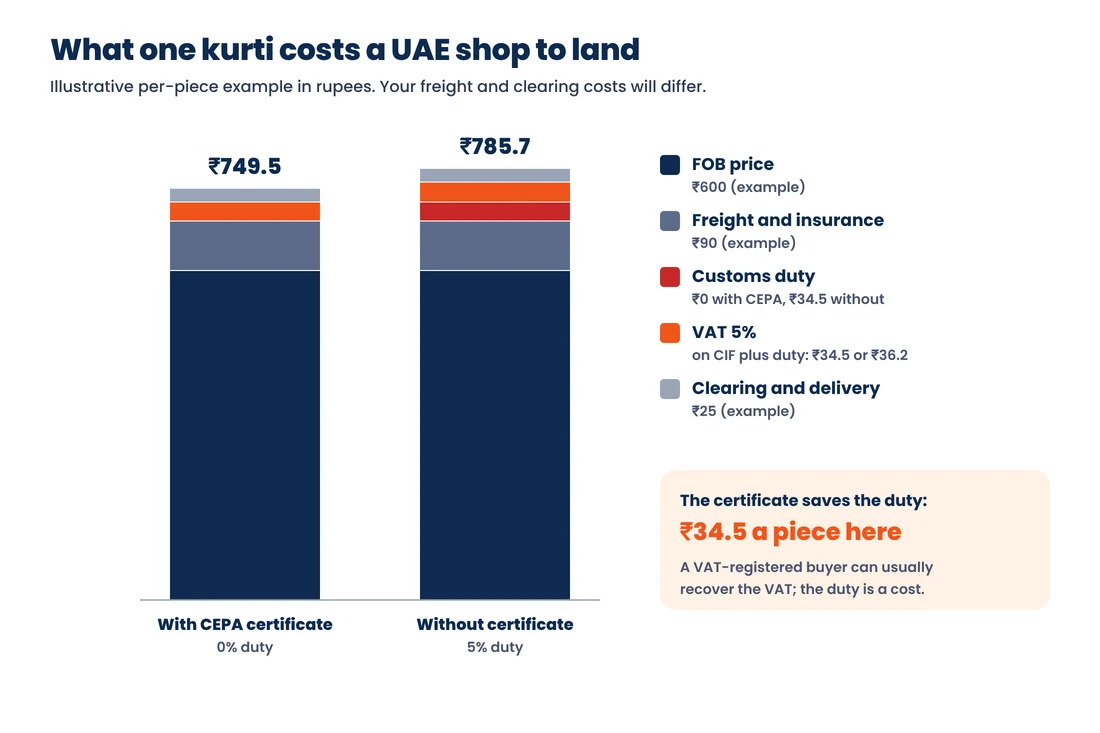
UAE buyers compare your price with what the piece costs them on the shelf, so quote with the full chain in mind:
- FOB price from your Surat or Ahmedabad unit, packed for export.
- Freight and insurance to the UAE (CIF). In 2026-27 this line has grown most.
- Duty: 0% with the CEPA certificate, 5% of CIF without.
- VAT 5% on CIF plus duty, usually recovered by a registered buyer.
- Clearing and local delivery in the UAE.
In the example above, a ₹600 kurti lands at about ₹750 with the certificate and ₹786 without. The shop then adds its own margin. Quote per piece and per set, and say clearly whether the price is FOB or CIF. Work out your margin on each product with the kurti, saree and suit margin calculators.
Payment Terms
- First order: ask for a confirmed letter of credit, or an advance. The Indian Consulate General in Dubai's trade advisory also recommends a letter of credit or bank guarantee for high-value contracts.
- Repeat buyers: one forwarder lists 30 to 60 day credit as typical. Move to documentary collection or open account only after clean orders.
- Insure the risk: ECGC, India's export credit insurer, covers non-payment by overseas buyers.
- Check the buyer: trade references, a credit report and, if you can, a visit. Dubai is a short flight from Ahmedabad or Mumbai.
How Surat rates, set prices and discounts are built is explained in how Surat wholesale pricing works.
How to Find UAE Buyers
- Trade fairs: the International Apparel and Textile Fair at Dubai World Trade Centre was listed for 16 to 18 November 2026 and is usually held twice a year. Confirm with the organiser before you book.
- Visit the souks: walk Meena Bazaar, Karama and Rolla with samples, a printed price list and your catalogue link.
- WhatsApp and Instagram: many UAE boutiques find suppliers here; send short fabric videos and set details.
- Your own catalogue website: a buyer in Dubai checks your range before replying. A site with designs, set sizes, MOQ, export packing and prices in rupees and dirhams answers the first questions without a call.
- Get listed: add your shop to the BizTorq directory and your designs to the wholesale catalog, so buyers who find the UAE guide can reach Indian sellers.
Other Gulf markets work in a similar way; see the Saudi Arabia, Kuwait and Oman guides, and how to export textiles from Surat.
Your First UAE Order, Step by Step
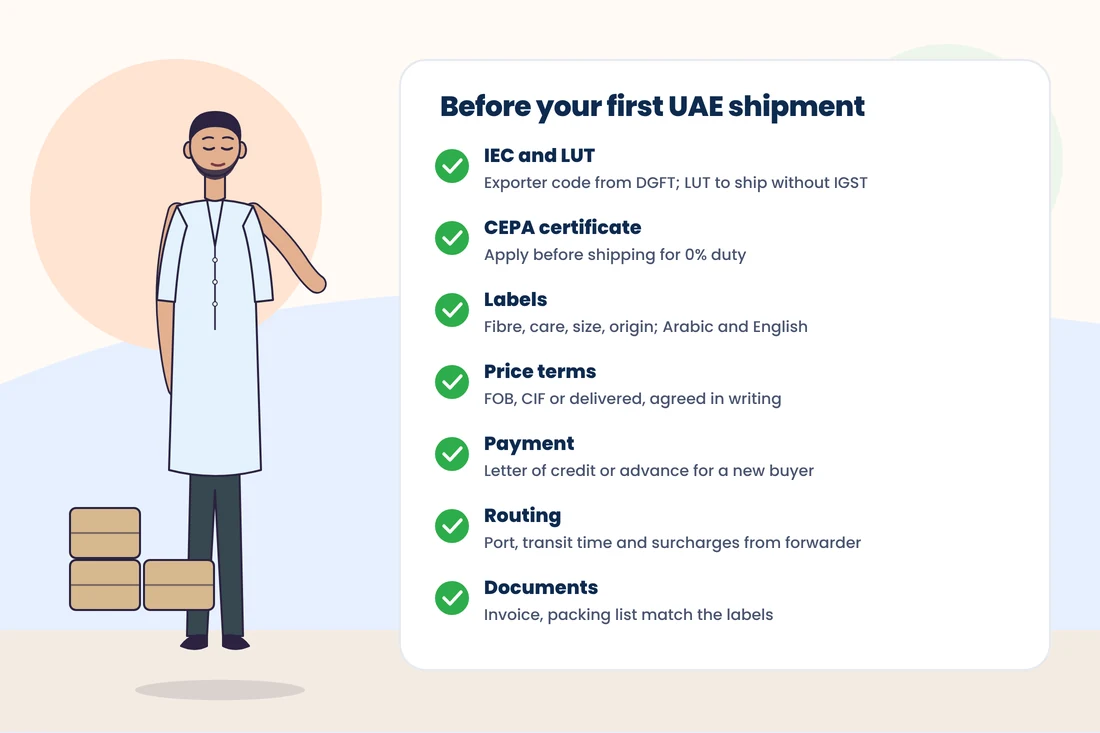
- Register: get an IEC and file an LUT for zero-rated exports.
- Agree the order: designs, sizes, set breakdown, quantities, price per piece, Incoterm and delivery window, in writing.
- Agree payment: letter of credit or advance for a new buyer.
- Produce and label: bilingual labels with fibre, care, size and origin; check finish and sizing piece by piece.
- Book the forwarder: confirm routing, transit time and surcharges in writing.
- Get the CEPA certificate: apply at least 5 working days before shipment.
- Send documents early: invoice, packing list and certificate, so the buyer can clear goods at 0% duty.
- Follow up: ask for sell-through after the festival and plan the next season's order.
Frequently Asked Questions
Is there import duty on Indian clothes in the UAE?
The normal UAE duty on most textiles and garments is 5%. Under the India-UAE CEPA, in force since 1 May 2022, Indian-origin goods enter at 0% if the shipment carries a CEPA Certificate of Origin and meets the rules of origin.
Who issues the CEPA Certificate of Origin?
Agencies authorised by India's DGFT, such as the Apparel Export Promotion Council (AEPC), TEXPROCIL, FIEO and designated chambers of commerce. Apply before the goods ship; one guide advises at least 5 working days.
Does the UAE charge VAT on imported ethnic wear?
Yes, 5% on the customs value plus any duty. The UAE importer normally pays it, and a VAT-registered business can usually recover it. Registration is required above AED 375,000 of taxable sales a year.
Do I pay GST when I export clothes to the UAE?
Exports are zero-rated under GST. Most exporters file a Letter of Undertaking (LUT) so they can ship without paying IGST. You also need an Importer Exporter Code (IEC) from DGFT. Confirm the details with your CA.
When should I ship Ramadan and Eid stock to the UAE for 2027?
Ramadan is expected to begin around 8 February 2027 and Eid al-Fitr around 9 or 10 March. Aim to have stock landed in the UAE by mid-December 2026, because shops display it early and sea transit is slower than usual.
How long does shipping from India to Dubai take now?
In normal times about 5 to 7 days port to port. Since the Strait of Hormuz was disrupted in 2026, much cargo is landed at Khor Fakkan or Fujairah and trucked to Jebel Ali, which was reported to take 8 to 15 days in late 2026. Get the current route and time from your forwarder.
Which Indian ethnic wear sells best in the UAE?
Long kurtis, kurti sets, Anarkalis, sharara sets and suits for Ramadan and Eid; lehengas and designer sarees for Diwali and weddings; chaniya cholis for Navratri; kasavu-style sets for Onam; and cotton kurtis and dress materials all year.
Where are Indian clothing shops in Dubai?
Mainly in Meena Bazaar along Al Fahidi Street in Bur Dubai, the Dubai Textile Souk by the creek and Karama. See the Dubai textile markets page.
Do clothes sold in the UAE need Arabic labels?
Labels should show garment type, fibre content, size, maker, care and country of origin in Arabic or in Arabic and English. The textile control scheme also refers to ECAS registration and the Emirates Conformity Mark, so agree with your buyer who handles it.
What payment terms should I offer a new UAE buyer?
For a first order, ask for a confirmed letter of credit or an advance. Offer 30 to 60 day credit only to repeat buyers with a clean record, and consider ECGC cover against non-payment.
How do I find buyers in the UAE?
Visit Meena Bazaar, Karama and Rolla with samples, attend the International Apparel and Textile Fair in Dubai, reach boutiques on WhatsApp and Instagram, and give buyers a catalogue website and a listing on the UAE export guide to check your range.
Can I sell to other Gulf countries through Dubai?
Yes. Dubai traders re-export to Saudi Arabia, Oman, Kuwait and Bahrain, and Dubai's free zones are outside UAE VAT while goods stay inside them. See the Saudi Arabia and Oman guides for their rules.
Sell to UAE Shops from Your Own Store
A shop in Meena Bazaar or Rolla can only order from you if it can find and browse your catalogue. Read the UAE export guide, check landed cost with the export duty calculator and list your business free.
Ready to sell abroad? BizTorq builds OpenCart wholesale stores for Surat and Ahmedabad sellers with catalogue sets, MOQ, dealer rates, multi-currency prices and WhatsApp enquiries. Start with the free online readiness check.
Duty, VAT, label and shipping details were checked in November 2026 and change often; the Strait of Hormuz situation in particular can change quickly. Islamic festival dates depend on the moon. Figures in the landed-cost example are illustrative. Confirm rules with your customs broker, forwarder, CA and the UAE buyer before you quote or ship.