Quick answer
Surat is India’s largest wholesale hub for man-made fibre sarees: georgette, chiffon, crepe, satin, art silk, organza and net, finished with print, digital print, embroidery, zari, sequins or stone work. Wholesalers sell by the catalogue (usually 4 to 12 designs), quote a rate per piece before 5% GST, and dispatch across India by transporter. A standard saree is about 5.5 m plus a blouse piece. Rough wholesale bands run from about ₹150 for daily wear to ₹2,500 and above for bridal work.
If you sell sarees anywhere in India, chances are many of them started in Surat. The city spins the yarn, weaves the grey fabric, dyes and prints it, adds embroidery and sells it from hundreds of wholesale shops along Ring Road. This guide is for retailers, boutique owners and resellers who want to buy Surat sarees wholesale with confidence: what the trade words mean, which fabrics and work to choose, what to expect to pay, and how to order without mistakes.
Contents
- Parts of a saree and standard sizes
- Types of sarees in Surat by fabric
- Saree work types and what they cost
- Surat saree wholesale price range (2026)
- How saree catalogues and MOQ work
- How to check saree quality
- How to buy sarees wholesale from Surat, step by step
- GST on sarees and shipping
- Best sarees for resellers, boutiques and online sellers
- FAQs
Parts of a Saree and Standard Sizes
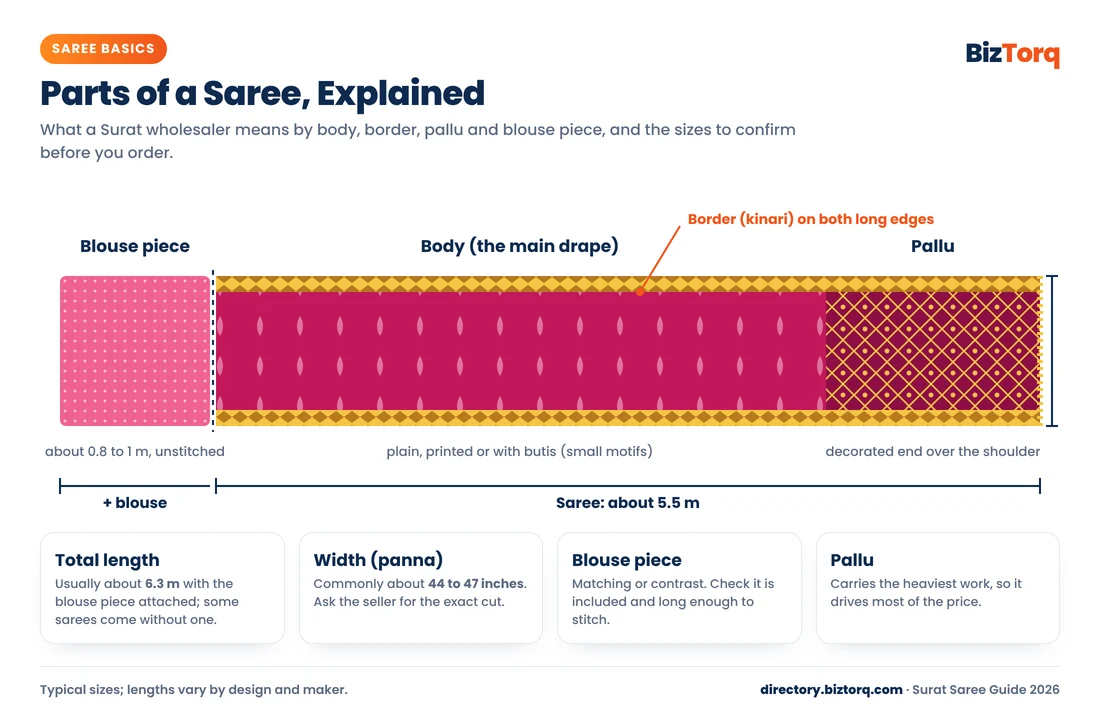
When a Surat wholesaler describes a saree, they talk about four parts: the body (the main drape), the border or kinari along both long edges, the pallu (the decorated end that falls over the shoulder) and the blouse piece. The pallu usually carries the heaviest work, so it often decides the price.
| Measurement | Typical size | Why it matters |
|---|---|---|
| Saree length | About 5.5 m | Shorter cuts are hard to drape; customers notice |
| Blouse piece | About 0.8 to 1 m | Too short and the blouse cannot be stitched |
| Total with blouse | About 6.3 m | Check it on the listing or the invoice |
| Width (panna) | About 44 to 47 inches | Affects drape and pleats |
For metre-by-metre cuts, fabric widths and kurti sizes, see our saree cuts, fabric widths and kurti size guide.
Types of Sarees in Surat by Fabric
Surat’s strength is man-made fibre: polyester and viscose yarn woven into fabrics that are affordable, colourful and easy to print or embroider. These eight fabrics cover most Surat saree catalogues.
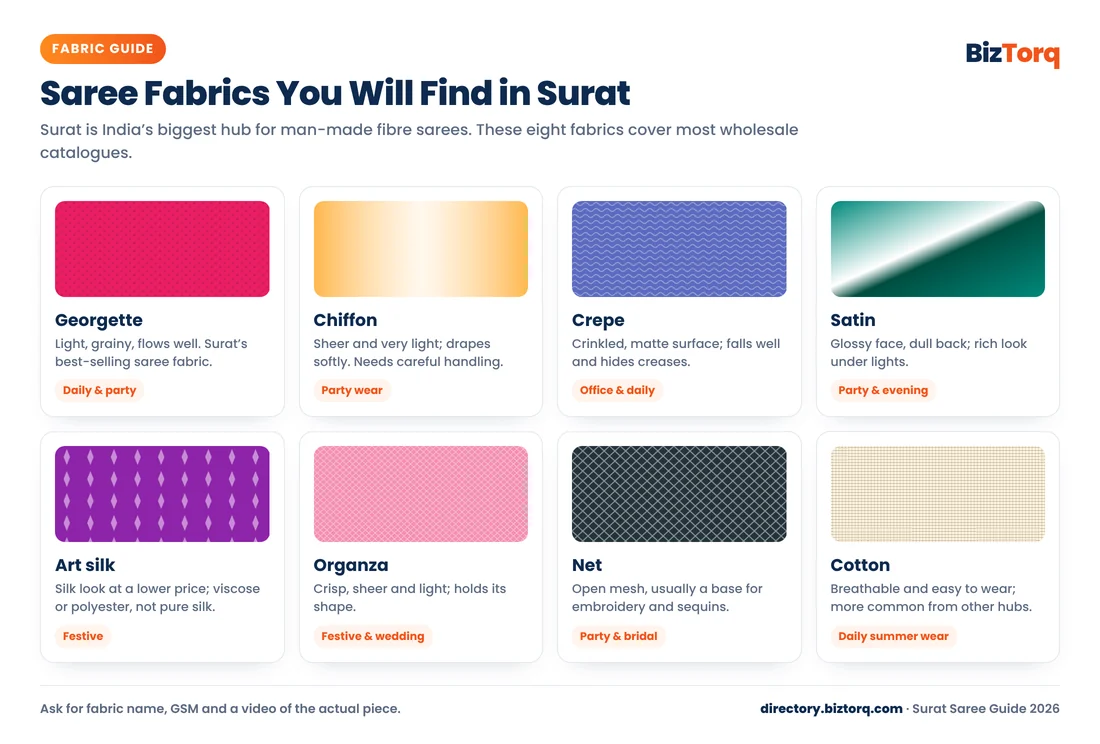
Georgette sarees
Georgette sarees wholesale from Surat are the backbone of the trade. The fabric is light, slightly grainy and flows well, and it takes printing, digital printing and embroidery equally well. You will find georgette in every price band from daily wear to designer.
Chiffon and crepe sarees
Chiffon is sheer and very light, popular for party wear but delicate to handle. Crepe has a crinkled, matte surface that drapes well and hides creases, which makes it a steady seller for office and daily wear.
Satin and art silk sarees
Satin has a glossy face and suits evening and party wear. Art silk means artificial silk, usually viscose or polyester made to look like silk; it gives a festive, silk-like look at a fraction of the price. A seller should always call it art silk, not silk.
Organza and net sarees
Organza is crisp and sheer and holds its shape, a favourite for festive and wedding catalogues. Net is an open mesh that usually serves as a base for embroidery, sequins and stone work in party and bridal sarees.
Cotton sarees
Cotton sarees are breathable and sell well in summer, but Surat’s range is smaller than its synthetics; many buyers also look at Ahmedabad and other cotton hubs. Compare the two cities in Surat vs Ahmedabad textile market.
Saree Work Types and What They Add to Price
The fabric sets the base rate. The work on it moves the price the most, so always compare two sarees with the same fabric and the same work, not just two photos.
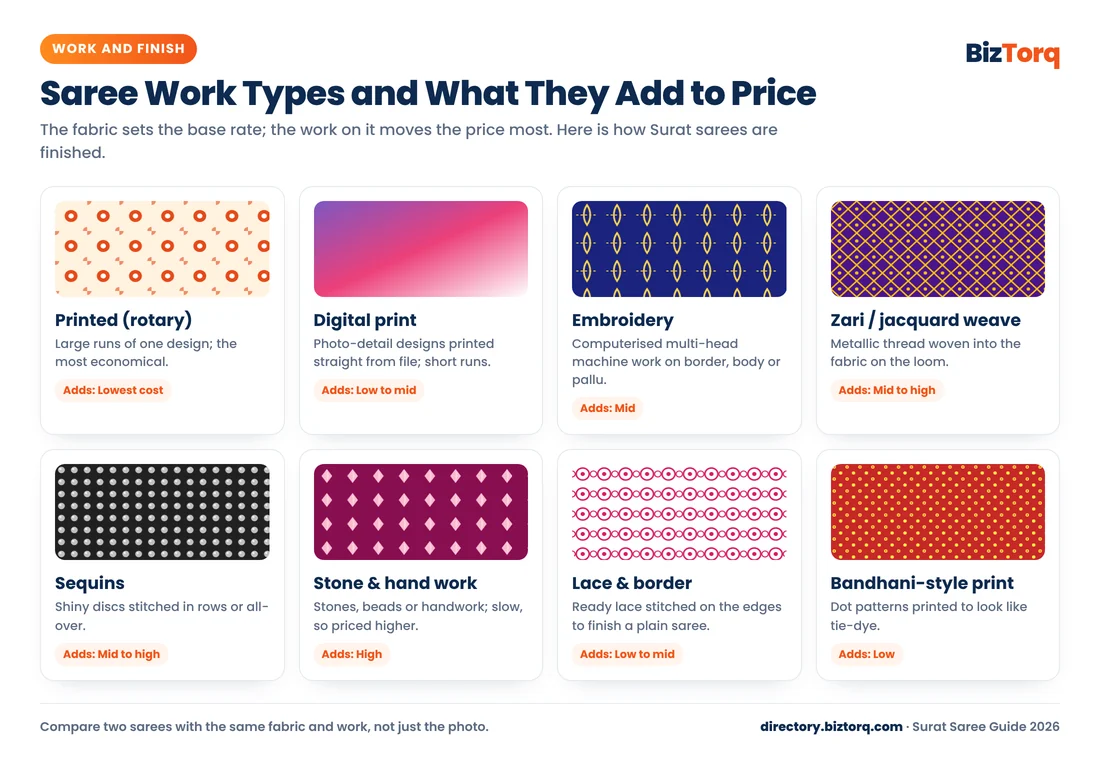
| Work | How it is done | Effect on price |
|---|---|---|
| Rotary print | Printing cylinders for long runs of one design | Lowest |
| Digital print | Printed straight from a design file; good for detail and short runs | Low to mid |
| Embroidery | Computerised multi-head machines on border, body or pallu | Mid |
| Zari / jacquard | Metallic or patterned thread woven in on the loom | Mid to high |
| Sequins | Shiny discs stitched in rows or all over | Mid to high |
| Stone and hand work | Stones, beads or handwork added piece by piece | High |
| Lace and border | Ready lace stitched on to finish the edges | Low to mid |
Most embroidery in Surat is done as job work by separate units, which is why embroidery capacity and labour can affect saree supply and rates in peak season. See our report on the Surat embroidery sector in 2026, and how printing works in the digital printing and dyeing guide.
Surat Saree Wholesale Price Range (2026)
There is no single Surat saree price list: every wholesaler sets rates by fabric, work, design and quantity, and rates move with yarn prices and the season. For budgeting, these bands are a reasonable starting point.
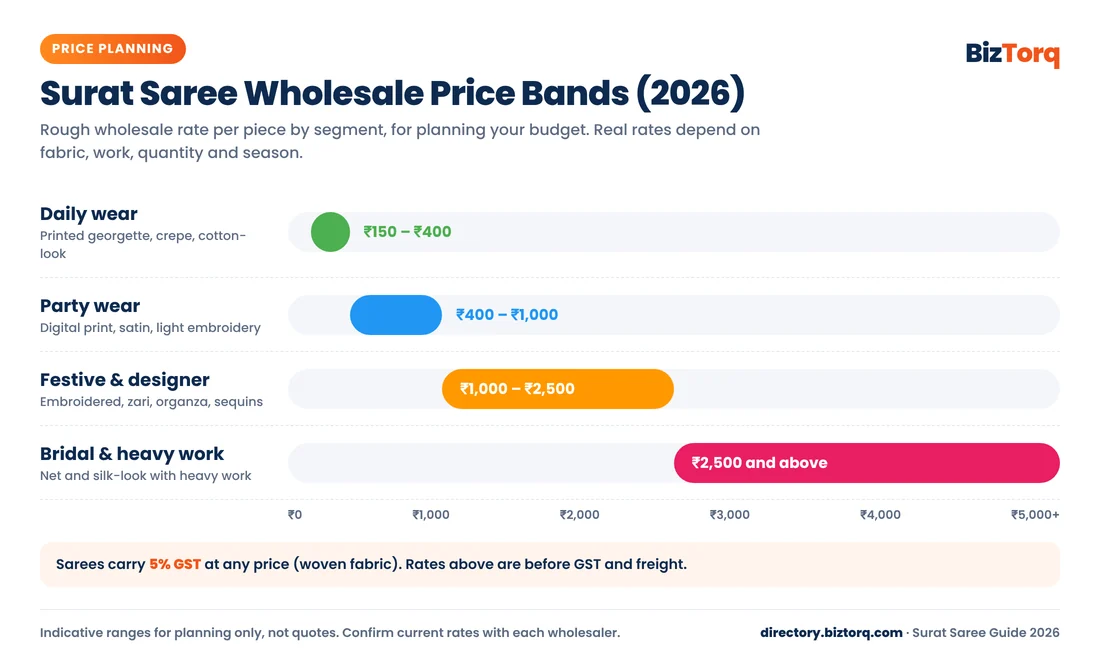
| Segment | Typical fabric and work | Indicative wholesale rate per piece |
|---|---|---|
| Daily wear | Printed georgette, crepe, cotton-look | About ₹150 to ₹400 |
| Party wear | Digital print, satin, light embroidery | About ₹400 to ₹1,000 |
| Festive and designer | Embroidery, zari, organza, sequins | About ₹1,000 to ₹2,500 |
| Bridal and heavy work | Net and silk-look with heavy work | ₹2,500 and above |
To turn a wholesale rate into a shop price, add GST (if you cannot claim it), freight and packing, then your margin. The saree margin calculator does it in seconds, and how Surat wholesale pricing works explains each layer.
How Saree Catalogues and MOQ Work
Most Surat saree wholesalers sell a catalogue: one collection of designs, numbered (for example D-101 to D-108) and sold together as a set. The rate is quoted per piece, and the minimum order (MOQ) is usually one full set.
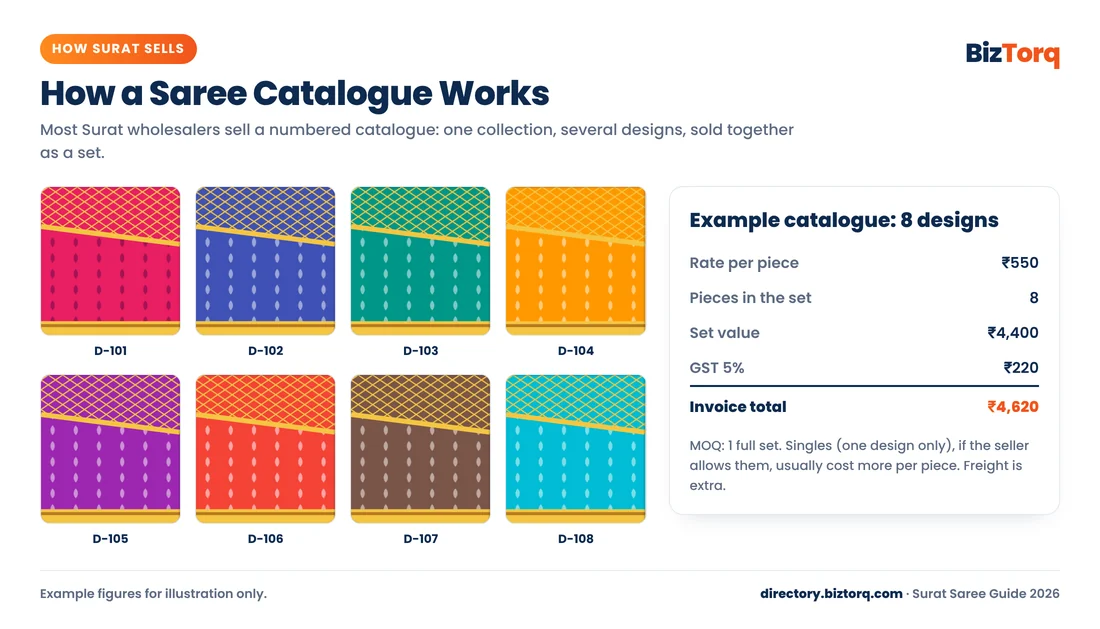
- Catalogue or set: all designs of the collection; the standard way to buy.
- Singles: one design only, allowed by some wholesalers, usually at a higher rate per piece.
- Repeat order: re-ordering a design that sold; ask how long a repeat takes and ask for the same dye lot.
- Fresh stock vs lot: new catalogues cost more; older or surplus lots sell cheaper.
New to these terms? The Surat textile trade glossary explains 60+ of them, and you can test yourself with the textile trade quizzes.
How to Check Saree Quality Before You Pay
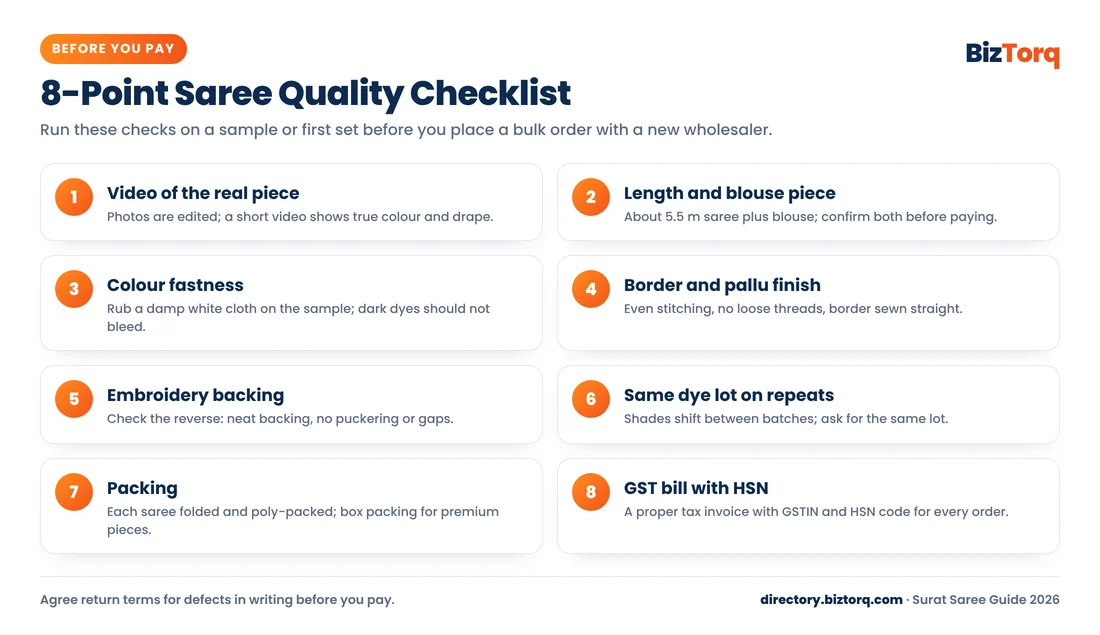
Photos are edited and lighting changes colours, so a short video of the actual saree is worth more than ten pictures. For a first order with a new seller, buy one set or a sample, check every point above, and only then place a bulk order. For deeper fabric checks such as GSM and shrinkage, see how to check fabric quality, and verify the seller with our 12-point supplier check.
How to Buy Sarees Wholesale from Surat, Step by Step
- Pick your segment and budget: daily, party, festive or bridal, and a price band per piece.
- Shortlist wholesalers: see saree wholesalers in Surat by shop and market, and browse ready designs with rate and MOQ in the wholesale saree catalog.
- Choose the market area: most saree trade is around Ring Road; compare markets in the best wholesale saree markets in Surat.
- Ask for catalogue, rate, set size, MOQ, GST and dispatch time in one WhatsApp message.
- Order a sample or one set, then check quality.
- Agree payment terms: advance for new buyers is normal. See credit and payment terms.
- Book dispatch: get the transporter name and LR (bilty) number. Find one in the Transporter Finder.
Visiting in person? Read the first-time visiting guide and check the market open today page, since markets close on set days and for Diwali. Buying remotely? Follow how to buy from Surat online.
GST on Sarees and Shipping
- GST: most sarees are woven fabric and carry 5% GST at any price. Within Gujarat it is 2.5% CGST plus 2.5% SGST; to other states, 5% IGST. Stitched lehenga sets follow the garment slab instead. See the saree and ethnic wear HSN codes and GST on textiles.
- Invoice: always take a GST tax invoice with GSTIN and HSN code.
- E-way bill: generally needed when goods worth more than ₹50,000 go to another state.
- Transport: bulk saree bales go by road transporter; samples by courier. See the freight and bilty guide and route pages such as Surat to Kolkata and Surat to Delhi.
Best Sarees for Resellers, Boutiques and Online Sellers
| You are a… | Start with | Why |
|---|---|---|
| WhatsApp or Instagram reseller | Digital print and light embroidery georgette | Photographs well, moderate price, wide appeal |
| Boutique | Festive embroidery, organza and a few heavy pieces | Higher margin and repeat festive buyers |
| Town or village retailer | Daily wear printed and crepe catalogues | Fast turnover at low price points |
| Online store | Mid-range designs with clear photos and videos | Fewer returns when the product matches the photo |
Starting out? Read how to start a saree reselling business or how to start a saree and kurti boutique. For wedding stock, see the bridal lehenga sourcing guide, and plan around market holidays and the best time to buy.
Frequently Asked Questions
Why is Surat famous for sarees?
Surat is India’s biggest centre for man-made fibre textiles. Yarn making, weaving, dyeing, printing, embroidery and wholesale trading all happen in one city, so sarees in georgette, chiffon, crepe, satin and art silk are made and sold here in very large volumes at competitive rates.
What is the wholesale price of sarees in Surat?
It depends on fabric, work and quantity. As rough planning bands, daily wear sarees start around ₹150 to ₹400 a piece, party wear around ₹400 to ₹1,000, festive and designer around ₹1,000 to ₹2,500, and bridal or heavy work above that. These are not quotes; confirm the current rate with each wholesaler.
Which saree fabric sells best from Surat?
Georgette is the volume seller because it is light, drapes well and takes print and embroidery. Crepe and printed sarees sell steadily for daily wear, while organza, net, satin and art silk lead in festive and wedding seasons.
What is the standard length of a saree?
Most sarees are about 5.5 metres long, plus a blouse piece of about 0.8 to 1 metre, for a total of around 6.3 metres. Width is commonly about 44 to 47 inches. Lengths vary by maker, so confirm before ordering. See our saree cut and fabric width guide.
Do wholesale sarees come with a blouse piece?
Most do, either attached at one end or supplied separately, and it may be matching or contrast. Some low-cost and some designer sarees come without one, so check the listing or ask the wholesaler.
What is the minimum order for sarees in Surat?
Most wholesalers sell by the catalogue, usually 4 to 12 designs in a set. Some allow single designs in multiples of 4 or 6, or one piece at a higher rate. Always ask for the MOQ along with the rate.
What does a saree catalogue mean in Surat?
A catalogue is one collection of designs, numbered and sold together as a set, for example 8 designs at one rate per piece. Buyers usually order the full catalogue rather than picking single designs.
What is the GST rate on sarees?
Most sarees are woven fabric and attract 5% GST at any price: 2.5% CGST plus 2.5% SGST within Gujarat, or 5% IGST to other states. Stitched lehenga sets follow the garment slab instead. Check codes in the saree HSN finder.
Is art silk the same as pure silk?
No. Art silk means artificial silk, usually viscose or polyester made to look like silk. It costs much less than pure silk. A seller should describe it as art silk, not silk.
How do I check saree quality before a bulk order?
Ask for a video of the actual piece, order a sample or one set first, check length and blouse piece, rub-test dark colours, and look at the reverse of embroidery. Read our fabric quality guide.
Can I buy Surat sarees online without visiting?
Yes. Most wholesalers share catalogues on WhatsApp and dispatch by transporter or courier. You can browse designs with rate and MOQ in the wholesale saree catalog. See how to buy from Surat online.
Which Surat market is best for wholesale sarees?
Most saree wholesale is on and around Ring Road, with many multi-storey markets close together. Different markets lean towards budget, party or heavy work sarees. Compare them in our guide to Surat’s saree markets and the Ring Road area page.
What margin do retailers make on Surat sarees?
It varies by segment and city, so work it out per design: wholesale rate, GST if you cannot claim it, freight and packing, then your margin. The saree margin calculator does this for you.
When is the best time to buy sarees from Surat?
Fresh festive and wedding catalogues launch from late monsoon to before Diwali, while the weeks after Diwali often bring clearance rates. Markets close for several days around Diwali, so check the market open today page before planning.
Find Surat Saree Wholesalers
Browse designs in the wholesale saree catalog, compare saree wholesalers in Surat, and price your stock with the saree margin calculator.
Are you a Surat saree wholesaler? List your shop free, add your catalogues to the wholesale catalog, check your online readiness score, or let BizTorq build your saree wholesale website with catalogue-wise selling, MOQ and WhatsApp ordering.
Price bands and sizes in this guide are indicative and for planning only. Rates, GST rules and practices change; confirm details with the wholesaler and your CA before ordering.