Quick answer
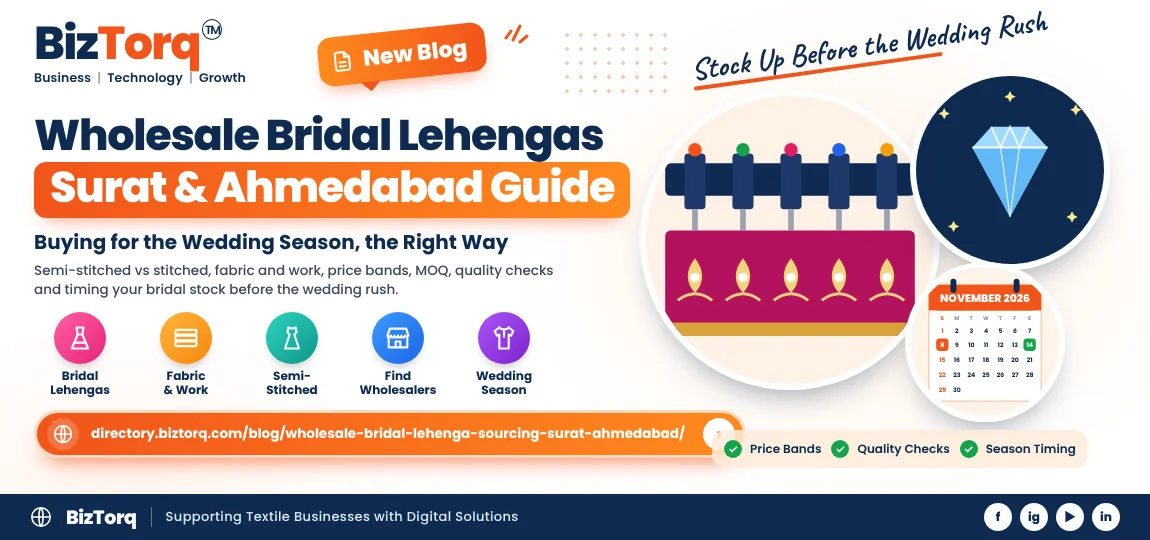
Sourcing wholesale bridal and festive lehengas from Gujarat requires mastering two regional hubs: Surat for multi-kalidar designer bridal, reception, and bridesmaid lehengas (velvet, raw silk, georgette, and organza featuring heavy dori, zardozi, and sequence work), and Ahmedabad for traditional folk, Gamthi, Kutchi mirror-work, and Navratri chaniya cholis. Over 90% of wholesale bridal inventory is sold in semi-stitched format (open side seam for up to 42–44 inch waist adjustments). Quality inspection depends on verifying the true flare circumference (Gher: 3.5m commercial vs 5.5m–6.5m bridal), double-layer can-can netting with canvas buckram, and 12% GST billing on garments wholesale-priced above ₹2,500.
Bridal and ceremonial ethnic wear represents the highest average order value (AOV) and retail markup category in Indian fashion. While daily-wear kurtis and printed sarees yield steady 35% to 50% margins, a bespoke semi-stitched bridal lehenga sourced directly from primary mills can comfortably yield 70% to 120% gross retail margin in boutiques, bridal studios, and overseas NRI showrooms.
However, lehengas also carry the highest capital risk per piece. Sourcing from secondary middlemen or failing to check inner construction can leave you with stiff, scratchy can-can netting, sparse embroidery repeats, and misleading flare cuts that disappoint brides on their wedding day. This comprehensive guide covers the technical specifications, regional manufacturing specializations, flare math, and commercial pricing needed to source bridal wear with confidence.
Surat vs. Ahmedabad: Regional Specialization & Market Map
While both cities sit on the same rail line, their lehenga manufacturing infrastructure serves distinct customer segments:
| Sourcing Hub | Core Specialties | Primary Base Fabrics | Key Wholesale Markets |
|---|---|---|---|
| Surat (The Grand Bridal & Contemporary Hub) | Bridal wedding lehengas, multi-kalidar flared skirts, sangeet/cocktail pastel designs, and bridesmaids sets. | Micro Velvet (9000 grade), Raw Silk, Dola Silk, Chinon, Organza, Net. | Millennium Market 1 & 2, Raghukul Market, JJ AC Market, and Saroli Industrial Parks. |
| Ahmedabad (The Traditional Folk & Chaniya Choli Hub) | Navratri Garba chaniya cholis, Kutchi mirror handwork, Gamthi embroidery, Patola borders, and Bandhani bridal wear. | Pure Cotton Cambric, Gajji Silk, Rayon, Mashru Silk. | Rani no Hajiro (Manek Chowk), Dhalgarwad, and Ratanpole. |
Buying Strategy: Source your rich reds, maroons, and pastel bridal lehengas from the modern complexes along Surat Ring Road, and reserve your Ahmedabad sourcing trips for festive folk wear, cotton Garba sets, and artisan Bandhani dupattas.
The Flare (Gher) Math: Commercial vs Heavy Bridal Standards
In wholesale catalogues, vendors frequently advertise “Full Gher” without specifying metric circumference. Always measure the hemline sweep before placing orders:
- Semi-Flared / Commercial Party-Wear (2.8 to 3.2 Metres): Standard for budget festive lehengas and bridesmaid sets priced under ₹1,500. Uses 8 to 12 kalis (panels) with a single light can-can strip.
- Standard Boutique Flare (3.5 to 4.2 Metres): The minimum acceptable standard for premium sangeet, reception, and engagement lehengas. Features 16 to 20 kalis that hold a graceful A-line silhouette.
- Grand Bridal Umbrella / Kalidar Flare (5.0 to 6.5+ Metres): The gold standard for wedding day brides. Uses 24 to 32 kalis or a double circular full-umbrella cut. Requires rigid double-layer can-can netting to sustain its dramatic volume without collapsing.
To verify the cut, spread the skirt flat on the wholesale gaddi floor. A full umbrella cut forms a complete 360-degree flat circle when laid out.
Inner Skirt Construction: Buckram, Can-Can & Linings
A lehenga skirt may look breathtaking on a showroom mannequin, but poor interior construction ruins the bridal drape. Check these three structural layers:
| Component | Boutique & Bridal Standard | Sub-Standard Warning Sign |
|---|---|---|
| Canvas Buckram | Heavy 8–10 inch stiff woven canvas band stitched inside the lower hemline to provide rigid flare structure. | Thin paper fusing or 3-inch narrow tape that curls up after one steam press. |
| Can-Can Netting | Double-layered, pleated stiff nylon netting measuring 18 to 22 inches in height, covered with a fabric flap. | Single, short 10-inch scratchy mesh attached directly against the skin without lining. |
| Inner Lining (Astar) | Full-length soft micro-cotton or heavy dull Santoon that extends to the bottom hemline. | Half-length, rough synthetic lining that clings to legs through static electricity. |
Embroidery Techniques: Handwork, Machine Dori & Cut-Dana
Understanding how embellishments are applied prevents overpaying for purely machine-made replicas:
- Computerized Multi-Head Embroidery (Machine Dori & Resham): Base embroidery produced on 400+ head machines in Katargam and Anjani. High-speed, uniform, and durable. Look for tight stitch density without gaps.
- Hand Embellishment (Zardozi, Cut-Dana, Moti & Dabka): Premium artisans in Surat add hand-sewn metallic springs (dabka), bugle beads (cut-dana), pearls, and real stone work on top of the machine base. Hand-highlighted lehengas command 2x to 3x higher retail pricing.
- Kutchi Gamthi & Real Mirror Work: Specialty of Ahmedabad. Authentic pieces feature real glass mirrors hand-stitched with colorful cotton thread; cheaper imitations use glued reflective plastic foils that scratch and peel off.
Anatomy of a Semi-Stitched Lehenga Set
Unlike sarees that are completely unstitched, bridal lehenga sets are packaged as 3 coordinated components:
- The Lehenga Skirt: Fully pleated, kalis joined, can-can attached, and hemline border finished. One side seam is left open so your boutique master tailor can adjust the waist circumference (up to 42–44 inches) and skirt length (standard 42 inches).
- The Blouse (Choli) Fabric: A 1.00 to 1.20-metre cut of heavy matching fabric featuring pre-embroidered front neck, back neck, and sleeve panels, allowing customization for sweetheart, deep-U, or high-neck bridal cuts.
- The Dupatta: A full 2.40 to 2.50-metre finished dupatta in soft net, organza, or chinon silk, finished with 4-sided embroidered lace borders, corner latkans (tassels), and all-over buttis.
Cost-to-Retail Margin Economics
Bridal lehengas provide exceptional retail margin headroom if you manage inventory carefully:
| Category | Wholesale Base Rate | GST (12%) & Road Freight | True Landed Cost | Realistic Retail MRP | Gross Margin % |
|---|---|---|---|---|---|
| Bridesmaid / Sangeet Flared Set | ₹1,400 | ₹195 | ₹1,595 | ₹3,499 – ₹3,999 | 54% – 60% |
| Heavy Pastel Reception Lehenga | ₹2,800 | ₹365 | ₹3,165 | ₹6,999 – ₹7,999 | 55% – 60% |
| Grand Bridal Velvet Wedding Set | ₹4,500 | ₹570 | ₹5,070 | ₹11,999 – ₹14,500 | 58% – 65% |
| Luxury Handwork Zardozi Masterpiece | ₹8,500 | ₹1,050 | ₹9,550 | ₹21,999 – ₹26,000 | 56% – 63% |
Compute precise landed costs and retail margins for your showroom using our free Textile Margin Calculator. Always verify the correct HSN code (6204) and tax slabs on the Textile GST & HSN Finder.
Packaging, Dispatch & Road Transport
High-end bridal lehengas cannot be crammed into standard tight fabric bales without crushing delicate embroidery and can-can netting. Require your suppliers to use:
- Rigid Saree/Lehenga Suitcase Packaging: Heavy cardboard presentation boxes or zippered non-woven fabric bags for each piece.
- Corrugated Master Cartons: Dispatch 6 to 10 boxed lehengas per heavy corrugated 7-ply shipping carton rather than soft jute bales.
- Bilty Tracking: Ensure your carrier issues a clear Lorry Receipt (LR) with private marking numbers. Find verified freight carriers on our Transporter Finder.
Frequently Asked Questions
What does semi-stitched lehenga mean in wholesale markets?
Semi-stitched means the lehenga skirt panels (kalis) are joined, flared, and finished with inner buckram and can-can net, but one side seam is left open so local tailors can adjust the waist (up to 42–44 inches) and length. The blouse fabric is unstitched with pre-embroidered neck and sleeve panels.
What is the standard minimum order quantity (MOQ) for bridal lehengas in Surat?
Unlike sarees or kurtis that require purchasing full 4-to-8 piece catalogue sets, most bridal lehenga manufacturers in Surat allow single-piece purchasing (MOQ: 1 piece per design) for high-value wedding pieces priced above ₹2,000.
How is the flare (gher) of a lehenga measured accurately?
Flare circumference is measured by laying the skirt hemline flat and measuring the full bottom circumference with a tape measure. Commercial party-wear lehengas measure 3.0 to 3.5 metres, while grand bridal lehengas measure 5.0 to 6.5+ metres.
Why is can-can netting important in bridal lehengas?
Can-can netting is stiff pleated nylon mesh stitched between the lining and outer fabric. It pushes the skirt outward, giving the lehenga an opulent, ball-gown flare that prevents heavy embroidery and velvet from sagging inward.
What GST rate applies to wholesale bridal lehengas?
Bridal lehengas fall under garment HSN 6204. Because almost all bridal lehengas are wholesale-billed above ₹2,500 per piece, they are taxed at 18% GST (or 12% under pre-reform transitional slabs). Pieces billed under ₹2,500 are taxed at 5% GST.
Where can I source Navratri Garba chaniya cholis wholesale in Ahmedabad?
Rani no Hajiro (near Manek Chowk), Dhalgarwad cloth market, and Ratanpole in Ahmedabad’s walled city are India’s premier wholesale hubs for traditional mirror-work, Kutchi Gamthi, and multi-colored Garba chaniya cholis.
What is the difference between machine dori work and real handwork zardozi?
Machine dori work uses high-speed multi-head computerized machines to stitch corded thread outlines rapidly and uniformly. Real handwork zardozi involves skilled artisans hand-sewing metallic dabka wires, stones, pearls, and cut-dana onto the fabric using specialized needles.
When is the best time to purchase wedding lehengas from Surat manufacturers?
Source in July and August for the winter wedding rush (November to February), and in January and February for the summer wedding season (April to June). Ordering 2 to 3 months ahead guarantees fresh designs, customization slots, and on-time dispatch.
How can overseas NRI boutique owners inspect bridal lehengas without traveling?
Overseas buyers connect with verified Surat manufacturers via scheduled WhatsApp video calls to inspect the true color in natural daylight, check the flare circumference, examine the backside embroidery finish, and arrange express air shipping via DHL or FedEx.
How can bridal lehenga wholesalers protect their designs from online copies?
Wholesale manufacturers build dedicated B2B e-commerce portals using BizTorq with private Login-to-See-Price controls, watermarked high-resolution images, and buyer GST verification, ensuring competitors cannot scrape or undercut exclusive bridal collections.
Source Bridal Collections with Confidence
Explore thousands of verified bridal manufacturers across 75+ Surat wholesale markets and Ahmedabad heritage bazaars, verify freight carriers on our Transporter Finder, and calculate your true landed retail margins with the Textile Margin Calculator.
Are you a bridal lehenga manufacturer or primary stockist? List your showroom for free on the BizTorq Directory, or let BizTorq build your custom B2B bridal portal with private wholesale logins, automated catalogue sync, and direct WhatsApp customer ordering.