
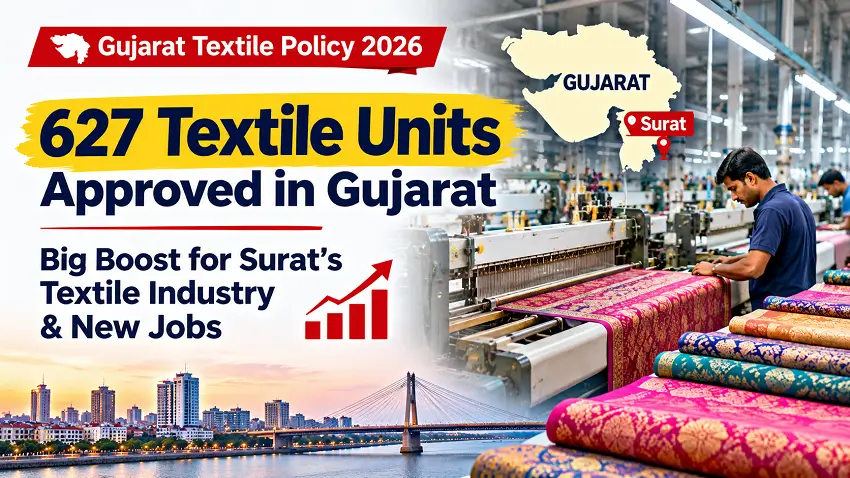
Investment momentum across South Gujarat’s synthetic textile value chain has received a formal boost this week. State industry authorities have cleared 627 project applications under the Gujarat Textile Policy 2024–29 across Surat district, a move projected to generate more than 3,500 direct jobs across weaving, garmenting, and processing estates.
Activity 1 vs. Activity 2 Subsidy Breakdown
In force from 1 October 2024 through 30 September 2029, the state policy divides textile manufacturing into two targeted assistance tiers:
- Activity 1 (Garments, Apparel, Made-Ups & Technical Textiles): Receives priority support with capital subsidies ranging from 20% to 35% on eligible fixed capital investments, aimed at strengthening Surat’s finished apparel and technical textile base.
- Activity 2 (Weaving, Knitting, Dyeing-Processing, Texturising, Twisting & Embroidery): Qualifies for 10% to 20% capital subsidy to help powerloom and processing clusters in Sachin GIDC, Pandesara GIDC, and Katargam upgrade to modern machinery.
- Interest & Power Support: Approved units across both categories receive a 5% to 7% interest subsidy and a ₹1 per unit power tariff subsidy for five years.
Taluka-Wise Categorisation in Surat District
To encourage industrial decentralisation beyond congested city limits, subsidy percentages are linked to three regional taluka tiers within Surat district:
- Category 1 (Highest Subsidy Tier): Umarpada and Mahuva talukas.
- Category 2 (Mid Tier): Mandvi and Bardoli talukas (including emerging weaving belts near Palsana and Kadodara).
- Category 3 (Urban Core): Surat city and remaining developed talukas.
Trade representatives on Ring Road welcomed the clearances, noting that faster disbursement of capital and power subsidies will help MSMEs offset rising yarn and imported coal costs once factories resume full operations after the Diwali break.