
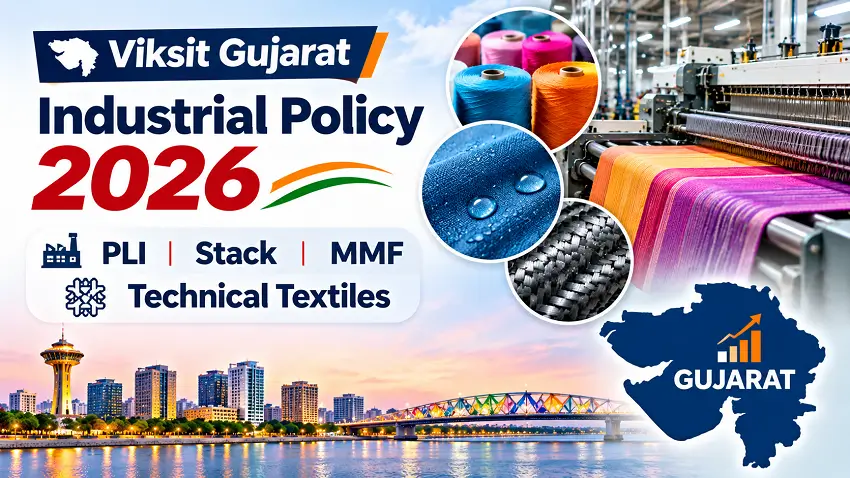
As global textile consumption shifts steadily toward man-made fibres (MMF) and performance-driven fabrics, manufacturers in Surat, Ahmedabad, Vadodara, and Bharuch are leveraging a three-tier policy stack to fund factory expansions in late 2026.
How the Capex + Opex + PLI Stack Works
Industrial consultants note that Gujarat offers a distinct financial advantage for textile MSMEs and large corporate investors by allowing central and state incentives to work in tandem:
- Gujarat Textile Policy (2024–2029): Softens upfront capital expenditure (20–35% capital subsidy for garments and technical textiles) and lowers operating costs via 5–7% interest subvention, ₹1/unit power tariff support, and payroll assistance.
- Viksit Gujarat Industrial Policy 2026: Effective from 1 June 2026, the overarching state industrial framework broadens combined assistance for MSMEs and mega projects, linking incentives to taluka development categories and thrust sectors to spread MMF processing and ancillary units beyond saturated estates.
- Central PLI Scheme (Round 4 Open Until 31 Dec 2026): With the turnover threshold reduced to ₹100 crore, the central Production Linked Incentive scheme rewards incremental production turnover once factory volumes scale up.
Growth Beyond Traditional Apparel Hubs
While Surat remains the anchor for synthetic filament fabrics and Ahmedabad leads in cotton and denim, the combined policy push is accelerating specialized clusters across the state. Units in Bharuch, Vadodara, and Navsari are expanding capacity in healthcare non-wovens, automotive interior fabrics, infrastructure geotextiles, defence gear, and industrial filtration membranes.
With the central PLI portal open until 31 December 2026, project finance advisors across South Gujarat report a surge in brownfield and greenfield filings from composite weaving and processing houses preparing for the 2027 export cycle.