
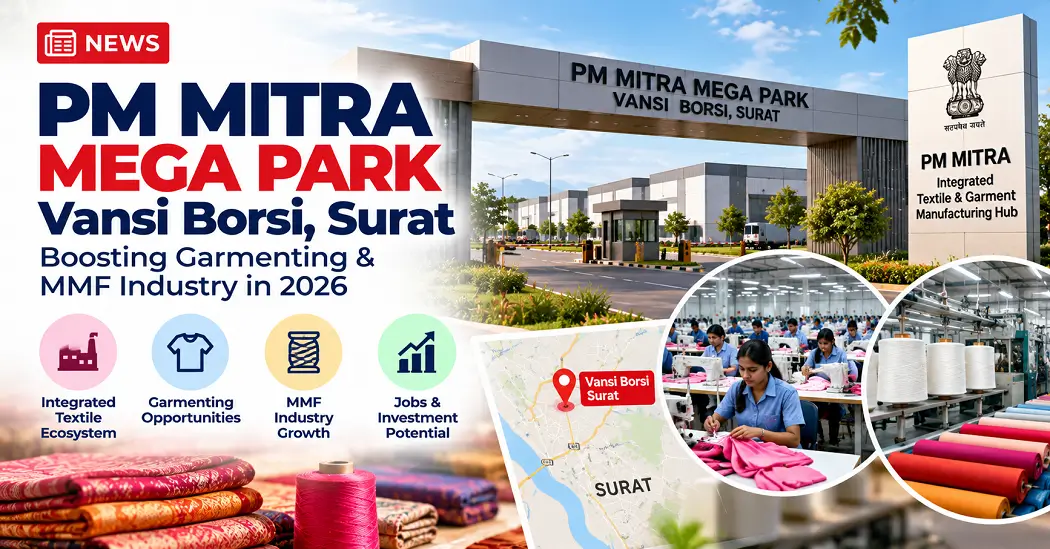
Infrastructure development at the 1,142-acre PM Mega Integrated Textile Region and Apparel (PM MITRA) Park at Vansi-Borsi in South Gujarat’s Navsari district has reached a pivotal implementation phase. Located less than 45 kilometres south of Surat, the mega park is designed to give the region’s massive synthetic textile belt something it has historically lacked: world-class, integrated garmenting and export-compliant finishing infrastructure under a single umbrella.
Bridging Surat’s Apparel Export Gap
While Surat produces over 65% of India’s man-made fibre (MMF) fabrics and weaves more than 3 to 4 crore metres of cloth daily, the bulk of its output has traditionally catered to domestic unstitched sarees, kurtis, and dress materials. High-value readymade garment (RMG) exports have largely stayed concentrated in hubs like Tiruppur, Bengaluru, and the NCR.
The PM MITRA Park aims to change that dynamic. By integrating effluent treatment plants (CETP), continuous water supply, uninterrupted high-tension power, and plug-and-play factory sheds, the project enables local weavers and processors to partner directly with large domestic apparel brands and global buyers.
Incentives Driving Corporate Interest
Manufacturers looking to set up units at Vansi-Borsi will benefit from dual policy support:
- Central PM MITRA Framework: Development Capital Support (DCS) of up to ₹500 crore per park alongside Competitive Incentive Support (CIS) of up to ₹300 crore per park to encourage rapid operationalisation.
- Gujarat Textile Policy: Eligible garment and technical textile setups can access up to 35% capital subsidy, power tariff subsidies of ₹1 per unit, and special wage assistance for female machine operators.
Connectivity Advantage
Positioned close to National Highway 48 and the Western Dedicated Freight Corridor (WDFC), and with direct coastal access to Adani Hazira Port and the upcoming Mumbai–Ahmedabad High-Speed Rail station at Bilimora, goods from the Vansi-Borsi park can be dispatched overseas without transshipment bottlenecks in Mumbai.
Trade bodies including the Southern Gujarat Chamber of Commerce and Industry (SGCCI) and the Federation of Surat Trade & Textile Associations (FOSTTA) have welcomed the progress, noting that value addition through modern garment manufacturing is the only lasting hedge against volatile yarn prices and thin weaving margins.