
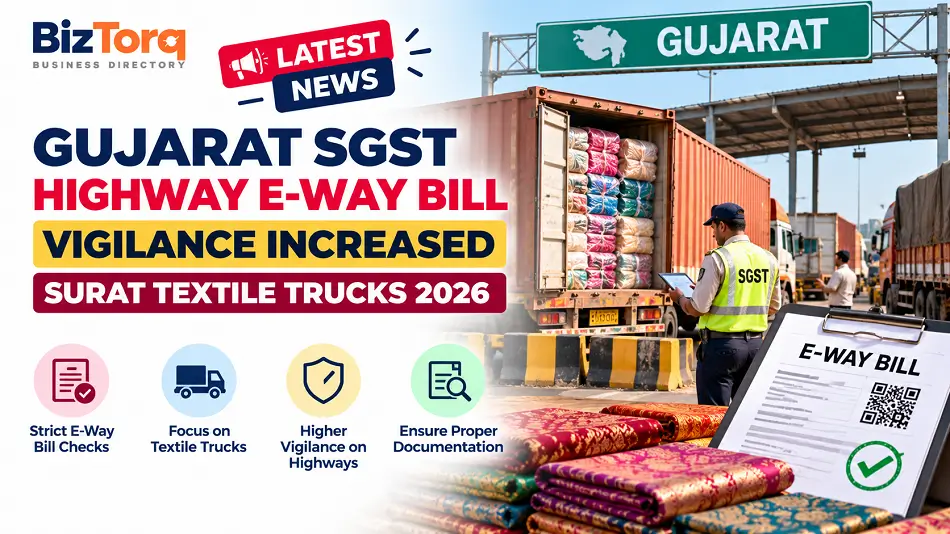
With over 350 to 400 transport trucks departing Surat daily ahead of the 31 October logistics deadline, the Gujarat State Goods and Services Tax (SGST) department has deployed mobile inspection teams along major freight arteries exiting the city. The intensified enforcement drive focuses on National Highway 48 (Surat–Navsari and Surat–Bharuch stretches), the Hazira freight bypass, and major transport aggregation nodes in Saroli and Kadodara.
Core Focus of Tax Inspections
According to commercial tax practitioners and logistics operators, flying squads are inspecting commercial parcel carriers for specific documentation irregularities:
- E-Way Bill Expiry: Trucks delayed by local Ring Road traffic or awaiting consolidated parcels risk moving with expired e-way bills, which attracts heavy penalties under Section 129 of the GST Act.
- Consignment Undervaluation: Scrutiny over mismatch between physical fabric weights and invoice valuations, particularly on high-value embroidered fabrics, lace-attached sarees, and bridal lehengas declared at nominal synthetic grey fabric rates.
- Part-B Transshipment Documentation: Verifying whether multi-parcel transporters have properly updated vehicle registration numbers on consolidated e-way bills (EWB-02) when shifting goods between feeder tempos and interstate trailers.
Trade Associations Issue Strict Packing & Bilty Advisory
In response to several tempo detentions earlier in the week, the Federation of Surat Trade & Textile Associations (FOSTTA) and the Surat Goods Transport Association (SGTA) have jointly advised all market traders and transport brokers to maintain meticulous paper trails.
Traders have been cautioned against releasing festive stock on delivery challans without valid tax invoices. Transporters have also been instructed to inspect parcel markas (bale tags) against invoice numbers before issuing the final Lorry Receipt (LR / bilty), ensuring drivers have digital or physical printouts of all valid e-way bills before leaving city limits.