
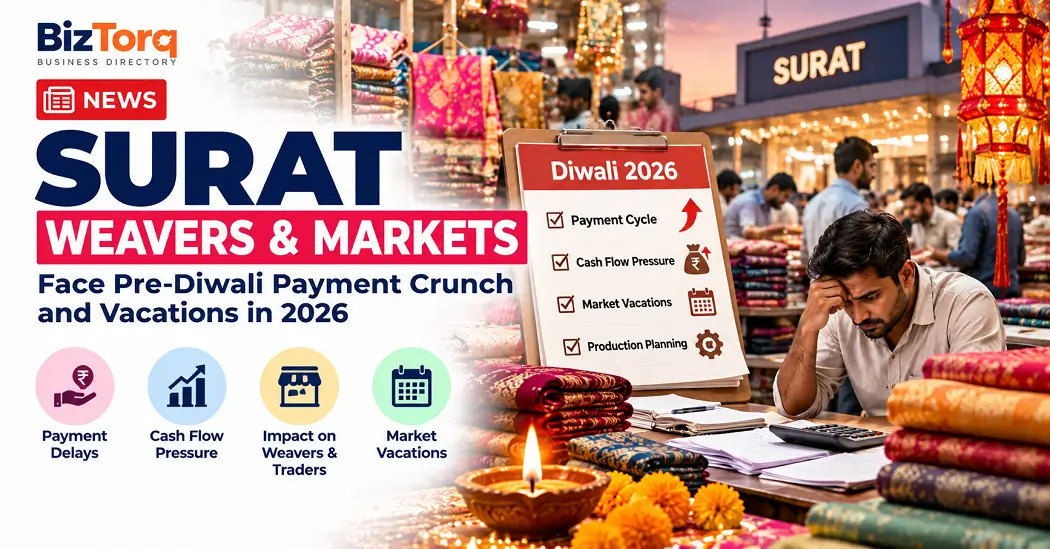
As the final countdown to Diwali begins, Surat’s massive textile manufacturing and trading ecosystem is navigating a significant working capital crunch. Despite relief following the withdrawal of weekly industrial power staggering by DGVCL, weaving units across Sachin GIDC, Pandesara, and Anjani, along with commission agents on Ring Road, report that cash flow and outstation remittances remain unusually slow for late October.
The Gap Between Input Costs and Market Realisation
The primary pressure point continues to be the severe margin mismatch that has built up over September and October 2026. While synthetic yarn and raw polymer costs rose sharply earlier in the season—with POY reaching around ₹180 a kg and weaving job costs climbing—wholesale buyers from primary destination states like Uttar Pradesh, Bihar, Maharashtra, and Karnataka have strictly resisted higher fabric prices.
Consequently, grey fabric inventories have piled up in weaving sheds, forcing several unit owners to absorb input spikes rather than pass them down the value chain. Master weavers and association leaders note that outstation retail buying has shifted to smaller, strictly need-based replenishment lots instead of the large festive parcel bookings traditionally recorded before Diwali.
Early Diwali Shutdown Weighs on Looms
Historically, Surat’s textile markets and weaving clusters observe an annual vacation of 7 to 15 days, usually starting 2 to 3 days before Diwali (scheduled for 8 November 2026) and continuing through Labh Pancham. However, industry representatives report that several weaving job-work sheds are considering advancing their shutdown by 7 to 10 days.
With worker availability already strained due to early departures for festive travel and ongoing negotiations over shift norms, running looms at a deficit makes little commercial sense for smaller MSME loom operators. Meanwhile, wholesale traders on Ring Road and Saroli are keeping shops open on Sundays to clear existing finished festive stock before the vacation begins.
Looking Ahead to the Wedding Season
Traders and mill owners are now shifting their commercial focus toward the post-Diwali wedding season commencing in late November. Market leaders believe that once festive stock at destination retail counters sells out, liquidity will return to Surat, allowing fresh bookings for jacquards, Dola silk, fancy georgettes, and bridal embroidery fabrics at corrected rate levels.