
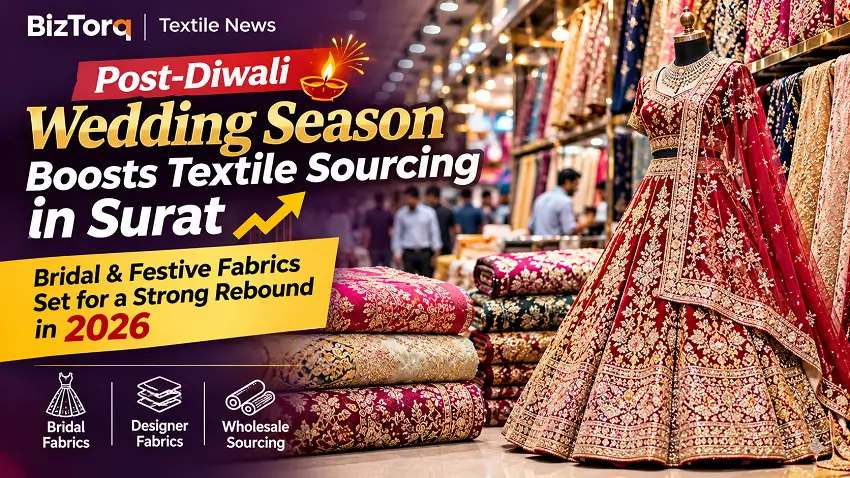
While Surat’s wholesale markets observe their scheduled holiday lull, commercial anticipation is rapidly pivoting toward the winter wedding calendar. Retail jewelers and wedding planners across North and Western India have marked over 35 auspicious marriage dates (muhurats) between late November 2026 and February 2027, setting the stage for an estimated ₹15,000 crore bridal fabric procurement cycle across South Gujarat.
Shift from Printed Saree Greige to High-Value Bridal Yards
Unlike Diwali buying, which relies heavily on low-ticket daily-wear printed sarees, the Indian wedding season demands structured, heavy, and embellished yardage that commands superior profit margins. Commission agents across Millennium Market and Raghukul Market report strong digital sample inquiries for specific high-value qualities:
- Dola Silk & Viscose Jacquards: Leading bridal kurti and semi-stitched suit collections due to their rich fall and affinity for foil and digital pigment overprinting.
- Organza Tissue & Metallic Shimmer: Widely booked for lehenga flares, tiered ethnic gowns, and bridal dupatta borders.
- Multi-Head Schiffli Embroidery Nets: Embroiderers in Katargam and Ved Road are setting up machines with dual-tone metallic zari, sequins, and thread-cording for reception lehenga panels.
Strategic Preparation Ahead of Labh Pancham (16 November)
Although composite dyeing mills are shut until 20 November, trading gaddis across Ring Road and Saroli will open their doors on Labh Pancham (Monday, 16 November 2026) to welcome visiting buyers from Rajasthan, Delhi NCR, Madhya Pradesh, and Maharashtra.
Traders holding ready inventory of dyed wedding bases expect rapid counter conversions as destination retailers rush to stock counters before Tulsi Vivah ceremonies commence in late November.
Stabilized Polyester Raw Material Baseline
Aiding the optimistic wedding outlook is the stabilization of synthetic raw materials. With crude benchmarks cooling and domestic POY rates holding steady at ₹178–₹180/kg, fabric converters can quote firmer wholesale prices without fear of unexpected price escalations eroding their wedding delivery contracts.